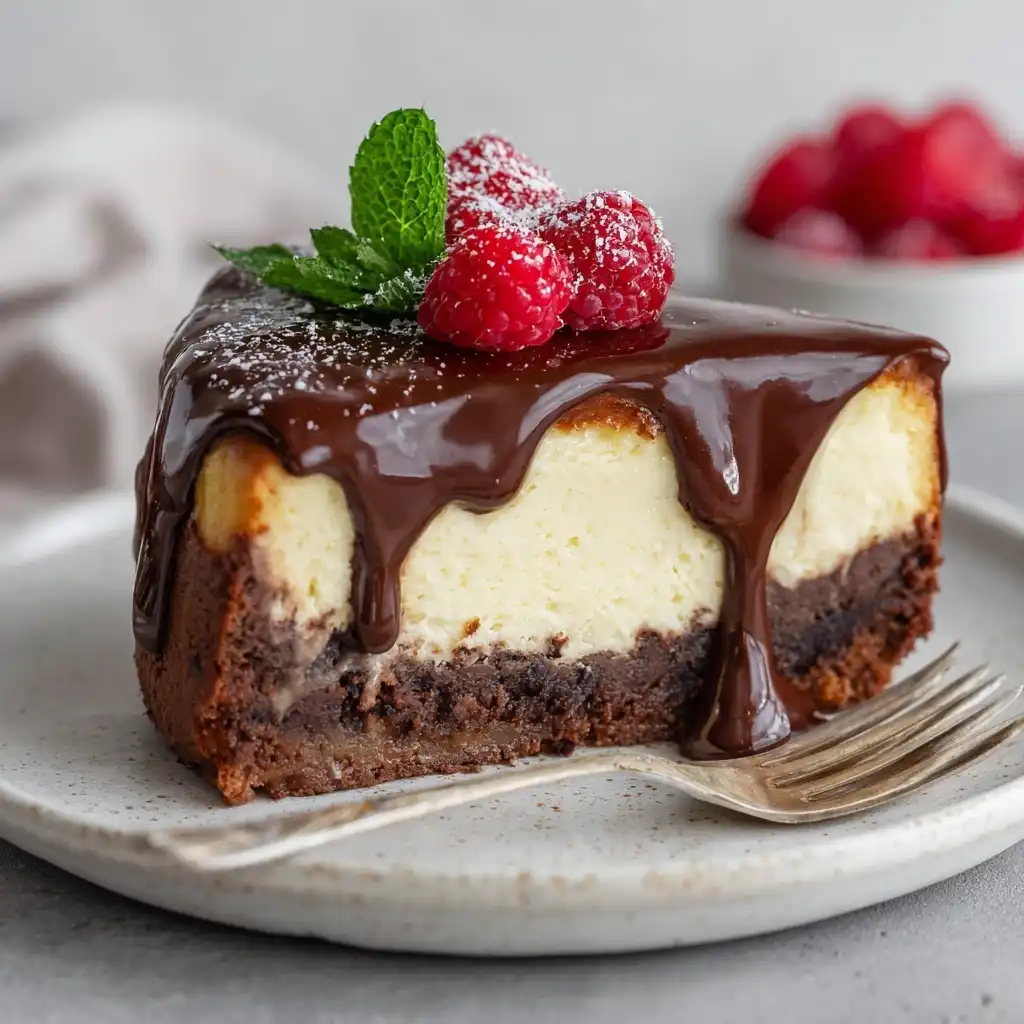
Introduction
Welcome to the ultimate guide to Chocolate Ganache Cheesecake — a luxurious, velvety, and deeply indulgent dessert that marries the rich creaminess of New York–style cheesecake with the glossy elegance of dark chocolate ganache. This isn’t just any cheesecake; it’s an artisanal confection designed for special occasions, dinner parties, holiday tables, or moments when only decadence will do. With its impossibly smooth texture, subtle tang from full-fat cream cheese, deep cocoa notes from premium chocolate, and a buttery graham cracker crust that provides the perfect structural and flavor counterpoint, this dessert delivers a symphony of contrasts: cool yet room-temperature friendly, dense yet airy, rich yet balanced. Whether you’re a seasoned baker or stepping into your first multi-layered dessert project, this guide walks you through every nuance — from the science behind crack-free baking to the artistry of a flawless ganache pour.
The History
The origins of cheesecake trace back over 2,000 years to ancient Greece, where early versions made with honey-sweetened cheese and flour were served to athletes during the first Olympic Games in 776 BCE. The Romans later adopted and refined the concept, adding crushed cheese, eggs, and honey to create a denser, more custard-like treat. When cheesecake migrated to Europe — particularly England and France — regional variations blossomed: Italian ricotta-based versions (cassata), French fromage blanc tarts, and German quark cakes all contributed to its evolution. In the late 19th century, American immigrants brought European cheesecake traditions to New York, where local dairy innovations — especially the development of Philadelphia-style cream cheese in 1872 by William Lawrence — catalyzed the birth of the modern American cheesecake. The iconic New York style emerged in the 1920s and ’30s, characterized by its ultra-rich, dense, and slightly tangy profile, often baked in a springform pan with a water bath.
Chocolate ganache, meanwhile, has French roots — “ganache” is believed to derive from the French slang term *ganache*, meaning “jowl” or “fool,” reportedly coined by Parisian chocolatier Émile Dufour in the 1860s after a clumsy apprentice accidentally poured hot cream over chocolate. Rather than discarding the mixture, Dufour tasted it, declared it divine, and named it playfully — a testament to culinary serendipity. Ganache quickly became the cornerstone of French patisserie: used as fillings, glazes, truffle centers, and elegant cake finishes. It wasn’t until the mid-to-late 20th century — spurred by rising gourmet food culture and the popularity of layered desserts — that bakers began fusing classic cheesecake with chocolate ganache, transforming the traditional white-topped dessert into a dramatic, glossy, two-tone masterpiece. Today, Chocolate Ganache Cheesecake stands as a hallmark of contemporary American pastry: respectful of tradition, unafraid of luxury, and engineered for visual and gustatory impact.
Ingredients Breakdown
Every exceptional Chocolate Ganache Cheesecake begins not with technique, but with intentionality in ingredient selection. Each component plays a precise functional and sensory role — and substitutions, while possible, can significantly alter texture, stability, and flavor balance. Below is a meticulous breakdown of why each ingredient matters:
- Graham Cracker Crumbs (1 ½ cups): Provides structure, crunch, and caramelized sweetness. The molasses and cinnamon in graham crackers complement chocolate beautifully. Opt for plain, uncoated graham crackers — avoid honey or cinnamon varieties unless specified, as added sugars and spices may throw off the crust’s moisture balance.
- Unsalted Butter (6 tbsp, melted): Acts as a binder and adds richness and flakiness. Unsalted butter ensures control over sodium content. Clarified butter may be used for enhanced browning, but standard melted unsalted butter yields optimal adhesion and tenderness.
- Granulated Sugar (¼ cup): Enhances browning, contributes to crust crispness, and balances the slight bitterness of graham crackers. Brown sugar may be substituted for deeper molasses notes — but reduce by 1 tbsp to prevent excess moisture.
- Cream Cheese (24 oz / 3 (8-oz) packages): Must be full-fat, brick-style, and at true room temperature (65–70°F). Cold cream cheese causes lumps; low-fat versions lack sufficient milk fat (at least 33%) needed for emulsification and creamy mouthfeel. Philadelphia, Kraft, or store-brand full-fat blocks are ideal — avoid whipped or spreadable varieties, which contain stabilizers and air that destabilize the batter.
- Granulated Sugar (1 cup + 2 tbsp): Not merely for sweetness — sugar tenderizes the protein matrix in cream cheese, aids in aeration during mixing, and helps stabilize the batter’s emulsion. Under-sugaring leads to dense, rubbery texture; over-sugaring risks weeping and cracking.
- Sour Cream (⅔ cup): Adds acidity, moisture, and subtle tang that cuts through richness. Full-fat sour cream is non-negotiable — low-fat versions contain gums and added water that interfere with setting. Greek yogurt (full-fat, strained) may substitute 1:1 but imparts a brighter, less mellow tang.
- Heavy Cream (⅔ cup): Provides additional fat and fluidity, promoting smoothness and preventing dryness. Minimum 36% milk fat required — half-and-half or whipping cream (30%) lacks sufficient fat for proper emulsification and may yield a fragile, grainy set.
- Large Eggs (4, room temperature): Act as primary binders and leavening agents. Room-temperature eggs incorporate more evenly and reduce mixing time — cold eggs cause the batter to seize and increase the risk of overmixing. Always add eggs one at a time, mixing *just until incorporated* after each addition to avoid trapping excess air.
- Pure Vanilla Extract (2 tsp): Enhances depth and rounds out chocolate’s bitterness. Madagascar bourbon vanilla is preferred for its complex, woody-sweet profile. Avoid imitation extract — its harsh alcohol notes clash with delicate ganache.
- Unsweetened Cocoa Powder (¼ cup, Dutch-process preferred): Adds intense chocolate flavor without extra sugar or acid. Dutch-process cocoa is alkalized, yielding smoother, darker, less acidic notes that harmonize with ganache. Natural cocoa (non-alkalized) is more acidic and may react unpredictably with baking soda/powder — omit unless recipe is reformulated.
- Sea Salt (¾ tsp, fine grind): Not optional — salt heightens all other flavors, suppresses bitterness, and balances sweetness. Use flaky sea salt only for garnish; fine sea salt or kosher salt ensures even distribution.
- High-Quality Dark Chocolate (8 oz, 60–70% cacao): The soul of the ganache. Choose couverture-grade chocolate with cocoa butter as the *only* fat — no vegetable oils or emulsifiers like soy lecithin in excess (small amounts are acceptable). Valrhona, Callebaut, Guittard, or Scharffen Berger are excellent choices. Avoid “chocolate chips” — they contain stabilizers that inhibit proper tempering and gloss.
- Heavy Cream (1 cup, for ganache): Must be cold or at room temperature — never heated separately before pouring over chocolate. The thermal shock initiates controlled crystallization for a silky, stable emulsion.
- Unsalted Butter (1 tbsp, for ganache): Added *after* the ganache cools slightly (to ~90°F), it imparts sheen, softness, and a luxurious mouth-melt. Ensure it’s cool but pliable — not melted or chilled.
- Optional Garnishes: Flaky sea salt (Maldon), edible gold leaf, chocolate curls shaved with a vegetable peeler, candied orange zest, espresso-dusted cocoa, or fresh raspberries for acidity contrast.
Step-by-Step Recipe
This meticulously engineered method prioritizes precision, patience, and process-driven success — especially critical for crack-free, sliceable, restaurant-quality results.
- Prep & Preheat (1 hour before baking): Center rack in oven. Preheat to 325°F (163°C). Wrap exterior of a 9-inch springform pan *completely* with two overlapping 18-inch squares of heavy-duty aluminum foil — ensure no gaps at the base or seams. This prevents water bath leakage. Place pan on a large roasting tray or rimmed baking sheet — it will hold the water bath.
- Make the Crust (10 minutes + 30 min chill): Pulse graham crackers in a food processor until fine crumbs form (no large pieces). Add sugar and melted butter; pulse until mixture resembles wet sand. Press firmly and evenly into bottom *and 1 inch up sides* of prepared springform pan using the back of a measuring cup or flat-bottomed glass. Chill uncovered for 30 minutes minimum (or freeze 15 min) — this sets the butter and prevents slumping during baking.
- Prepare Water Bath (essential for gentle, even heat): Fill roasting tray with 1–2 inches of *hot tap water* (not boiling — ~120°F). This pre-warms the environment and avoids shocking the cheesecake later.
- Make the Filling (15 minutes, room-temp focus): In a large bowl, beat cream cheese with paddle attachment (stand mixer) or hand mixer on medium-low until completely smooth and lump-free (~2 min). Scrape bowl thoroughly. Add sugar gradually; beat 2–3 min until pale, fluffy, and no graininess remains. Add sour cream and heavy cream; mix 1 min until homogenous. Add eggs one at a time, mixing *only until yolk disappears* (5–10 sec per egg). Scrape bowl after each. Stir in vanilla, cocoa powder, and salt by hand with spatula — *do not mix with electric mixer*, to avoid incorporating air. Batter should be thick, glossy, and free of streaks.
- Pour & Bake (1 hr 20 min + cooling): Pour batter into chilled crust. Tap pan sharply 3x on counter to release air bubbles. Carefully place pan inside roasting tray. Gently pour hot water around pan until it reaches halfway up sides. Bake 70–80 minutes: edges should be set with 3-inch center wobble (like Jell-O). Turn off oven, crack door 1 inch with wooden spoon, and let cheesecake cool *in water bath* for 1 hour. Remove from water bath, run thin knife around edge to loosen, then cool completely at room temp (~2 hrs). Refrigerate *uncovered* for at least 12 hours — preferably 24–48 hours — for full flavor development and clean slicing.
- Prepare Ganache (Day of serving, 15 minutes): Chop chocolate finely. Heat cream in small saucepan until steaming (180°F), not boiling. Pour over chocolate. Wait 3 minutes — no stirring! Then stir slowly in concentric circles from center outward until smooth and glossy. Stir in butter until fully absorbed. Let cool to 90–95°F (slightly warm to touch, like warm milk) — this ensures perfect pourability and shine without sliding off.
- Glaze & Finish (5 minutes): Place *fully chilled* cheesecake on wire rack over parchment-lined tray. Pour ganache gently onto center. Use offset spatula to nudge toward edges; ganache will cascade naturally. Rotate pan to ensure full coverage. Tap lightly to pop air bubbles. Refrigerate 30–45 minutes to set ganache surface. Optional: Sprinkle with flaky salt immediately after pouring, before chilling.
Tips
- Room Temperature Is Non-Negotiable: Cream cheese, eggs, and sour cream must be 65–70°F. Take them out 2–3 hours ahead; never microwave or use warm water baths — uneven heating creates pockets of melted fat and curdled proteins.
- Scrape Religiously: Scrape bowl and paddle after *every* mixing step — especially after cream cheese, sugar, and eggs. Missed lumps become permanent flaws.
- Undermix, Not Overmix: Once eggs are added, mixing time is measured in seconds. Overmixing incorporates air → expansion → collapse → cracks.
- Water Bath Wisdom: Use hot (not boiling) water to minimize thermal shock. Line roasting tray with towel to cushion pan and absorb minor splashes. If water seeps in, don’t panic — most leaks won’t ruin the crust if foil is properly sealed.
- Cooling Is Baking: The slow, gradual cooldown in the oven prevents rapid contraction — the #1 cause of cracks. Skipping the 1-hour oven cooldown guarantees fissures.
- Chill Deeply: Cheesecake needs 24+ hours refrigeration. Rushing leads to smearing, crumbling, and poor ganache adhesion.
- Ganache Temp Matters: Too hot (>100°F) melts the cheesecake surface; too cold (<85°F) becomes stiff and dull. Use instant-read thermometer for accuracy.
- Clean Slicing: Dip sharp, thin-bladed knife in hot water, wipe dry, and cut with gentle sawing motion. Wipe and reheat between slices.
- Freeze for Longevity: Un-ganached, fully chilled cheesecake freezes beautifully for 2 months (wrap tightly in plastic + foil). Thaw overnight in fridge *before* ganaching.
- Rescue a Cracked Cheesecake: Don’t despair! A generous ganache layer hides most cracks. Or top with whipped cream, berry compote, or chocolate shavings — presentation saves perfection.
Variations and Customizations
This foundational recipe is a canvas for creativity — whether elevating luxury, accommodating dietary needs, or exploring global flavors. All variations preserve structural integrity and balance:
- White Chocolate Ganache: Replace dark chocolate with 8 oz high-quality white chocolate (32–35% cocoa butter). Reduce cream to ¾ cup. Add ¼ tsp vanilla bean paste and pinch of salt to balance sweetness.
- Espresso-Chocolate Ganache: Dissolve 1 tbsp instant espresso powder in warm cream before pouring over chocolate. Enhances depth without bitterness.
- Orange-Infused Ganache: Add 1 tsp finely grated orange zest + ½ tsp orange oil (not juice) to cooled ganache. Pairs brilliantly with dark chocolate and graham crust.
- Gluten-Free: Use certified GF graham crackers or almond flour + coconut sugar crust (1 ¼ cups almond flour, ¼ cup coconut sugar, 6 tbsp melted butter). Ensure all other ingredients are GF-certified (vanilla, cocoa).
- Reduced-Sugar: Substitute granulated sugar with ⅔ cup monk fruit-erythritol blend (e.g., Lakanto Golden) in both crust and filling. Note: texture may be slightly less tender; add 1 tsp xanthan gum to filling for stability.
- Vegan Adaptation: Crust: GF oats + dates + coconut oil. Filling: blended silken tofu + cashew cream + coconut cream + maple syrup + lemon juice + agar-agar (bloomed). Ganache: coconut cream + vegan dark chocolate. Requires extensive testing and chilling (24–48 hrs).
- Crust Variations: Oreo (remove filling, 24 cookies), Biscoff (speculoos cookies), Digestive (UK-style), or toasted hazelnut–brown butter graham.
- Swirled Ganache: After pouring base ganache, drop teaspoonfuls of contrasting ganache (e.g., white chocolate or raspberry coulis) and swirl gently with toothpick.
- Mini Versions: Bake in lined muffin tins (foil + paper liners) for 25–30 min. Cool, chill, then dip tops in tempered chocolate or spoon ganache.
- Seasonal Twists: Pumpkin Spice (add 2 tsp pumpkin pie spice + ½ cup pure pumpkin purée to filling); Peppermint (add ¼ tsp peppermint extract to ganache + crushed candy cane garnish); Salted Caramel (drizzle warm caramel over ganache before chilling).
Health Considerations and Nutritional Value
A single generous slice (1/12th of a 9-inch cake) contains approximately:
- Calories: 580–640 kcal
- Total Fat: 42–47g (26–30g saturated)
- Cholesterol: 145–165mg
- Sodium: 320–380mg
- Total Carbohydrates: 44–49g (32–36g sugars)
- Protein: 8–10g
- Cocoa Flavanols: ~120–180mg (from 60–70% dark chocolate) — linked to improved endothelial function and antioxidant activity.
Key Considerations:
- Saturated Fat: Primarily from cream cheese, butter, heavy cream, and chocolate. While recent research nuances blanket warnings, moderation remains prudent for those managing LDL cholesterol or cardiovascular risk. Substituting part of the cream cheese with low-fat cottage cheese (blended smooth) reduces sat fat by ~30% with minimal texture loss.
- Sugar Load: Significant — mainly from crust, filling sugar, and chocolate. Those monitoring blood glucose may benefit from the reduced-sugar variation above or pairing with fiber-rich berries to slow absorption.
- Lactose Content: Moderate — cream cheese and sour cream contain ~2–4g lactose per serving. Lactase enzyme supplements taken before eating can aid digestion for sensitive individuals.
- Portion Control: This is a celebration food — not an everyday dessert. Serving smaller portions (1/16th slice) with fresh fruit extends enjoyment while reducing caloric impact.
- Nutrient Positives: Calcium (from dairy), magnesium (from cocoa), vitamin A (cream), and polyphenols (dark chocolate) offer measurable benefits — reinforcing that indulgence and nutrition aren’t mutually exclusive when consumed mindfully.
- Allergens: Contains dairy, eggs, wheat (in graham crackers), and soy (in many chocolates). Always verify labels for shared equipment warnings if severe allergy exists.
Ingredients
For the Crust:
- 1 ½ cups (150g) graham cracker crumbs (about 12 full sheets)
- 6 tablespoons (85g) unsalted butter, melted
- ¼ cup (50g) granulated sugar
- ¼ teaspoon fine sea salt
For the Cheesecake Filling:
- 24 oz (680g) full-fat brick-style cream cheese, room temperature
- 1 cup + 2 tablespoons (230g) granulated sugar
- ⅔ cup (150g) full-fat sour cream, room temperature
- ⅔ cup (150ml) heavy cream (36% fat), room temperature
- 4 large eggs, room temperature
- 2 teaspoons pure vanilla extract
- ¼ cup (20g) Dutch-process unsweetened cocoa powder
- ¾ teaspoon fine sea salt
For the Chocolate Ganache:
- 8 oz (225g) high-quality dark chocolate (60–70% cacao), finely chopped
- 1 cup (240ml) heavy cream (36% fat)
- 1 tablespoon (14g) unsalted butter, cool but pliable
- Flaky sea salt, for garnish (optional)
Directions
- Preheat oven to 325°F (163°C). Prepare pan: Wrap the *outside* of a 9-inch springform pan with two overlapping 18-inch squares of heavy-duty aluminum foil, ensuring full coverage of the bottom and seams are tightly folded. Place pan on a large roasting tray or rimmed baking sheet.
- Make crust: In food processor, pulse graham crackers until fine crumbs form. Add sugar and salt; pulse to combine. Add melted butter; pulse until mixture resembles wet sand. Press firmly and evenly into bottom and 1 inch up sides of pan. Chill 30 minutes.
- Prepare water bath: Fill roasting tray with 1–2 inches of hot tap water (~120°F).
- Make filling: In stand mixer with paddle attachment, beat cream cheese on medium-low 2 minutes until smooth. Gradually add sugar; beat 3 minutes until pale and fluffy. Add sour cream and heavy cream; mix 1 minute. Add eggs one at a time, mixing *just until yolk disappears* (5–10 sec each). Scrape bowl well after each. Stir in vanilla, cocoa, and salt by hand until fully combined and no streaks remain.
- Bake: Pour batter into chilled crust. Tap pan sharply 3 times. Place pan in roasting tray. Carefully pour hot water around pan to reach halfway up sides. Bake 70–80 minutes — edges set, 3-inch center wobbles like Jell-O. Turn off oven, crack door 1 inch, cool 1 hour *in water bath*. Remove from water bath, run knife around edge, cool 2 hours at room temp. Refrigerate uncovered ≥12 hours (ideally 24–48 hrs).
- Make ganache: Finely chop chocolate. Heat cream in saucepan until steaming (180°F). Pour over chocolate. Wait 3 minutes. Stir slowly from center outward until smooth. Stir in butter until absorbed. Cool to 90–95°F (use thermometer).
- Glaze: Place chilled cheesecake on wire rack over parchment. Pour ganache onto center. Spread gently to edges; it will cascade. Tap pan lightly. Refrigerate 30–45 minutes until set. Garnish with flaky salt if desired. Slice with hot, dry knife.
FAQ
- Can I make this without a water bath?
- No — the water bath is essential for gentle, even heat transfer. Without it, the outer edges overbake and contract violently as the center cools, causing deep cracks and uneven texture. A steam oven or tightly covered Dutch oven with boiling water on the rack below are rare alternatives — but the traditional water bath remains the gold standard.
- Why did my ganache seize or become grainy?
- Seizing occurs when chocolate is exposed to even a trace of water (including steam or damp utensils) or overheated beyond 120°F. Graininess usually stems from using low-cocoa-butter chocolate, insufficient cream, or stirring too vigorously while hot. Rescue: Add 1 tsp warm cream and stir gently until smooth. Prevention: Use dry tools, high-quality chocolate, and precise temperatures.
- Can I use milk or semi-sweet chocolate for the ganache?
- Milk chocolate works but yields a sweeter, softer ganache with less shine and shorter shelf life — refrigerate and serve within 3 days. Semi-sweet (52–58% cacao) is acceptable but less complex than 60–70%; avoid anything below 50% — it lacks sufficient cocoa solids for structure and flavor depth.
- My cheesecake cracked — what went wrong?
- Most common causes: (1) Overmixing after eggs added, (2) Skipping the 1-hour oven cooldown, (3) Cooling too quickly (e.g., refrigerating while warm), (4) Opening oven door before 60 minutes, (5) Under-chilling before slicing. Ganache will conceal most cracks — but mastering the method eliminates them entirely.
- Can I bake this in a regular cake pan?
- No — a springform pan is mandatory for clean release. Attempting removal from a fixed-bottom pan will destroy the crust and ganache. If only regular pans available, line with parchment overhang and chill thoroughly before lifting — but springform is strongly advised.
- How long does it keep? Can I freeze it?
- Refrigerated (covered loosely with plastic): 5 days. Un-ganached, fully chilled cheesecake freezes beautifully for 2 months (wrap tightly in plastic wrap + heavy foil). Thaw overnight in fridge *before* applying ganache. Ganached cheesecake freezes poorly — condensation dulls shine and softens texture.
- Can I make this ahead for an event?
- Absolutely — in fact, it’s recommended. Bake and chill filling 2–3 days ahead. Ganache the day before or morning of service. The flavors deepen and textures harmonize with extended chilling.
- What if I don’t have Dutch-process cocoa?
- You can use natural cocoa, but reduce baking soda/powder if present (this recipe has none). Natural cocoa is more acidic and may impart a sharper, fruitier note — acceptable, but Dutch-process yields superior depth and compatibility with ganache.
- Is there a way to make it lighter without sacrificing texture?
- Yes — substitute 8 oz (225g) of the cream cheese with equal weight