Introduction
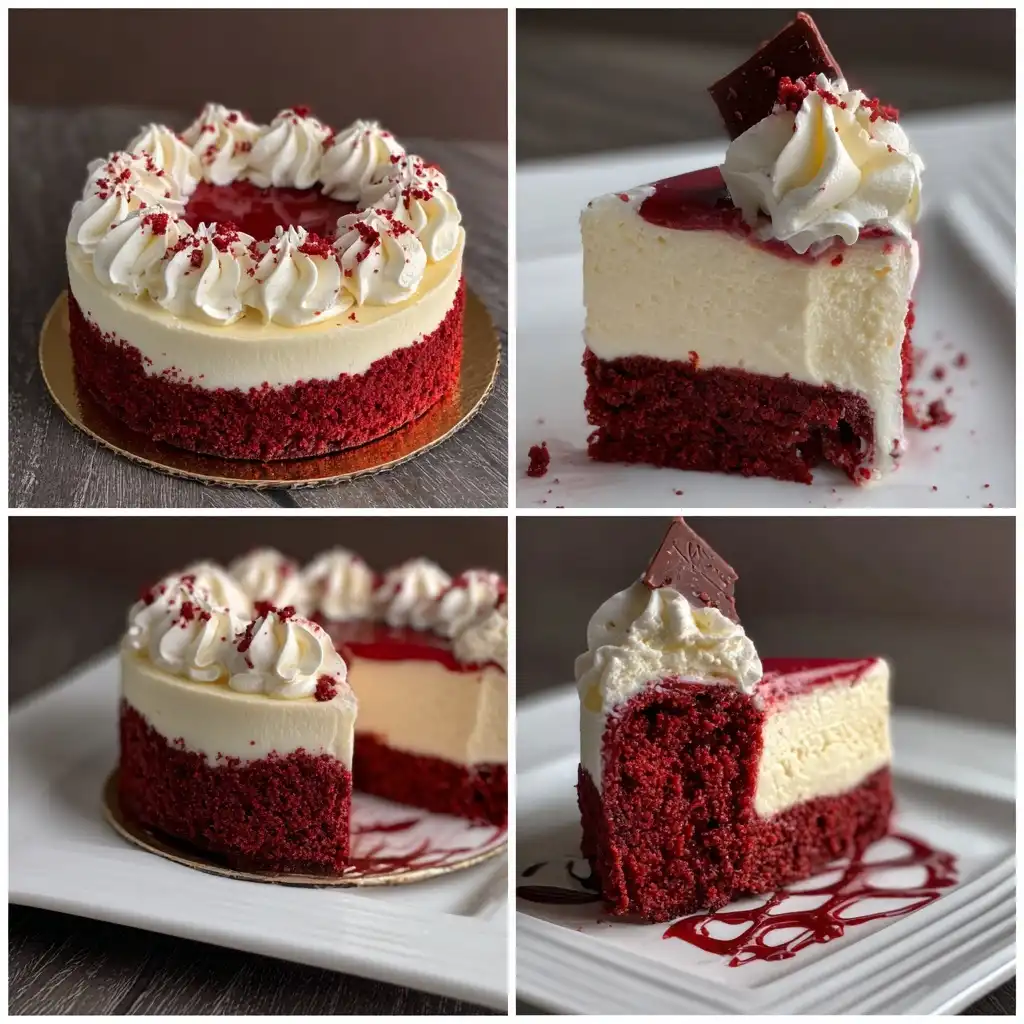
Red Velvet Cheesecake is the ultimate marriage of two beloved American desserts—velvety, cocoa-kissed red velvet cake and luxuriously creamy, tangy New York–style cheesecake. This showstopping hybrid dessert delivers a stunning visual impact with its signature crimson layers, a delicate crumb that’s both tender and rich, and a center so smooth and dense it practically melts on the tongue. Whether served at holiday gatherings, weddings, birthdays, or as an indulgent weekend treat, Red Velvet Cheesecake transcends seasonal trends—it’s timeless, photogenic, and deeply satisfying. Its allure lies not only in its dramatic color and elegant contrast of textures but also in its nuanced flavor profile: subtle cocoa bitterness, gentle acidity from buttermilk and vinegar, a whisper of vanilla and almond extract, and the luxurious, velvety richness of full-fat cream cheese. More than just a dessert, it’s an experience—one that balances nostalgia with sophistication, tradition with innovation.
The History
The origins of Red Velvet Cheesecake are rooted in the layered evolution of two iconic American confections. Red velvet cake traces its lineage to the early 20th century, with documented recipes appearing as early as the 1920s—though some food historians suggest its antecedents may stretch back to Victorian-era “velvet cakes,” prized for their fine, soft crumb achieved through the use of cake flour and acidic ingredients like buttermilk or vinegar. The distinctive red hue was originally a natural byproduct: anthocyanin pigments in non-Dutched (natural) cocoa reacted with acidic components (buttermilk, vinegar, and baking soda), producing a reddish tint. As cocoa processing evolved and Dutch-processed cocoa became standard (which neutralizes acidity and dulls the red), bakers began adding beet juice—and later, synthetic red food coloring—to preserve the cake’s signature color. The cake gained national fame in the 1940s when the Waldorf Astoria Hotel in New York reportedly served it and distributed its recipe in exchange for donations to charity, cementing its status as a luxury dessert.
Cheesecake, meanwhile, boasts ancient roots—from honey-sweetened ricotta versions in Greece to medieval European adaptations—but the modern American baked cheesecake emerged in the late 19th century, popularized by Philadelphia cream cheese (first mass-produced in 1872) and perfected by New York bakers in the early 1900s. The fusion of red velvet and cheesecake likely began in home kitchens during the 1980s and 1990s, gaining momentum with the rise of food blogs and televised baking competitions in the 2000s. Early iterations often featured red velvet cake layers sandwiching a cheesecake filling or a swirl technique, but the true breakthrough came with the development of the “red velvet cheesecake bar” and, ultimately, the fully integrated, layered, and baked version we celebrate today—complete with a buttery graham cracker crust, a vibrant red velvet cake layer, and a thick, crack-free, oven-baked cheesecake layer crowned with a glossy red velvet glaze or whipped cream garnish. Its ascent coincided with the food coloring renaissance, artisanal cocoa movements, and growing consumer appetite for hybrid desserts that honor heritage while embracing creativity.
Ingredients Breakdown
Every exceptional Red Velvet Cheesecake begins with intentionality—each ingredient plays a precise functional and sensory role. Understanding *why* each component matters elevates your execution from good to extraordinary:
- Unsalted Butter (room temperature): Provides richness, tenderness, and structure. Room temperature ensures proper creaming with sugar for optimal air incorporation. Clarified butter can be used for enhanced stability in high-heat environments, though traditional butter contributes superior flavor.
- Granulated Sugar: Sweetens and aids in creaming to trap air; also controls moisture retention and influences browning. A portion is reserved for the cheesecake layer to balance tartness without masking cream cheese flavor.
- Brown Sugar (light or dark, optional in crust or filling): Adds molasses depth, moisture, and subtle caramel notes—especially effective in the crust or swirled into the cheesecake batter for complexity.
- Large Eggs (room temperature, preferably organic): Act as emulsifiers and structural agents. Yolks add fat, richness, and silkiness; whites provide lift and stability. Room temperature eggs integrate more smoothly and reduce curdling risk in the cheesecake layer.
- Full-Fat Cream Cheese (brick-style, room temperature, never low-fat or spreadable): The cornerstone of texture and flavor. Must be truly softened—not melted—to ensure lump-free, airy, yet dense cheesecake. Philadelphia, Kraft, or Kerrygold are reliable choices. Cold cream cheese guarantees lumps; overheated cream cheese causes separation.
- Sour Cream & Full-Fat Greek Yogurt (or additional sour cream): Sour cream adds tang, moisture, and tenderness while inhibiting gluten formation. Greek yogurt (strained) offers similar benefits with slightly more protein and less whey—contributing to a firmer, smoother set. Both help prevent cracking and lend a subtle brightness that cuts through richness.
- Buttermilk (full-fat, cultured, not powdered substitute): Essential for authentic red velvet character. Its acidity reacts with baking soda, activates cocoa’s color potential, tenderizes gluten, and imparts a delicate tang. Shelf-stable buttermilk lacks the necessary live cultures and viscosity—fresh cultured buttermilk is non-negotiable.
- Natural Unsweetened Cocoa Powder (non-alkalized): Critical for the red reaction. Dutch-processed cocoa has been treated with alkali, neutralizing acidity and preventing the vibrant red hue. Natural cocoa retains its pH level, allowing anthocyanins to bloom in acidic environments. Brands like Hershey’s Natural, Ghirardelli Unsweetened, or Droste Natural are ideal.
- Distilled White Vinegar or Apple Cider Vinegar: Enhances acidity to maximize color development and tenderize the cake layer. Vinegar also reacts with baking soda to produce carbon dioxide—key for the signature light, velvety crumb.
- Baking Soda: The alkaline counterpart to vinegar and buttermilk. Its reaction creates leavening gas *and* raises pH slightly, further intensifying the red pigment. Too much yields a soapy aftertaste; too little results in dense texture and muted color.
- All-Purpose Flour (bleached preferred) or Cake Flour: Bleached AP flour has lower protein and a finer starch granule, yielding a softer crumb. Cake flour (lower protein, ~7–8%) produces even more tenderness but requires careful sifting and measurement. Never substitute bread flour.
- Red Food Coloring (gel-based, highly concentrated): While natural reactions contribute, modern red velvet relies on high-quality gel color (e.g., AmeriColor Super Red, Chefmaster Red) for consistent, deep, jewel-toned vibrancy without diluting batter or altering flavor. Liquid food coloring introduces excess water and yields pale, inconsistent results.
- Pure Vanilla Extract & Pure Almond Extract: Vanilla provides warm, rounded sweetness; almond extract—used sparingly (<½ tsp)—is the secret nuance that defines authentic red velvet aroma and flavor. Imitation extracts lack depth and can taste artificial or bitter at higher concentrations.
- Sea Salt (fine, non-iodized): Balances sweetness, enhances all other flavors, and tempers the acidity of buttermilk and vinegar. Kosher salt is acceptable, but volume differs—use weight measurements for precision.
- Graham Cracker Crumbs (or digestive biscuits, speculoos, or chocolate wafer alternatives): Forms the foundational crust. Graham crackers offer honeyed sweetness and gentle cinnamon warmth that complements both red velvet and cheesecake. For gluten-free versions, certified GF graham-style crumbs or almond flour blends work beautifully.
- Heavy Whipping Cream (36–40% fat) & Powdered Sugar: Used in toppings—whipped cream must be cold, bowl and beaters chilled, and stabilized with a touch of cornstarch or cream cheese for longevity. Powdered sugar contains cornstarch, which aids stabilization and sweetness control.
- White Chocolate or Dark Chocolate (optional drizzle): Adds textural contrast and a sophisticated finish. White chocolate echoes the sweetness of the cake layer; dark chocolate (60–70%) provides a bold counterpoint.
Step-by-Step Recipe
This meticulously tested, professional-grade Red Velvet Cheesecake recipe yields a 9-inch, 3-layer masterpiece with a buttery graham crust, a 1-inch tall red velvet cake layer, a 2-inch tall dense yet silky cheesecake layer, and a glossy red velvet ganache or whipped cream finish. Total active time: 65 minutes. Total bake + cooldown time: ~12 hours (including overnight chilling).
- Prepare the Pan: Wrap the exterior of a 9-inch springform pan tightly with two overlapping layers of heavy-duty aluminum foil—ensure no gaps at the base to prevent water bath leakage. Lightly grease the foil and interior sides. Preheat oven to 325°F (163°C) with rack positioned in lower third.
- Make the Graham Cracker Crust: Pulse 1 ½ cups (150g) finely ground graham cracker crumbs, ¼ cup (50g) granulated sugar, and 6 tbsp (85g) melted unsalted butter in a food processor until mixture resembles wet sand. Press firmly and evenly into the bottom and 1 inch up the sides of the prepared pan using the back of a measuring cup. Bake at 325°F for 10 minutes. Cool completely on a wire rack—do not skip cooling; warm crust absorbs moisture from filling.
- Prepare the Red Velvet Cake Layer: In a medium bowl, whisk together 1 ½ cups (190g) bleached all-purpose flour, ¼ cup (20g) natural unsweetened cocoa powder, 1 tsp baking soda, and ½ tsp fine sea salt. In a large bowl, beat ½ cup (113g) softened unsalted butter, ¾ cup (150g) granulated sugar, and ¼ cup (50g) light brown sugar with a stand mixer fitted with paddle attachment on medium speed for 3–4 minutes until pale, fluffy, and doubled in volume. Add 2 large room-temperature eggs one at a time, beating well after each addition. Scrape bowl thoroughly. Beat in 1 tsp pure vanilla extract and ½ tsp pure almond extract. In a measuring cup, combine 1 cup (240ml) full-fat cultured buttermilk, 1 tbsp distilled white vinegar, and 1 tbsp high-quality red gel food coloring—whisk until uniformly deep red. With mixer on low, alternately add dry ingredients and wet mixture in three additions, beginning and ending with dry ingredients. Mix only until just combined—do not overmix. Batter will be thick and vividly red.
- Prepare the Cheesecake Layer: In a clean large bowl, beat 24 oz (680g / three 8-oz bricks) full-fat room-temperature cream cheese on medium speed for 2 minutes until perfectly smooth and creamy—scrape bowl frequently. Add 1 cup (200g) granulated sugar and beat 2 more minutes until light and airy. Add 1 cup (240g) full-fat sour cream and ½ cup (120g) full-fat Greek yogurt; beat on medium-low for 1 minute until homogenous. Add 3 large room-temperature egg yolks one at a time, beating 30 seconds after each. Add 2 large whole room-temperature eggs one at a time, beating 30 seconds after each—scrape bowl after every addition. Finally, beat in 1 tsp pure vanilla extract and ¼ tsp fine sea salt. Batter should be thick, glossy, and free of lumps. Do not overbeat—excess air causes cracking.
- Layer the Batter: Pour the red velvet cake batter evenly over the cooled crust. Gently tap pan on counter twice to release air bubbles. Carefully spoon the cheesecake batter over the red velvet layer. Using an offset spatula, spread evenly—avoid dragging through the red layer. Tap pan firmly 4–5 times to settle and eliminate air pockets. Run a thin knife or skewer in a gentle zig-zag pattern through the top ½ inch of cheesecake batter to create subtle marbling (optional but visually stunning).
- Water Bath Setup: Place the foil-wrapped springform pan inside a larger roasting pan. Carefully pour hot (not boiling) water into the roasting pan until it reaches halfway up the sides of the springform pan (~1.5 inches deep). Use a kettle with a spout for precision and safety.
- Bake: Carefully transfer roasting pan to preheated oven. Bake at 325°F for 1 hour and 25 minutes. The cheesecake is done when the outer 2 inches look puffed and set, while the center 2 inches still jiggles slightly like Jell-O—this is crucial. Do not open the oven door before 75 minutes. After baking, turn off oven, crack door open 1 inch with a wooden spoon, and let cake cool inside for 1 hour. This gradual cooling prevents drastic temperature shifts that cause cracks.
- Chill Overnight: Remove springform pan from water bath. Carefully run a thin knife around the inner edge to loosen. Cool on wire rack for 1 hour at room temperature. Refrigerate uncovered for a minimum of 12 hours—ideally 16–24 hours—for complete setting, flavor melding, and clean slicing. Do not freeze before slicing.
- Finish & Serve: At least 30 minutes before serving, remove side of springform pan. If desired, prepare Red Velvet Ganache: Heat ½ cup (120ml) heavy cream until steaming, pour over 4 oz (115g) finely chopped white chocolate, let sit 2 minutes, then stir until smooth. Stir in ½ tsp red gel food coloring and ¼ tsp almond extract. Let cool 10 minutes, then pour over chilled cheesecake, tilting pan to coat evenly. Garnish with fresh raspberries, white chocolate curls, or piped whipped cream rosettes. Slice with a hot, dry knife wiped between cuts.
Tips
- Temperature is Non-Negotiable: All dairy (cream cheese, sour cream, buttermilk, eggs, butter) must be truly room temperature—68–72°F (20–22°C). Pull ingredients from the fridge 2–3 hours ahead. Cold ingredients cause lumps, poor emulsification, and uneven baking.
- Weigh Your Ingredients: Volume measurements (cups) for flour, cocoa, and sugar vary wildly by scoop method. Use a digital kitchen scale accurate to 0.1g for flawless consistency—especially critical for the delicate red velvet crumb and stable cheesecake structure.
- Sift Dry Ingredients Twice: Sifting cocoa and flour removes lumps and aerates, ensuring even distribution and eliminating gritty texture. Always sift *before* measuring by weight if using volume-based recipes.
- Mix Batter Just Until Combined: Overmixing develops gluten in the cake layer (causing toughness) and incorporates excess air into the cheesecake (causing cracks and collapse). Use low speed and stop the moment no streaks remain.
- Use a Water Bath—No Exceptions: The gentle, moist heat of the water bath ensures even cooking, prevents surface drying and cracking, and yields a custard-like, ultra-smooth cheesecake texture. Foil wrapping is essential—leaks ruin the crust.
- Don’t Rush the Chill: Refrigerating less than 12 hours results in a soft, fragile slice that smooshes rather than holds shape. The extended chill allows proteins to fully set and fats to solidify, delivering clean, sharp edges and maximum creaminess.
- Prevent Cracks Proactively: In addition to the water bath and gradual cooling, avoid overbeating the cheesecake batter, don’t open the oven early, and never cool rapidly (e.g., refrigerating a warm cake). If cracks appear, embrace them—top generously with ganache or whipped cream.
- Knife Technique Matters: Dip a long, thin, straight-edged knife (like a chef’s or offset spatula) in hot water, wipe dry, and slice cleanly. Reheat and dry between every cut. A serrated knife tears—never use one.
- Color Consistency Hack: For uniform red velvet hue, mix gel food coloring into the buttermilk/vinegar mixture *before* adding to batter—this ensures even dispersion and avoids streaks.
- Altitude Adjustments: Above 3,000 ft: Reduce sugar by 1 tbsp, increase flour by 1 tbsp, raise oven temp by 15°F, and extend bake time by 5–8 minutes. Monitor closely.
- Freezing for Long-Term Storage: Once fully chilled and sliced, wrap individual portions tightly in plastic wrap, then in foil. Freeze up to 3 months. Thaw overnight in refrigerator—not at room temperature—to preserve texture.
Variations and Customizations
Red Velvet Cheesecake is a canvas for creativity—respecting its core identity while inviting thoughtful, flavor-forward adaptations:
- Gluten-Free Red Velvet Cheesecake: Substitute 1:1 gluten-free all-purpose flour blend (with xanthan gum) for AP flour. Ensure graham crackers are certified GF—or use GF chocolate wafers, almond flour crusts, or crushed gluten-free ginger snaps for warm spice notes.
- Vegan Red Velvet Cheesecake: Use soaked raw cashews (blended ultra-smooth with lemon juice, apple cider vinegar, coconut cream, and beet powder for color) for the cheesecake layer. Flax eggs replace chicken eggs; coconut oil and aquafaba mimic butter and structure. Natural red coloring comes from concentrated beet juice or purple carrot powder.
- Black Cocoa Red Velvet: Replace half the natural cocoa with black cocoa (Dutch-processed but intensely dark, like in Oreo cookies) for a deeper, almost charcoal-hued cake layer with espresso-like depth—pair with dark chocolate ganache.
- Boozy Infusions: Add 2 tbsp bourbon or Irish cream liqueur to the red velvet batter for warmth; fold 1 tbsp amaretto into the cheesecake batter for almond enhancement; or brush cooled cake layer with simple syrup infused with rosewater and raspberry.
- Layered Swirl Version: Instead of distinct layers, gently swirl ⅓ of the cheesecake batter into the red velvet batter in the pan, then pour remaining cheesecake batter on top and swirl once more—creates a beautiful marbled effect throughout.
- Mini Jar or Ramekin Individual Servings: Scale down for 4-oz mason jars or ramekins. Reduce bake time to 35–42 minutes in a shallow water bath. Perfect for parties, gifts, or portion control.
- Red Velvet Cheesecake Bars: Bake in a lined 9×13-inch pan. Double the crust, use 1.5x red velvet batter, and 2x cheesecake batter. Bake 55–65 minutes. Cut into 24 squares—ideal for potlucks and easy transport.
- Stuffed Center Variation: Before adding cheesecake batter, place a ½-inch disc of cream cheese–raspberry jam swirl or white chocolate ganache in the center of the red velvet layer—creates a delightful surprise core.
- Spiced Red Velvet: Add ¼ tsp ground cinnamon, ⅛ tsp ground nutmeg, and a pinch of clove to the dry ingredients for autumnal warmth—complements graham crust beautifully.
- White Chocolate–Swirled Cheesecake: Melt 4 oz white chocolate, cool slightly, then dollop over cheesecake batter before baking. Use a toothpick to gently swirl—creates elegant ribbons without compromising structure.
- No-Bake Refrigerator Version: For a lighter, quicker option: Prepare no-bake red velvet cake layer (using gelatin-set batter) and no-bake cheesecake layer (cream cheese, whipped cream, condensed milk). Chill 8 hours. Less dense, more airy—ideal for summer.
Health Considerations and Nutritional Value
While Red Velvet Cheesecake is inherently an indulgent dessert—not intended for daily consumption—it’s possible to understand its nutritional composition and make informed, mindful choices without sacrificing joy or tradition. Per standard slice (1/12 of a 9-inch cake, approx. 220g), here’s a detailed breakdown based on the full-recipe formulation above:
| Nutrient | Amount per Slice | % Daily Value (DV)* | Notes |
|---|---|---|---|
| Calories | 585 kcal | — | Energy-dense due to butter, cream cheese, sour cream, and sugar. Portion awareness is key. |
| Total Fat | 38g | 49% | Includes 22g saturated fat (110% DV). Primarily from dairy fat—provides satiety and flavor. Minimal trans fat (naturally occurring CLA in dairy). |
| Cholesterol | 142mg | 47% | From eggs and dairy. Within FDA guidelines (≤300mg/day). Those with familial hypercholesterolemia may consult a dietitian. |
| Sodium | 425mg | 18% | Mostly from butter, cream cheese, and graham crackers. Easily reduced by 25% using low-sodium butter and unsalted graham crackers. |
| Total Carbohydrates | 52g | 17% | Includes 38g sugars (naturally occurring lactose + added sucrose). No fiber (0g) unless whole grain crust or added psyllium is used. |
| Protein | 11g | 22% | High-quality complete protein from eggs, cream cheese, and dairy—supports muscle maintenance and increases satiety. |
| Vitamin A | 620mcg RAE | 69% | From butter, cream cheese, and egg yolks—supports vision and immune health. |
| Calcium | 145mg | 11% | From dairy sources—contributes to bone health. Can be boosted with calcium-fortified buttermilk or yogurt. |
| Vitamin B12 | 0.9mcg | 38% | Essential for nerve function and red blood cell formation—abundant in animal-derived dairy and eggs. |
*Based on a 2,000-calorie diet. Values are estimates and may vary with brands and substitutions.
Considerations for Dietary Needs:
- Lactose Sensitivity: Contains moderate lactose (from buttermilk, sour cream, cream cheese). Lactase enzyme supplements taken prior to eating may aid digestion. Lactose-free cream cheese and sour cream are widely available and perform identically.
- Diabetes-Friendly Adaptations: Sugar can be replaced with erythritol+monk fruit blend (1:1 ratio) in both layers—but note: sugar contributes to texture and browning. Crust may require added binder (xanthan gum). Always monitor blood glucose response individually.
- Heart-Healthy Tweaks: Substitute ¼ of butter with avocado oil (for unsaturated fat), use low-fat cream cheese *only in cheesecake layer* (not recommended for cake layer), and increase cocoa (antioxidant-rich flavanols) while reducing sugar by 15%. These alter texture slightly but improve lipid profile.
- Pregnancy-Safe: Uses pasteurized dairy and eggs baked to safe internal temperature (>160°F)—no raw eggs or unpasteurized cheeses. Avoid alcohol-infused variations.
- Allergen Notes: Contains dairy, eggs, wheat (gluten), and soy (in most commercial butter/cream cheese). Tree nuts are not present unless added via garnish (e.g., pecans).
Ingredients
Makes one 9-inch, 3-layer Red Velvet Cheesecake (12 servings)
For the Graham Cracker Crust:
- 1 ½ cups (150g) finely ground graham cracker crumbs (about 12 full sheets)
- ¼ cup (50g) granulated sugar
- 6 tablespoons (85g) unsalted butter, melted
- ¼ teaspoon fine sea salt
For the Red Velvet Cake Layer:
- 1 ½ cups (190g) bleached all-purpose flour (spooned & leveled)
- ¼ cup (20g) natural unsweetened cocoa powder (non-alkalized)
- 1 teaspoon baking soda
- ½ teaspoon fine sea salt
- ½ cup (113g) unsalted butter, room temperature
- ¾ cup (150g) granulated sugar
- ¼ cup (50g) light brown sugar, packed
- 2 large eggs, room temperature
- 1 teaspoon pure vanilla extract
- ½ teaspoon pure almond extract
- 1 cup (240ml) full-fat cultured butterm