Introduction
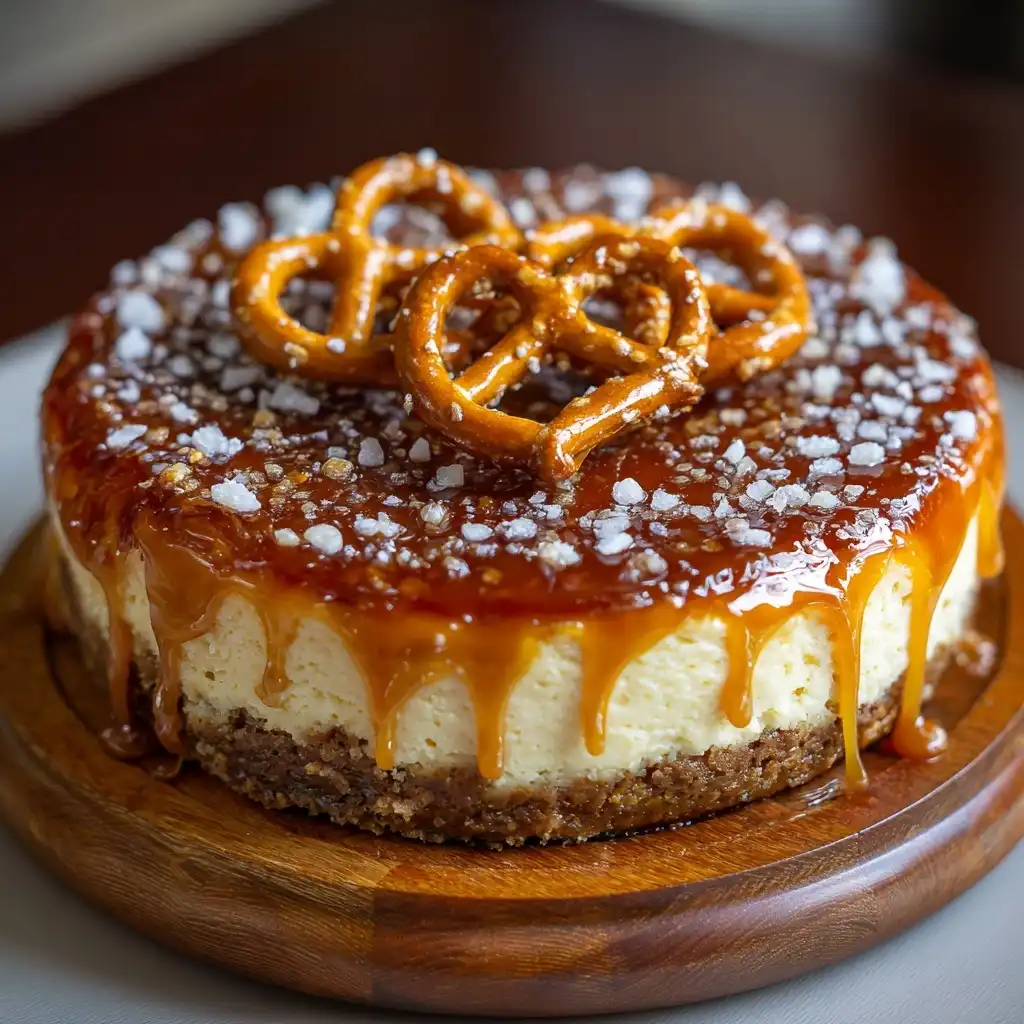
Welcome to the ultimate indulgence: Salted Caramel Pretzel Cheesecake — a decadent, texturally thrilling masterpiece that marries creamy richness, buttery crunch, deep caramel complexity, and a delicate kiss of sea salt. This isn’t just dessert; it’s an experience — one that balances sweet and savory, smooth and crisp, cool and warm, all in a single, unforgettable bite. Whether you’re hosting a holiday gathering, celebrating a milestone, or simply treating yourself after a long week, this cheesecake delivers showstopping elegance with surprisingly approachable technique. Its layered architecture — from the salty-sweet pretzel crust to the velvety New York–style filling and glossy, hand-swirled salted caramel topping — ensures every slice tells a story of thoughtful craftsmanship and bold flavor harmony.
The History
The Salted Caramel Pretzel Cheesecake is a relatively modern culinary evolution, born at the intersection of three iconic American dessert trends: the resurgence of gourmet salted caramel (popularized in the early 2000s by chefs like Jacques Torres and later mainstreamed by brands like Häagen-Dazs and Starbucks), the nostalgic revival of snack-inspired baking (think Oreos in cookies, Fruity Pebbles in cakes), and the enduring legacy of New York–style cheesecake — a dense, luxurious, oven-baked tradition rooted in late 19th-century immigrant kitchens, particularly those of Jewish bakers on the Lower East Side. Pretzels entered the dessert lexicon more deliberately in the 2010s, as pastry chefs and home bakers began exploring savory-sweet contrasts — notably with chocolate-covered pretzels and pretzel-crumb crusts for pies and bars. The fusion of pretzel crust with caramel and cheesecake gained viral traction around 2015–2016 via food blogs and Instagram, where its photogenic layers — golden-brown crust, ivory filling, amber drizzle, flaky salt crystals — captivated audiences. Today, it stands as a hallmark of contemporary comfort baking: deeply rooted in tradition yet unafraid to innovate, honoring texture, contrast, and balance above all else.
Ingredients Breakdown
Understanding each component is key to mastering this dessert. Below is a meticulous, function-driven breakdown:
- Pretzel Crust: Crushed unsalted pretzels (preferably thin, rod-shaped or mini twists) provide structural integrity, a clean wheat-forward flavor, and a subtle alkaline tang from the lye-dipped baking process — which also enhances browning. Melted unsalted butter binds the crumbs and adds richness, while granulated sugar lends mild sweetness and promotes caramelization. A pinch of flaky sea salt (like Maldon) amplifies the pretzel’s inherent savoriness without overpowering.
- Cheesecake Filling: Full-fat brick-style cream cheese (Philadelphia or similar) is non-negotiable — its high milk fat and stable protein matrix ensures dense creaminess and prevents curdling. Sour cream adds acidity, moisture, and a gentle tang that cuts through richness; heavy cream contributes silkiness and helps control density. Granulated sugar dissolves into the batter to feed fermentation (affecting texture), while brown sugar (optional but recommended) imparts molasses depth and slight hygroscopic softness. Pure vanilla extract (not imitation) provides aromatic warmth, and fresh lemon juice brightens the profile and stabilizes proteins. Eggs — brought to room temperature — act as emulsifiers and leaveners; their yolks enrich, while whites add lift (though minimal in a dense style). A touch of cornstarch or flour (often debated among purists) offers insurance against cracking by gently reinforcing the protein network.
- Salted Caramel Sauce: Made from granulated sugar heated to the amber stage (~340–350°F), then carefully tempered with heavy cream (cold, to control steam), unsalted butter, and a measured amount of flaky sea salt. The caramel must be cooked precisely: undercooked yields a cloying, sticky sauce; overcooked becomes bitter and brittle. High-fat dairy ensures lush mouthfeel, while the salt is added *after* cooking to preserve its delicate crystalline texture and volatile aroma compounds.
- Garnish & Finish: Extra crushed pretzels add textural contrast and visual appeal. A final sprinkle of flaky sea salt just before serving heightens perception of sweetness (a well-documented sensory phenomenon) and delivers a satisfying burst of salinity with each bite.
Step-by-Step Recipe
- Prepare the Pretzel Crust (Day Before or Morning Of): Preheat oven to 350°F (175°C). In a food processor, pulse 2 cups (about 180g) finely crushed unsalted pretzels until uniformly crumbly — no large shards. Transfer to a bowl; whisk in ¼ cup (50g) granulated sugar and ¼ tsp flaky sea salt. Pour in 6 tbsp (85g) melted unsalted butter and stir until all crumbs are evenly moistened and hold together when pinched. Press firmly and evenly into the bottom and 1 inch up the sides of a 9-inch springform pan lined with parchment (bottom only). Use the flat bottom of a measuring cup or glass to compact thoroughly. Bake for 10 minutes, then cool completely on a wire rack — at least 45 minutes. Reduce oven temp to 325°F (165°C) for baking the cheesecake.
- Make the Cheesecake Batter: In a large bowl, beat 24 oz (680g / four 8-oz bricks) full-fat cream cheese at medium speed with an electric mixer until completely smooth and lump-free (2–3 min). Scrape down bowl and paddle. Add 1 cup (200g) granulated sugar and ¼ cup (50g) light brown sugar; beat 2 minutes until fluffy and pale. Add 1 cup (240g) full-fat sour cream and ½ cup (120ml) heavy cream; beat 1 minute until homogenous. Beat in 2 tsp pure vanilla extract and 1 tbsp fresh lemon juice. One at a time, add 4 large eggs (room temperature), beating just until yolk disappears after each addition (≈15 seconds per egg). Avoid overmixing — no visible streaks, but no excess air incorporation. Optional: sift in 1 tbsp cornstarch or all-purpose flour and fold gently with a spatula just until incorporated.
- Bake Using the Water Bath Method (Essential for Cracking Prevention): Wrap the *outside* of the cooled springform pan tightly with two overlapping sheets of heavy-duty aluminum foil (to prevent water seepage). Place pan inside a larger roasting pan. Carefully pour batter into crust. Fill roasting pan with hot tap water until it reaches halfway up the springform pan’s sides. Gently transfer to center rack of preheated 325°F oven. Bake for 1 hour 15 minutes — edges should be set with a 3-inch wobble in the center. Turn off oven, crack door open 1 inch with a wooden spoon, and let cheesecake cool *in the water bath* for 1 hour. Remove from water bath, run a thin knife around inner edge to loosen, and cool completely at room temperature (≈2 hours), then refrigerate uncovered for *at least 12 hours*, preferably 24–48 hours for optimal texture and flavor development.
- Prepare the Salted Caramel Sauce: In a heavy-bottomed, light-colored saucepan (for monitoring color), combine 1 cup (200g) granulated sugar and ¼ cup (60ml) water. Stir gently to moisten sugar, then place over medium heat. Do NOT stir once boiling begins. Swirl pan occasionally. Cook until mixture turns deep amber (≈345°F on a candy thermometer), ~8–12 minutes. Immediately remove from heat. Carefully whisk in ½ cup (120ml) cold heavy cream (mixture will bubble vigorously). Whisk in 4 tbsp (57g) cold unsalted butter until fully melted and glossy. Stir in 1 tsp flaky sea salt. Cool to lukewarm (~90°F), stirring occasionally to prevent skin formation. Sauce will thicken as it cools.
- Assemble & Serve: Run a warm knife around the cheesecake edge again. Release springform collar. Drizzle ¾ of the cooled caramel sauce over top in concentric circles. Use a toothpick or skewer to gently swirl into marbled patterns. Sprinkle generously with additional crushed pretzels and a final delicate dusting of flaky sea salt. Chill for 30 minutes before slicing. For clean cuts, dip a sharp, thin-bladed knife in hot water, wipe dry, and slice between servings.
Tips
- Room Temperature is Non-Negotiable: Cold cream cheese = lumps. Cold eggs = uneven emulsification and potential curdling. Take ingredients out 3–4 hours ahead — never rush this step.
- Crush Pretzels Strategically: Use a zip-top bag and rolling pin for even, sand-like crumbs. Avoid over-processing into powder — you want fine gravel, not flour, for optimal crunch.
- Water Bath Mastery: Use a roasting pan with high, straight sides. Boil kettle water beforehand for faster, safer filling. Line foil wraps *before* adding batter to avoid spills.
- No Peeking, No Rushing: Opening the oven door early causes thermal shock and cracking. The slow, gradual cooling in the turned-off oven is as critical as the bake itself.
- Patience Pays Off: Refrigerating for 24+ hours allows flavors to meld, textures to settle, and the cake to achieve its signature dense-yet-creamy mouthfeel. Slicing too soon results in smearing and loss of definition.
- Caramel Safety First: Molten sugar is hotter than boiling water and can cause severe burns. Keep children/pets away. Have vinegar nearby (to cool burns) and use long-handled utensils.
- Knife Technique: For pristine slices: heat knife in hot water, dry *thoroughly*, cut, wipe, reheat, repeat. A bench scraper helps lift slices cleanly from the base.
- Storage Wisdom: Keep covered tightly with plastic wrap or in an airtight container. Lasts 5 days refrigerated. Freeze unfrosted (wrap in plastic + foil) up to 3 months — thaw overnight in fridge before caramelizing and garnishing.
Variations and Customizations
This recipe is a canvas — adaptable for dietary needs, seasonal whims, and creative flair:
- Dietary Adaptations: Gluten-Free: Substitute certified GF pretzels (like Snyder’s GF sticks) and ensure all other ingredients are GF-certified. Vegan: Use cashew-based “cream cheese” (blended soaked cashews, coconut oil, lemon, nutritional yeast), coconut cream instead of dairy, and date-sugar caramel with coconut butter. Lower-Sugar: Replace granulated sugar with erythritol/monk fruit blend (1:1), omit brown sugar, and use sugar-free caramel syrup (though texture may differ).
- Flavor Twists: Maple-Bourbon: Replace 2 tbsp cream with bourbon and 2 tbsp sugar with pure maple syrup in filling; swirl in maple-infused caramel. Espresso-Sea Salt: Dissolve 1 tbsp instant espresso powder in lemon juice before adding; finish with espresso-salted caramel. Spiced Chai: Infuse cream with chai spices (cardamom, ginger, cinnamon) overnight, strain, then use in filling and caramel.
- Texture & Visual Upgrades: Add a layer of toasted pecans or candied bacon between crust and filling. Pipe rosettes of stabilized whipped cream around the perimeter. Top with edible gold leaf and caramelized white chocolate shards. Embed whole mini pretzels vertically into the top before chilling.
- Miniature Format: Bake in lined muffin tins (with pretzel crusts) for individual portions — reduce bake time to 22–25 minutes in water bath. Perfect for parties and portion control.
- No-Bake Version: Replace baked filling with a no-bake version: blend 16 oz cream cheese, 1 cup powdered sugar, 1 cup cold heavy cream (whipped to stiff peaks), 2 tsp vanilla, and 1 tbsp lemon juice. Fold in whipped cream gently. Set in fridge 8 hours. Top with chilled caramel.
Health Considerations and Nutritional Value
A single generous slice (1/12 of a standard 9-inch cake) contains approximately 620–750 calories, 42–52g total fat (26–34g saturated), 75–90g carbohydrates (58–72g sugars), and 8–10g protein. While undeniably rich, mindful enjoyment within a balanced diet is entirely possible. Key considerations:
- Sodium Awareness: Pretzels and added salt contribute ~380–480mg sodium per slice — moderate for most, but those on sodium-restricted diets (e.g., hypertension, CKD) should consume sparingly or reduce salt in crust/caramel.
- Sugar Density: With 3–4 tbsp sugar in the crust, 1¼ cups in the filling, and 1 cup in caramel, this is a high-glycemic dessert. Pairing with a protein-rich beverage (e.g., Greek yogurt parfait) or serving post-exercise may mitigate blood sugar spikes.
- Positive Nutrients: Provides calcium (from dairy), vitamin A (cream cheese, sour cream), and choline (eggs). Pretzels offer trace B vitamins and iron (especially if enriched). Using grass-fed dairy or organic eggs increases omega-3s and antioxidant content.
- Portion Mindfulness: Serving smaller slices (1/16 instead of 1/12) reduces calories by ~15% without sacrificing satisfaction. Using a fork to take deliberate bites enhances satiety signals.
- Allergen Notes: Contains dairy, eggs, wheat (unless GF pretzels used), and soy (in most commercial pretzels and butter). Always verify labels for sensitivities.
- Mindful Indulgence Philosophy: Rather than labeling “unhealthy,” consider it nutrient-dense *in context*: high-quality fats support hormone health; natural sugars fuel brain activity; the ritual of shared dessert fosters connection and joy — validated contributors to holistic well-being.
Ingredients
For the Pretzel Crust:
- 2 cups (180g) finely crushed unsalted pretzels (thin rods or mini twists)
- ¼ cup (50g) granulated sugar
- ¼ teaspoon flaky sea salt (e.g., Maldon)
- 6 tablespoons (85g) unsalted butter, melted and slightly cooled
For the Cheesecake Filling:
- 24 ounces (680g) full-fat brick-style cream cheese, room temperature (four 8-oz packages)
- 1 cup (200g) granulated sugar
- ¼ cup (50g) light brown sugar, packed
- 1 cup (240g) full-fat sour cream, room temperature
- ½ cup (120ml) heavy cream (36–40% fat), room temperature
- 2 teaspoons pure vanilla extract
- 1 tablespoon fresh lemon juice
- 4 large eggs, room temperature
- 1 tablespoon cornstarch or all-purpose flour (optional, for extra stability)
For the Salted Caramel Sauce:
- 1 cup (200g) granulated sugar
- ¼ cup (60ml) water
- ½ cup (120ml) cold heavy cream
- 4 tablespoons (57g) cold unsalted butter
- 1 teaspoon flaky sea salt
For Garnish:
- ¼ cup (30g) additional crushed pretzels
- ¼ teaspoon flaky sea salt
Directions
- Preheat oven to 350°F (175°C). Prepare crust: Pulse pretzels in food processor until fine crumbs form (no large pieces). In bowl, mix pretzel crumbs, granulated sugar, and ¼ tsp sea salt. Stir in melted butter until mixture resembles wet sand. Press firmly into bottom and 1 inch up sides of 9-inch springform pan lined with parchment on bottom only. Bake 10 minutes. Cool completely on wire rack (≥45 min). Reduce oven temp to 325°F (165°C).
- Make filling: In large bowl, beat cream cheese with electric mixer on medium until perfectly smooth (2–3 min). Add granulated and brown sugars; beat 2 min until light and fluffy. Add sour cream and heavy cream; beat 1 min. Add vanilla and lemon juice; beat 15 sec. Add eggs one at a time, beating just until incorporated after each (≈15 sec). If using cornstarch/flour, sift over batter and fold gently with spatula until no streaks remain. Do not overmix.
- Water bath setup: Wrap outside of cooled springform pan tightly with two sheets heavy-duty foil. Place pan inside larger roasting pan. Pour batter into crust. Carefully pour hot water into roasting pan until halfway up springform sides.
- Bake: Place roasting pan on center oven rack. Bake 1 hour 15 minutes — center should jiggle like set Jell-O. Turn off oven, crack door open 1 inch with wooden spoon, and let cool in water bath 1 hour. Remove from water bath. Run thin knife around edge. Cool completely at room temp (≈2 hours), then refrigerate uncovered ≥12 hours (ideally 24–48 hrs).
- Make caramel: In heavy saucepan, combine sugar and water. Stir to moisten. Heat over medium, swirling occasionally, until deep amber (345°F). Remove from heat. Whisk in cold cream (vigorous bubbling). Whisk in cold butter until melted. Stir in 1 tsp sea salt. Cool to lukewarm (~90°F), stirring occasionally.
- Assemble: Release springform collar. Drizzle ¾ of caramel over top. Swirl gently with toothpick. Sprinkle with crushed pretzels and final pinch of sea salt. Chill 30 min. Slice with hot, dry knife.
FAQ
- Can I make this without a water bath?
- Technically yes — but strongly discouraged. Without the humid, gentle heat, cracking is nearly guaranteed, and the texture becomes drier and more cake-like rather than luxuriously creamy. A makeshift water bath (oven-safe skillet filled with water placed on lower rack) is better than none.
- Why did my caramel seize or crystallize?
- Crystallization occurs when sugar grains splash onto the pan’s side and recrystallize during cooking. To prevent: wash down sides with a wet pastry brush *before* boiling begins, avoid stirring once boiling starts, and ensure all utensils are completely dry.
- My crust stuck to the pan — what went wrong?
- Parchment lining is essential. Also, ensure butter is fully melted (not greasy pools) and pressed *very firmly*. Let crust cool completely before adding batter — residual warmth weakens adhesion.
- Can I freeze the finished cheesecake?
- Absolutely. Freeze *without* caramel or garnish. Wrap tightly in plastic, then foil. Thaw overnight in fridge. Add caramel and toppings just before serving for best texture and appearance.
- What if I don’t have a candy thermometer?
- You can judge caramel stage visually: deep amber (like peanut butter) with a rich, nutty aroma. When a drop placed in cold water forms a hard, brittle thread that cracks when bent, it’s ready. Err on the side of underdone — it thickens significantly upon cooling.
- Can I use low-fat cream cheese or sour cream?
- No. Reduced-fat versions contain added stabilizers and water, causing excessive weeping, graininess, and poor setting. Full-fat dairy is foundational to structure and flavor.
- How do I fix a cracked cheesecake?
- Embrace it! Cover cracks generously with caramel, pretzel crumbles, and sea salt — most guests won’t notice. Or, transform it: scoop into glasses with whipped cream and caramel for parfaits, or blend with ice cream for a frozen mousse.
- Is there a way to make this less sweet?
- Reduce granulated sugar in filling to ¾ cup and omit brown sugar. Use unsalted pretzels and reduce crust sugar to 2 tbsp. Make caramel with ¾ cup sugar and add 1 tsp apple cider vinegar for brightness that offsets perceived sweetness.
Summary
Salted Caramel Pretzel Cheesecake is a triumph of contrast and craftsmanship — where a shatteringly crisp, savory-sweet pretzel crust anchors a luxuriously dense, tangy-sweet filling, crowned with glossy, deeply complex caramel and a whisper of flaky sea salt.
Though rich and time-intensive, its success hinges on patience, precision, and respect for ingredient integrity — rewarding the dedicated baker with a dessert that’s as unforgettable in memory as it is on the tongue.