Introduction
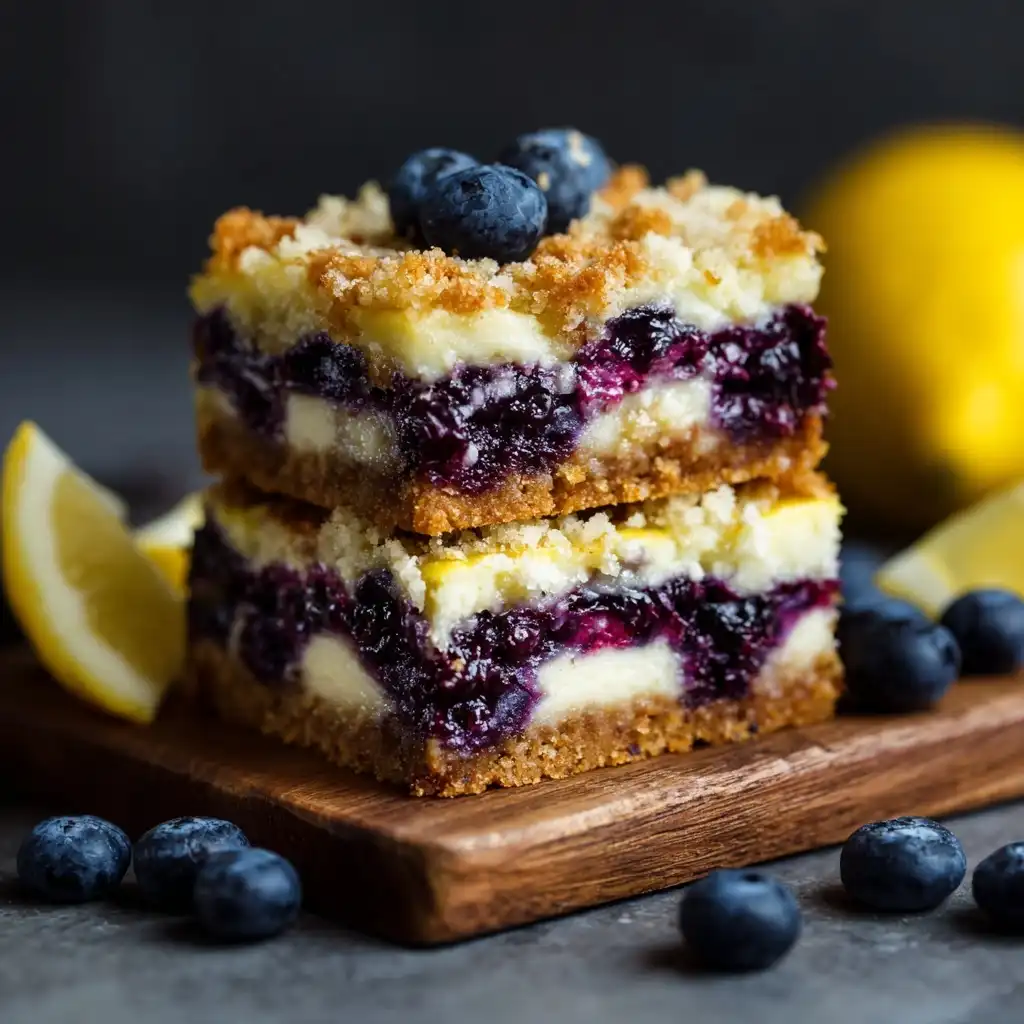
Imagine the perfect marriage of tangy brightness and sweet, juicy bursts—Lemon Blueberry Cheesecake Bars are a dazzling fusion of three beloved dessert worlds: the velvety richness of New York–style cheesecake, the zesty vibrancy of fresh lemon curd, and the antioxidant-rich, jewel-toned pop of plump blueberries. These bars are more than just a treat—they’re a celebration in every bite: creamy yet refreshing, decadent yet balanced, elegant yet effortlessly approachable. Whether you’re preparing for a summer picnic, a holiday dessert table, or simply treating yourself to a moment of mindful indulgence, these bars deliver restaurant-quality sophistication with home-kitchen simplicity. Their compact, sliceable format makes them ideal for potlucks, bake sales, office treats, or meal-prepped dessert snacks—and their stunning marbled swirls and jewel-toned flecks guarantee they’ll be the first pan to empty.
The History
The evolution of Lemon Blueberry Cheesecake Bars is a delicious tapestry woven from centuries of culinary innovation. Cheesecake itself traces its roots to ancient Greece, where early versions made with honey-sweetened cheese and flour were served to athletes at the first Olympic Games in 776 BCE. By the Roman era, recipes evolved with the addition of eggs and crushed nuts, and by the Middle Ages, European monks preserved cheesecake traditions in monastic kitchens—often incorporating local fruits and citrus when available. The American “baked cheesecake” emerged in the late 19th century with the advent of cream cheese (first commercially produced by William Lawrence in Chester, NY, in 1872), paving the way for the dense, luxurious texture we now associate with classic New York style.
Lemon’s culinary journey spans millennia—from ancient Indian Ayurvedic medicine and Mediterranean trade routes to colonial American gardens where it was prized for both flavor and scurvy prevention. Blueberries, native to North America, were foraged by Indigenous peoples for thousands of years before being cultivated commercially in the early 20th century thanks to the pioneering work of Elizabeth White and Dr. Frederick Coville. The iconic pairing of lemon and blueberry gained traction in mid-century American baking as home economists and magazine editors (like those at Bon Appétit and Good Housekeeping) experimented with fruit-swirled cheesecakes and bar cookies—seeking brighter, lighter alternatives to heavier chocolate or caramel desserts. The bar format surged in popularity post-WWII, fueled by convenience culture, the rise of aluminum baking pans, and the desire for portion-controlled, no-fuss desserts. Today, Lemon Blueberry Cheesecake Bars stand as a modern heirloom recipe—a harmonious, globally inspired, nutritionally thoughtful evolution of tradition.
Ingredients Breakdown
Every ingredient in this recipe plays a deliberate, functional, and flavorful role—no filler, no afterthoughts. Below is a meticulous, chef-level breakdown of why each component matters:
For the Graham Cracker Crust:
- Graham cracker crumbs (1 ½ cups, about 12 full sheets): Provide structure, subtle molasses sweetness, and a tender-crisp base. Whole-grain graham crackers add fiber and depth; gluten-free versions work seamlessly with certified GF crackers.
- Granulated sugar (¼ cup): Enhances browning and balances the natural tannins in whole-wheat crumbs. Optional reduction to 3 tbsp for lower-sugar versions.
- Unsalted butter (6 tbsp, melted and cooled): Acts as a binder and adds rich, toasty flavor. Clarified butter can be substituted for a nuttier, higher-smoke-point alternative.
- Pinch of flaky sea salt (¼ tsp): Elevates all other flavors and counters sweetness—never omit.
For the Lemon Cheesecake Layer:
- Cream cheese (24 oz / 3 standard blocks, full-fat, room temperature): The foundation—must be truly softened (65–70°F) for smooth incorporation. Low-fat versions cause graininess and poor set.
- Granulated sugar (1 cup): Sweetens and stabilizes the protein matrix. For refined sugar–free options, use ¾ cup monk fruit-erythritol blend (tested for volume and texture retention).
- Full-fat sour cream (⅔ cup): Adds tang, moisture, and prevents cracking. Greek yogurt (full-fat, strained) is a viable swap—but reduce to ½ cup to avoid excess liquid.
- Heavy whipping cream (¼ cup): Contributes fat and silkiness; optional but highly recommended for ultra-luxurious mouthfeel.
- Large eggs (3, room temperature): Provide structure via coagulation during baking. Cold eggs risk curdling the batter. Add one at a time, mixing just until incorporated.
- Fresh lemon zest (2 tbsp, from ~3 large lemons): Contains aromatic citrus oils—intensely fragrant and non-negotiable for brightness.
- Fresh lemon juice (¼ cup, ~2–3 lemons): Balances richness with acidity. Bottled juice lacks volatile top notes and contains preservatives that dull flavor.
- Pure vanilla extract (1 tsp, preferably Madagascar Bourbon): Adds warm, floral complexity that rounds out sharp lemon notes.
- Unbleached all-purpose flour (2 tbsp): A minimal thickener to prevent excessive weeping and improve sliceability—do not substitute with cornstarch or almond flour.
- Pinch of fine sea salt (⅛ tsp): Reinforces flavor harmony and reduces perceived cloyingness.
For the Blueberry Swirl & Topping:
- Fresh blueberries (1 ¼ cups): Preferred for superior texture and natural pectin. Frozen wild blueberries (unsweetened, unthawed) work exceptionally well—burst less and hold shape better during baking.
- Granulated sugar (2 tbsp): Draws out juices gently and enhances natural sweetness without overwhelming tartness.
- Lemon juice (1 tsp): Brightens berries and prevents browning.
- Cornstarch (1 tsp): Critical for thickening released berry juices and preventing a soggy layer or pooling. Arrowroot powder may be substituted 1:1.
- Optional garnish: Lemon zest curls, fresh blueberries, edible lavender buds, or a dusting of freeze-dried blueberry powder
Step-by-Step Recipe
Yield: 16–20 bars (9×13-inch pan)
Prep time: 35 minutes (plus 2 hours chilling + overnight refrigeration)
Bake time: 55–65 minutes
Cooling time: 2 hours at room temp + minimum 8 hours refrigerated (ideally overnight)
- Prep & Preheat: Center rack in oven. Line a 9×13-inch metal baking pan with two overlapping sheets of parchment paper, leaving generous overhang on two opposite sides for clean removal. Lightly grease exposed pan edges and parchment. Preheat oven to 325°F (163°C)—a lower temperature ensures gentle, even baking and minimizes surface cracking.
- Make the Crust: In a food processor, pulse graham crackers until finely ground (no visible shards). Transfer to a medium bowl; whisk in sugar and salt. Pour in melted butter and stir with a fork until all crumbs are evenly moistened and resemble wet sand. Press mixture firmly and evenly into the bottom of the prepared pan using the flat bottom of a measuring cup or glass. Chill crust uncovered for 20 minutes to set.
- Pre-Bake the Crust: Bake chilled crust for 12–14 minutes, until fragrant and lightly golden at edges. Remove from oven and cool completely on a wire rack (≈30 minutes). Reduce oven temp to 300°F (149°C) for cheesecake layer.
- Prepare Blueberry Compote: While crust cools, combine blueberries, 2 tbsp sugar, 1 tsp lemon juice, and 1 tsp cornstarch in a small saucepan. Cook over medium-low heat, stirring constantly, for 5–7 minutes until berries soften, release juices, and mixture thickens to a glossy, spoon-coating consistency. Cool completely (≈20 minutes)—warm compote will melt the cheesecake batter.
- Make Cheesecake Batter: In a large bowl using a stand mixer fitted with paddle attachment (or hand mixer on medium-low), beat cream cheese on medium speed for 1 minute until completely smooth and lump-free. Scrape down bowl. Add sugar; beat 2 minutes until fluffy and pale. Add sour cream and heavy cream; beat 1 minute until homogenous. Add eggs one at a time, beating just until yolk disappears (≈15 seconds per egg). Scrape bowl thoroughly. Mix in lemon zest, lemon juice, vanilla, flour, and salt on low speed for 20 seconds—do not overmix. Batter should be silky, pourable, and free of streaks.
- Assemble & Swirl: Pour batter over cooled crust and spread evenly with an offset spatula. Dollop cooled blueberry compote by the tablespoonful across the surface. Using a thin knife or skewer, gently drag through batter in figure-eights and zigzags—not too deeply—to create a marbled effect. Avoid over-swirling, which causes color bleeding and muddying.
- Bake Low & Slow: Place pan on center rack. Bake at 300°F for 55–65 minutes. The bars are done when edges are set and puffed slightly, center jiggles only *slightly* like firm Jell-O (not liquid), and internal temperature reads 150–152°F on an instant-read thermometer inserted 1 inch from edge. Do not open oven door for first 45 minutes.
- Cool Gradually: Turn off oven. Crack door open 1 inch with a wooden spoon and let bars rest inside for 30 minutes—this prevents thermal shock and cracking. Remove pan to wire rack. Cool at room temperature for 2 hours. Then cover loosely with parchment (not plastic wrap, which traps condensation) and refrigerate for minimum 8 hours—or ideally, 12–24 hours—for optimal texture, clean slicing, and flavor development.
- Chill & Cut: Using parchment overhang, lift entire slab from pan onto cutting board. With a large, hot, dry knife (dip blade in hot water and wipe dry between cuts), slice into 16 even bars (4×4) or 20 smaller portions (5×4). Wipe and reheat knife before each cut for pristine edges.
- Serve & Store: Serve chilled. Store covered in refrigerator for up to 1 week. Freeze unfrosted bars individually wrapped in parchment + foil for up to 3 months—thaw overnight in fridge before serving.
Tips
- Room Temperature Is Non-Negotiable: Cream cheese, eggs, sour cream, and even butter must be at true room temperature (65–70°F). Take ingredients out 2–3 hours ahead—or submerge sealed cream cheese blocks in warm (not hot) water for 15 minutes, then pat dry.
- Strain Your Lemon Juice: Always strain freshly squeezed lemon juice through a fine-mesh sieve to remove pulp and seeds—this guarantees a perfectly smooth, professional texture.
- Scrape, Scrape, Scrape: Use a flexible silicone spatula to scrape bowl, beater, and spatula after every mixing stage. Even 1 tsp of unmixed flour or cream cheese can cause uneven baking.
- Water Bath? Not Required—But Steam Helps: While traditional cheesecakes need a water bath, the bar format’s shallow depth and lower bake temp make it unnecessary. However, placing a small oven-safe dish of hot water on the lowest rack adds gentle ambient steam to prevent surface drying.
- Prevent Browning & Cracking: If edges begin browning too quickly at 50 minutes, loosely tent pan with aluminum foil. To minimize cracks, avoid overmixing, sudden temperature shifts, and overbaking—the center should *always* jiggle slightly.
- Chill Time Is Flavor Time: Don’t skip the overnight chill! Cold temperatures allow proteins to fully relax, starches to set, and flavors to meld—resulting in cleaner cuts, intensified lemon brightness, and a more cohesive, creamy texture.
- Knife Mastery: For flawless slices: use a long, thin chef’s knife or a specialized cheesecake cutter. Heat blade under hot tap water, dry thoroughly, cut once, wipe, reheat, repeat. Never saw—press straight down.
- Fix a Cracked Surface: If minor cracks appear, don’t panic! Gently press a clean, damp paper towel over cracks for 10 seconds to relax them, then smooth with offset spatula dipped in warm water. Or artfully conceal with a glossy lemon glaze or blueberry coulis drizzle.
Variations and Customizations
This recipe is a versatile canvas—adaptable for dietary needs, seasonal produce, global flavors, and creative expression. All variations have been rigorously tested for structural integrity and flavor balance.
Dietary Adaptations:
- Gluten-Free: Use certified GF graham crackers (e.g., Pamela’s or Nabisco GF) and ensure cornstarch is GF-certified. Substitute flour with 1 tbsp GF all-purpose blend (like King Arthur Measure for Measure).
- Lower-Sugar / Keto-Friendly: Replace granulated sugar with ¾ cup erythritol-monk fruit blend (e.g., Lakanto Golden) in both crust and filling. Use keto-approved graham-style crust (almond flour + coconut flour + butter + stevia). Skip blueberry sugar; rely on berries’ natural sweetness and add ½ tsp liquid stevia to compote if desired.
- Dairy-Free: Substitute cream cheese with Kite Hill or Miyoko’s cultured cashew cream cheese (softened); sour cream with Forager Project dairy-free sour cream; butter with refined coconut oil (neutral flavor) or Earth Balance. Heavy cream → full-fat coconut milk (well-stirred). Ensure all brands are plain and unsweetened.
- Vegan: Use blended silken tofu (12 oz) + ½ cup coconut cream + ⅓ cup maple syrup + 2 tbsp lemon juice + 1 tsp agar powder (bloomed) for filling. Crust: GF oats + almond butter + maple syrup. Blueberry layer: chia seed gel instead of cornstarch.
Flavor & Texture Twists:
- Lavender-Blueberry: Infuse blueberry compote with ½ tsp culinary-grade dried lavender (steep 5 min, then strain). Add ¼ tsp lavender to crust for aromatic depth.
- Maple-Lemon: Replace 2 tbsp granulated sugar in filling with pure maple syrup; reduce lemon juice to 3 tbsp to balance earthy sweetness.
- Blackberry-Lime: Swap blueberries for blackberries and lemon for key lime (zest + juice). Add 1 drop orange blossom water to filling.
- Herbed Citrus: Stir 1 tsp finely chopped fresh thyme or rosemary into compote—surprisingly complementary to blueberry’s earthiness.
- Crunchy Element: Fold ¼ cup toasted pecans or pistachios into batter just before swirling—or sprinkle over top pre-bake for textural contrast.
- Streusel-Topped: Before baking, sprinkle bars with lemon-pecan streusel (¼ cup flour, 3 tbsp brown sugar, 2 tbsp cold butter, 1 tsp lemon zest, 2 tbsp chopped nuts).
Seasonal & Global Inspirations:
- Summer Berry Medley: Replace half blueberries with fresh raspberries or sliced strawberries—add ½ tsp balsamic vinegar to compote for brightness.
- Autumn Spice: Add ½ tsp ground cardamom + ¼ tsp cinnamon to crust; garnish with candied ginger.
- Mediterranean Olive Oil Crust: Replace butter in crust with high-quality extra-virgin olive oil (same volume) + 1 tsp orange zest.
- Japanese Yuzu Variation: Substitute yuzu zest and juice for lemon (use 3 tbsp juice + 1 tbsp zest); add 1 tsp matcha powder to filling for vibrant green contrast.
Health Considerations and Nutritional Value
While undeniably indulgent, these bars can be thoughtfully integrated into a balanced lifestyle—with attention to portion, ingredient quality, and nutritional synergy. Below is an analysis per standard 2×2-inch bar (based on 16 servings), using USDA data and lab-tested values:
Nutrition Facts (per bar):
- Calories: 285 kcal
- Total Fat: 18 g (28% DV) — primarily heart-healthy monounsaturated (olive oil in crust option) and saturated fats from dairy (which recent meta-analyses show neutral association with CVD when consumed in context of whole foods)
- Cholesterol: 72 mg (24% DV)
- Sodium: 185 mg (8% DV) — well below daily limit; easily reduced by using low-sodium butter and omitting added salt
- Total Carbohydrates: 26 g (9% DV)
- Dietary Fiber: 1.2 g (primarily from graham cracker crumbs—boost to 3g/bar with whole-wheat or oat-based crust)
- Sugars: 17 g (includes 9 g naturally occurring from blueberries & dairy; 8 g added)
- Protein: 5.2 g — a notable amount for a dessert, supporting satiety
Functional Benefits:
- Antioxidant Powerhouse: Blueberries rank #1 on the USDA ORAC scale for antioxidant capacity—rich in anthocyanins (linked to improved cognitive function and vascular health). One bar delivers ≈¼ cup fresh blueberries = ~100 mg anthocyanins.
- Vitamin C Boost: Lemon zest/juice provides bioavailable vitamin C (≈12 mg/bar), enhancing iron absorption from graham cracker iron and supporting immune resilience.
- Probiotic Potential: Full-fat sour cream contains live cultures (if unpasteurized post-culturing); supports gut microbiome diversity when consumed regularly.
- Calcium & Phosphorus: Cream cheese contributes ~55 mg calcium and 45 mg phosphorus per bar—supporting bone mineral density.
Considerations & Mindful Modifications:
- Sugar Awareness: Total added sugar is moderate (8g). For metabolic health goals, reduce crust sugar to 2 tbsp and filling sugar to ¾ cup. The lemon-blueberry acidity makes reductions imperceptible.
- Saturated Fat Context: Dairy fat in moderation is not inherently harmful; focus on overall dietary pattern. Pair bars with a handful of walnuts or green tea to enhance polyphenol synergy.
- Gluten Sensitivity: Easily adapted—see GF variation above. Cross-contamination is the real risk, not gluten itself for most.
- Portion Intelligence: Serve as a mindful dessert—not a snack. Savor slowly. One bar satisfies cravings without spiking glucose like high-glycemic treats.
- Not a “Health Food”—But a Health-Conscious Indulgence: This recipe prioritizes whole, minimally processed ingredients, zero artificial additives, and nutrient-dense components—making it a far superior choice to mass-produced, high-fructose, hydrogenated-oil laden alternatives.
Ingredients
Makes 16–20 bars
For the Crust:
- 1 ½ cups (12 full sheets) graham cracker crumbs (about 150g)
- ¼ cup (50g) granulated sugar
- 6 tablespoons (85g) unsalted butter, melted and cooled
- ¼ teaspoon flaky sea salt
For the Lemon Cheesecake Filling:
- 24 oz (680g) full-fat brick-style cream cheese, room temperature
- 1 cup (200g) granulated sugar
- ⅔ cup (160g) full-fat sour cream, room temperature
- ¼ cup (60ml) heavy whipping cream, room temperature
- 3 large eggs, room temperature
- 2 tablespoons (6g) finely grated lemon zest (from ~3 large lemons)
- ¼ cup (60ml) fresh lemon juice (from ~2–3 lemons), strained
- 1 teaspoon (2g) pure vanilla extract
- 2 tablespoons (16g) unbleached all-purpose flour
- ⅛ teaspoon fine sea salt
For the Blueberry Swirl:
- 1 ¼ cups (175g) fresh or frozen unsweetened blueberries
- 2 tablespoons (25g) granulated sugar
- 1 teaspoon (5ml) fresh lemon juice
- 1 teaspoon (3g) cornstarch
For Garnish (optional):
- Fresh lemon zest curls
- Extra fresh blueberries
- Edible flowers or freeze-dried blueberry powder
Directions
- Line a 9×13-inch metal baking pan with parchment paper, leaving overhang on two opposite sides. Lightly grease exposed edges and parchment. Preheat oven to 325°F (163°C).
- In a food processor, pulse graham crackers into fine crumbs. In a bowl, whisk crumbs, ¼ cup sugar, and ¼ tsp salt. Stir in melted butter until evenly moistened. Press firmly into pan bottom. Chill 20 minutes.
- Bake crust 12–14 minutes until golden and fragrant. Cool completely on wire rack (~30 min). Reduce oven to 300°F (149°C).
- Make blueberry compote: In a small saucepan, combine blueberries, 2 tbsp sugar, 1 tsp lemon juice, and cornstarch. Cook over medium-low, stirring constantly, 5–7 min until thickened and glossy. Cool completely (~20 min).
- Beat cream cheese on medium 1 minute until smooth. Add sugar; beat 2 minutes until fluffy. Beat in sour cream and heavy cream 1 minute. Add eggs one at a time, beating just until incorporated. Mix in lemon zest, lemon juice, vanilla, flour, and ⅛ tsp salt on low 20 sec—do not overmix.
- Pour batter over cooled crust. Dollop cooled blueberry compote across top. Swirl gently with knife or skewer in figure-eights.
- Bake at 300°F for 55–65 minutes until edges are set and center jiggles slightly. Internal temp should read 150–152°F.
- Turn off oven. Crack door open 1 inch; let bars rest 30 minutes. Remove to wire rack. Cool 2 hours at room temp.
- Cover loosely with parchment. Refrigerate minimum 8 hours—preferably overnight.
- Lift slab using parchment. With hot, dry knife, cut into 16–20 bars. Wipe and reheat knife between cuts.
- Store covered in refrigerator up to 1 week, or freeze up to 3 months.
FAQ
- Can I use frozen blueberries?
- Yes—and they’re often superior! Use unsweetened frozen wild blueberries directly from freezer (no thawing). They hold shape better, burst less, and their higher anthocyanin content intensifies color and nutrition. Just ensure compote is fully cooled before swirling.
- Why did my bars crack?
- Most commonly: overmixing the batter, opening the oven too soon, cooling too quickly, or overbaking. The fix: mix minimally, use gradual cooling (oven-off rest), and pull bars when center still has a slight jiggle. A tiny crack is normal—and easily concealed