Introduction
Baked French Toast Casserole is the ultimate brunch hero — a rich, comforting, make-ahead dish that transforms humble pantry staples into a decadent, crowd-pleasing centerpiece. Unlike traditional stovetop French toast, this oven-baked version delivers unparalleled consistency: golden-brown edges with a custardy, tender interior, layered with warm spices, vanilla sweetness, and deep caramelized notes. It’s beloved for its versatility (easily adapted for dietary preferences), forgiving prep window (can be assembled the night before), and remarkable scalability — equally at home on a cozy Sunday morning or served to 25 guests at a holiday gathering. Whether you’re feeding sleepy teenagers, impressing in-laws, or seeking a stress-free solution for overnight guests, this casserole checks every box: indulgent yet approachable, elegant yet unfussy, nostalgic yet endlessly reinventable.
The History
The origins of French toast itself stretch back over two millennia — ancient Romans prepared a similar dish called *Pan Dulcis*, soaking stale bread in milk and eggs before frying it, as documented in the 1st-century Roman cookbook *Apicius*. In medieval Europe, resourceful cooks repurposed day-old or hardened loaves into “lost bread” (*pain perdu* in French), a frugal tradition rooted in minimizing waste. The concept crossed the Atlantic with European settlers, evolving regionally across the U.S. — from Southern cornbread-based versions to New England maple-kissed iterations. The casserole format, however, emerged more recently, gaining traction in mid-20th-century American home economics and community cookbooks. Its rise coincided with the postwar proliferation of casseroles — dishes prized for convenience, economy, and communal appeal. Magazines like *Better Homes & Gardens* and church-published recipe collections popularized the baked version in the 1950s and ’60s, touting its “overnight magic” and hands-off baking. Today, Baked French Toast Casserole stands as a modern heirloom: honoring centuries-old ingenuity while embracing contemporary lifestyles — proof that the most enduring recipes are those that balance tradition with thoughtful adaptation.
Ingredients Breakdown
Understanding each ingredient’s role elevates both flavor and texture — this isn’t just a list; it’s a carefully orchestrated system:
- Bread (8–10 cups cubed): The foundation. Stale, dense, high-quality bread is ideal — brioche, challah, French baguette, or sourdough provide structure and absorbency without disintegrating. Fresh bread turns mushy; overly dry bread yields crumbly results. Day-old is perfect — lightly toasted cubes enhance integrity.
- Eggs (8 large): The binding agent and primary source of richness and lift. Egg yolks contribute creaminess and emulsification; whites add lightness and set the custard. Room-temperature eggs incorporate more smoothly and reduce curdling risk.
- Milk (2½ cups whole or 2%): Adds moisture and tenderness. Whole milk provides optimal fat for richness and browning; 2% works well for lighter versions. Avoid skim — insufficient fat leads to rubbery texture and poor browning.
- Heavy Cream (½ cup): The secret luxury ingredient. Its high fat content (36–40%) ensures an ultra-creamy, velvety custard, promotes deep golden browning, and prevents drying during baking. Substitutes like half-and-half or evaporated milk work but yield less opulence.
- Granulated Sugar (⅔ cup): Sweetens the custard base and aids in caramelization. Adjust slightly based on bread sweetness (e.g., reduce by 1–2 tbsp for brioche).
- Brown Sugar (¼ cup, packed): Adds molasses depth, moisture retention, and complex caramel notes — essential for that signature warm, toasty aroma. Light or dark both work; dark intensifies flavor.
- Pure Vanilla Extract (2 tbsp): Not imitation — real Madagascar or Tahitian vanilla provides floral, woody, and sweet nuances that elevate the entire dish. Alcohol content helps carry flavor evenly.
- Ground Cinnamon (1½ tsp): Warm, aromatic backbone. Freshly ground offers superior potency versus pre-ground. Pair with a pinch of freshly grated nutmeg (⅛ tsp) for dimensional warmth.
- Salt (1 tsp fine sea salt): Critical for balancing sweetness and enhancing all other flavors. Don’t omit — it prevents cloyingness and sharpens spice perception.
- Butter (½ cup, unsalted, melted): For greasing the dish and brushing over the top layer pre-bake. Unsalted allows precise sodium control. Clarified butter or ghee adds nutty complexity.
Optional but highly recommended enhancements: A splash (1 tsp) of pure almond extract for marzipan-like nuance; 1 tbsp bourbon or rum for sophisticated depth (alcohol bakes off); a pinch of cardamom or ginger for intrigue.
Step-by-Step Recipe
- Prep the Bread (Day Before or Morning Of): Cut 1 loaf (16–20 oz) of sturdy bread into 1-inch cubes (approx. 8–10 cups). Spread evenly on baking sheets. Dry at room temperature for 8–12 hours (ideal) OR bake at 300°F for 15–20 minutes until dry but not browned. Cool completely.
- Assemble the Custard Base: In a large mixing bowl, whisk together eggs, granulated sugar, brown sugar, salt, cinnamon, and nutmeg until fully dissolved and slightly frothy (2 min). Gradually whisk in milk, heavy cream, vanilla, and any optional extracts (almond, bourbon) until smooth and homogenous. Avoid over-whisking to prevent excess air bubbles.
- Layer the Casserole Dish: Generously butter a 9×13-inch baking dish (or 3-quart oval casserole). Arrange half the bread cubes in an even layer. Pour half the custard mixture over top, gently pressing down with a spatula to ensure full saturation. Repeat with remaining bread and custard. Let sit 5 minutes, then gently press again to submerge any floating pieces.
- Refrigerate Overnight (Essential Step): Cover tightly with plastic wrap, pressing it directly onto the surface to prevent drying. Refrigerate for *at least 8 hours, ideally 12–16 hours*. This slow absorption allows custard to fully penetrate every crumb, resulting in uniform tenderness and preventing soggy centers or dry edges.
- Preheat & Prep for Baking: Remove casserole from fridge 30 minutes before baking. Preheat oven to 350°F (convection bake at 325°F). Melt remaining 2 tbsp butter. Brush or drizzle evenly over the top layer of soaked bread.
- Bake to Perfection: Place dish on a parchment-lined or foil-lined baking sheet (to catch potential drips). Bake uncovered for 45–55 minutes. Rotate pan halfway through. It’s done when the center is puffed and set (no liquid jiggle), edges are deeply golden and crisp, and internal temperature reaches 160°F on an instant-read thermometer. A toothpick inserted 1 inch from edge should come out clean; near center, it may have slight moist crumbs (not wet batter).
- Rest and Serve: Let rest for 10–15 minutes before slicing. This allows residual heat to finish cooking the center and lets custard reabsorb, yielding cleaner cuts and richer texture. Serve warm, never piping hot.
Tips
- Bread Selection is Non-Negotiable: Choose bread with tight crumb and moderate density. Brioche adds buttery richness; challah offers eggy sweetness; sourdough lends pleasant tang and chew. Avoid soft sandwich bread (too fragile) or very porous artisan loaves (soaks unevenly).
- Don’t Skip the Drying Step: Even “stale” bread benefits from intentional drying. Moisture control is key — too much water = mush; too little = dryness. Oven-drying gives consistent results.
- Custard Temperature Matters: Use room-temp eggs and dairy. Cold ingredients cause the melted butter in the custard to seize into tiny solids, creating graininess.
- Press, Don’t Stir: After layering, use a flat spatula or your hands to gently press down — this encourages absorption without breaking cubes. Never stir or flip; you’ll destroy the layered structure.
- Chill Time is Sacred: Less than 8 hours = under-saturated, uneven texture. More than 24 hours risks oversaturation and loss of distinct cube identity (though still delicious!).
- Golden Edge Hack: For extra-crispy, caramelized edges, increase oven temp to 425°F for the final 5–7 minutes — watch closely to prevent burning.
- Check Doneness Accurately: Visual cues (golden color, puffed center) are helpful, but an instant-read thermometer is foolproof. Underbaked = eggy; overbaked = rubbery and dry.
- Resting is Part of the Recipe: Cutting too soon releases steam and custard, making slices sloppy. That 10-minute pause transforms texture.
- Make-Ahead Mastery: Assemble and refrigerate up to 24 hours. Freeze unbaked casserole (tightly wrapped) for up to 3 months — thaw overnight in fridge before baking (add 5–10 min to bake time).
- Reheating Right: Individual portions: microwave 45–60 sec covered. Whole casserole: 325°F oven, covered with foil, 20–25 min until warmed through. Avoid repeated reheating — texture degrades.
Variations and Customizations
This casserole is a canvas — here’s how to reimagine it for every palate and occasion:
Dietary Adaptations
- Gluten-Free: Use certified GF brioche or challah-style bread (like Schar or Canyon Bakehouse). Ensure all extracts and sugars are GF-certified. Add 1 tsp xanthan gum to custard for binding if needed.
- Dairy-Free: Substitute full-fat coconut milk (canned, shaken well) for milk + cream combo. Use dairy-free butter for greasing/brushing. Nutritional yeast (1 tsp) adds subtle umami depth.
- Vegan: Replace eggs with flax “eggs” (8 tbsp ground flax + 20 tbsp warm water, rested 10 min) + ¼ cup silken tofu (blended smooth) for richness. Use plant milks and vegan butter. Increase cinnamon and vanilla to compensate for egg’s flavor contribution.
- Lower-Sugar: Reduce granulated sugar to ⅓ cup; keep brown sugar for moisture. Use monk fruit or erythritol blends (1:1 ratio). Add 1 mashed ripe banana or ¼ cup unsweetened applesauce for natural sweetness and binding.
Flavor & Texture Twists
- Fruit-Infused: Fold 2 cups fresh or frozen berries (tossed in 1 tbsp cornstarch), sliced apples (tossed in lemon juice + 1 tsp cinnamon), or pitted cherries into the bottom bread layer before pouring custard.
- Nutty & Crunchy: Press 1 cup toasted pecans, walnuts, or sliced almonds into the top layer before baking. Or mix ½ cup chopped nuts into the custard.
- Chocolate Lover’s: Layer 1 cup chocolate chips (semi-sweet or dark) or chopped chocolate bars between bread layers. Sprinkle cocoa powder (1 tbsp) into custard for deeper mocha notes.
- Maple-Pecan Swirl: Whisk ⅓ cup pure maple syrup + ¼ cup melted butter + 1 tsp cinnamon into custard. Top with maple-glazed pecans (toasted pecans tossed in 2 tbsp maple syrup + pinch salt) in last 10 minutes of baking.
- Savory-Sweet (Brunch Innovation): Omit sugar and vanilla. Add 1 tsp black pepper, ½ tsp smoked paprika, 2 tbsp grated Gruyère, and ¼ cup crumbled cooked bacon to custard. Top with chives.
Global Inspirations
- Chai-Spiced: Steep 3 chai tea bags in warm milk for 5 min, cool, then strain into custard. Add ½ tsp ginger, ¼ tsp cardamom, pinch cloves.
- Coconut-Lime: Replace milk/cream with full-fat coconut milk. Add zest of 1 lime + 1 tsp lime juice to custard. Top with toasted coconut flakes.
- Italian Rum Baba Style: Soak bread cubes in ¼ cup dark rum + 2 tbsp orange liqueur before layering. Add orange zest to custard. Dust with powdered sugar and orange segments.
Health Considerations and Nutritional Value
A single 1-cup serving (approx. 300g) of classic Baked French Toast Casserole contains roughly:
- Calories: 420–480 kcal
- Protein: 14–16g (from eggs, dairy, bread)
- Total Fat: 22–26g (13–15g saturated — primarily from eggs, butter, cream)
- Carbohydrates: 42–48g (28–32g sugars — natural lactose + added sucrose/maltose)
- Fiber: 1–2g (low unless using whole-grain bread)
- Key Micronutrients: Excellent source of Vitamin D (from eggs, fortified milk), Riboflavin (B2), Choline (brain health), Calcium, and Selenium.
Health-Conscious Strategies:
- Boost Protein & Fiber: Use whole-grain or sprouted grain bread (adds 3–5g fiber/serving). Add 2 tbsp chia or flax seeds to custard.
- Reduce Saturated Fat: Substitute 1 cup milk for unsweetened almond or oat milk; use ¼ cup heavy cream + ¼ cup Greek yogurt (full-fat) for creaminess with less saturated fat.
- Manage Blood Sugar: Opt for lower-glycemic sweeteners (allulose, tagatose) and pair servings with protein-rich sides (turkey sausage, Greek yogurt) to slow glucose absorption.
- Allergen Awareness: Contains major allergens: eggs, dairy, wheat (gluten), tree nuts (if added). Always label clearly for guests.
- Mindful Indulgence: This is inherently a treat food — enjoy intentionally. Portion control (¾ cup vs. 1¼ cup) and balancing with vegetable-forward sides (roasted tomatoes, sautéed spinach, arugula salad) supports overall dietary harmony.
Note: Nutritional values vary significantly based on bread type, dairy choices, sugar amount, and add-ins. For precise tracking, calculate using your exact ingredients via tools like Cronometer or MyFitnessPal.
Ingredients
- 1 (16–20 oz) loaf day-old brioche, challah, or French bread, cut into 1-inch cubes (8–10 cups)
- 8 large eggs, room temperature
- ⅔ cup granulated sugar
- ¼ cup packed light or dark brown sugar
- 1 teaspoon fine sea salt
- 1½ teaspoons ground cinnamon
- ⅛ teaspoon freshly grated nutmeg (optional but recommended)
- 2½ cups whole milk or 2% milk
- ½ cup heavy cream
- 2 tablespoons pure vanilla extract
- ½ cup unsalted butter, melted (plus extra for greasing)
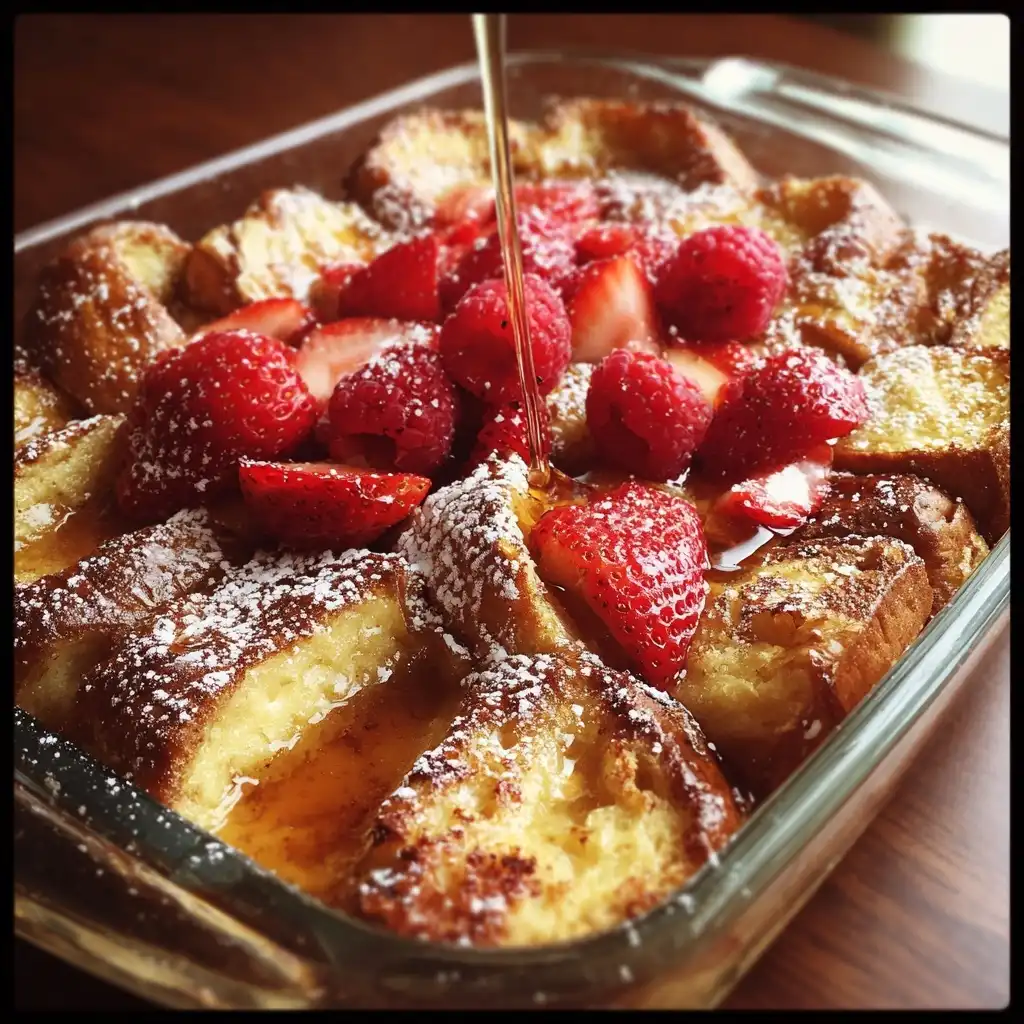
- Maple syrup, powdered sugar, fresh berries, whipped cream, or yogurt for serving
Directions
- Preheat oven to 350°F (175°C). Generously butter a 9×13-inch (or 3-quart) baking dish.
- In a large bowl, whisk eggs, granulated sugar, brown sugar, salt, cinnamon, and nutmeg until smooth and slightly frothy (about 2 minutes).
- Gradually whisk in milk, heavy cream, and vanilla extract until fully combined and no streaks remain.
- Arrange half the bread cubes in an even layer in the prepared dish. Pour half the custard mixture over the bread, then gently press down with a spatula to saturate. Repeat with remaining bread and custard.
- Cover tightly with plastic wrap, pressing it directly onto the surface. Refrigerate for at least 8 hours or up to 16 hours.
- Remove casserole from refrigerator 30 minutes before baking. Preheat oven to 350°F. Brush or drizzle melted butter evenly over the top layer.
- Bake uncovered for 45–55 minutes, rotating pan halfway through, until puffed, golden brown, and set in the center (internal temperature 160°F; toothpick inserted near center comes out with moist crumbs, not wet batter).
- Let rest for 10–15 minutes before slicing into squares or rectangles. Serve warm with desired toppings.
FAQ
- Can I use fresh bread instead of stale?
- Yes, but it requires modification: lightly toast cubes at 300°F for 12–15 minutes until dry but pale. Fresh bread absorbs custard too quickly and can become gummy without proper drying.
- Why does my casserole have soggy spots?
- Most commonly caused by insufficient chilling time (<8 hours), using overly moist bread, or not pressing the layers to ensure full saturation. Also check oven calibration — underbaking leaves pockets of uncooked custard.
- Can I prepare this without eggs?
- Absolutely — see the Vegan variation above. Flax eggs + silken tofu create a surprisingly cohesive, rich custard, though texture will be slightly denser and less airy than traditional.
- How do I prevent the top from burning before the center is done?
- Cover loosely with foil for the first 30 minutes of baking, then remove for the final 15–25 minutes to allow browning. Also ensure your oven rack is centered — too close to the top element causes scorching.
- Can I double the recipe?
- Yes — use two 9×13-inch dishes or one 12×17-inch roasting pan. Increase bake time by 5–10 minutes and check doneness with a thermometer. Avoid overcrowding in one oversized pan — it steams instead of bakes.
- What’s the best way to store leftovers?
- Cool completely, cover tightly, and refrigerate for up to 4 days. Reheat individual portions in the microwave (45–60 sec, covered) or oven (325°F, covered with foil, 15–20 min). Freezing is possible for up to 3 months — thaw overnight in fridge before reheating.
- Is it safe to leave the custard-soaked casserole in the fridge for 24 hours?
- Yes — the combination of sugar, salt, and acidity from dairy creates an environment where harmful bacteria struggle to proliferate within this timeframe. However, 12–16 hours is the flavor and texture sweet spot; beyond 24 hours, bread may start to break down excessively.
- Can I add fruit the night before?
- Fresh berries release juice and can make the bottom layer watery. Best practice: fold in frozen berries (unthawed) or gently layer fresh fruit *just before baking*, not during assembly. Apples and pears hold up better overnight if tossed in lemon juice and cornstarch.
- Why does my casserole taste eggy?
- Often due to insufficient vanilla or spices, or using older eggs. Boost flavor with extra 1 tsp vanilla, ½ tsp almond extract, or a pinch of cardamom. Ensure eggs are fresh and well-incorporated — lumps in the custard can cause uneven flavor distribution.
- Can I make this in a slow cooker?
- Not recommended — the slow, moist heat prevents proper browning and results in a dense, steamed texture rather than the signature custardy-yet-crisp contrast. Stick to the oven for authentic results.
Summary
Baked French Toast Casserole is a timeless, versatile, and deeply satisfying brunch masterpiece — born from centuries-old frugality, perfected through mid-century American ingenuity, and endlessly adaptable to modern tastes and dietary needs. With its luscious custard-soaked bread, golden caramelized crust, and warm spice perfume, it transforms simple ingredients into an unforgettable, stress-free centerpiece that nourishes both body and soul.
Whether made ahead for effortless entertaining, customized for allergies or health goals, or elevated with seasonal fruits and global spices, this casserole endures because it honors tradition while inviting creativity — a true testament to the power of humble, heartfelt cooking.