Introduction
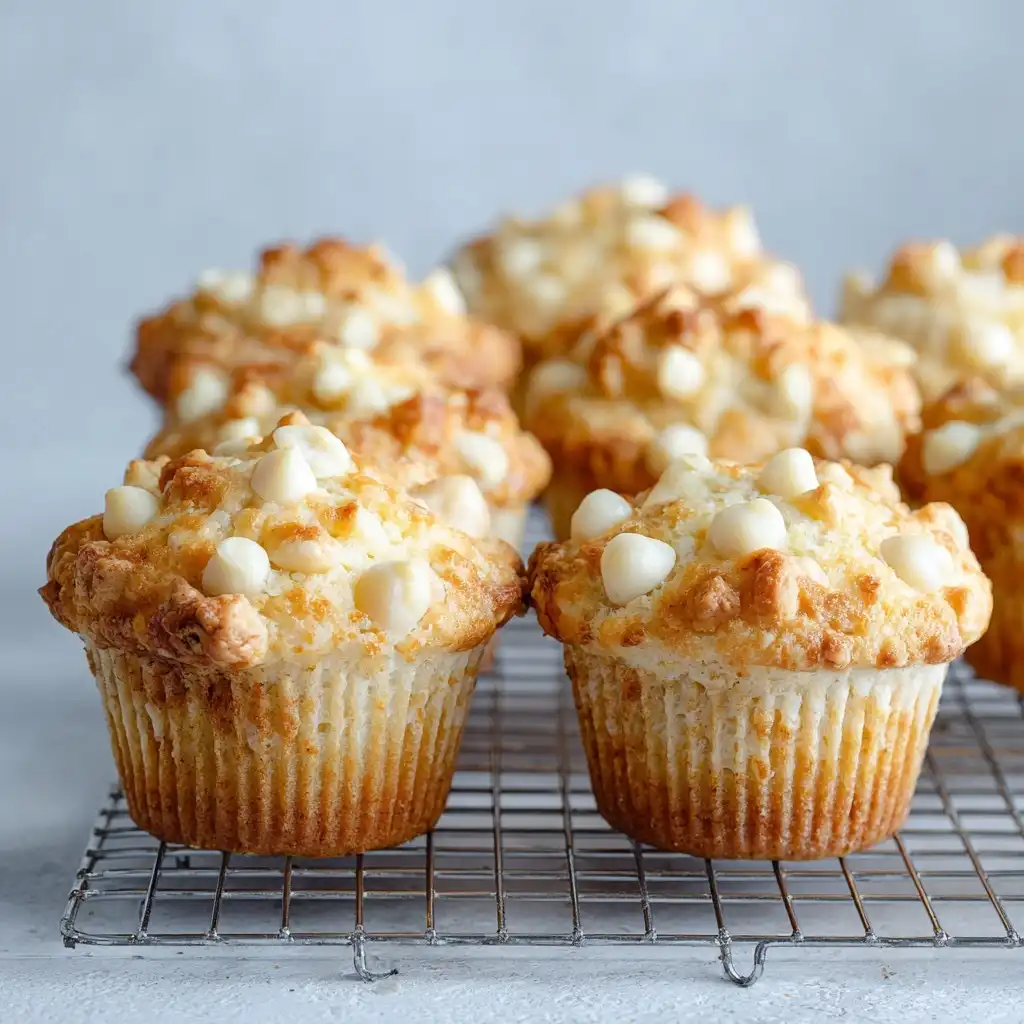
White Chocolate Macadamia Muffins are the epitome of indulgent, bakery-style comfort in a handheld package—rich, buttery, tender-crumbed, and studded with creamy white chocolate chunks and crunchy, buttery macadamia nuts. Unlike their more austere cousins (think plain blueberry or bran muffins), these treats embrace decadence without apology: velvety white chocolate melts into warm pockets of sweetness, while toasted macadamias lend an elegant, tropical richness and satisfying textural contrast. They’re equally at home as a weekend breakfast paired with strong coffee, an afternoon tea centerpiece alongside Earl Grey, or a celebratory dessert served warm with vanilla bean ice cream and a drizzle of salted caramel. What sets them apart isn’t just flavor—it’s balance. When executed thoughtfully, these muffins avoid cloying sweetness through careful sugar modulation, achieve structural integrity without toughness via precise mixing technique, and deliver consistent rise and domed tops thanks to optimal leavening synergy. Whether you’re a seasoned baker refining your crumb-tenderizing skills or a novice seeking a showstopping first foray into gourmet muffin-making, this recipe delivers reliability, luxury, and unmistakable warmth in every golden-brown, paper-lined bite.
The History
The lineage of the White Chocolate Macadamia Muffin is a delicious convergence of mid-20th-century American baking innovation, Hawaiian agricultural ingenuity, and Swiss confectionery evolution. While muffins themselves trace back to early British “muffin” cakes (a yeasted griddle bread) and evolved into American quick-breads by the 1800s, the *white chocolate macadamia* iteration didn’t emerge until the 1980s—a golden era of gourmet snack expansion fueled by rising consumer interest in premium, regionally sourced ingredients. Macadamia nuts, native to Australia but commercially cultivated on a large scale in Hawaii beginning in the 1920s, gained national prominence in the U.S. after World War II, especially following the establishment of the Hawaii Macadamia Nut Association in 1946. Their rich, buttery profile made them a natural fit for upscale baked goods. Meanwhile, white chocolate—though invented in Switzerland in the 1930s by Nestlé (using cocoa butter, milk solids, and sugar)—was long considered a lesser cousin to dark and milk chocolate due to its lack of cocoa solids. It wasn’t until the 1970s and ’80s that artisanal chocolatiers and pastry chefs began championing its unique mouthfeel and pairing versatility. The iconic marriage of the two—white chocolate and macadamia—was popularized by Hawaii-based bakeries and resorts in the late 1970s, notably appearing on menus at The Mauna Kea Beach Hotel and later immortalized in the 1983 cookbook Hawaii’s Best Recipes. By the mid-1980s, national chains like Mrs. Fields and regional bakeries across California and the Pacific Northwest adopted the combination, transforming it from a tropical novelty into a beloved American classic. Today, it stands as one of the most recognizable and nostalgically evocative muffin varieties—symbolizing sun-drenched luxury, culinary harmony, and the art of thoughtful ingredient pairing.
Ingredients Breakdown
Every exceptional White Chocolate Macadamia Muffin begins not with technique alone—but with intentionality behind each component. Below is a granular, function-driven analysis of every ingredient—not just *what* goes in, but *why* it’s included, how it interacts, and what substitutions (if any) preserve structural and sensory integrity:
- All-Purpose Flour (2 ½ cups / 315g): Provides gluten structure and volume. A blend of hard and soft wheat ensures enough elasticity for lift without chewiness. For optimal tenderness, we recommend bleached all-purpose flour (like Pillsbury Softasilk), which has lower protein (≈9–9.5%) and finer starch granules that absorb liquid more evenly and yield a softer crumb. Unbleached flour works but may produce a slightly denser, chewier texture.
- Granulated Sugar (¾ cup / 150g): Serves four critical roles: sweetener, tenderizer (interfering with gluten formation), moisture retainer (via hygroscopic properties), and contributor to browning (caramelization during baking). Reducing beyond ⅔ cup risks diminished rise and dryness; increasing beyond 1 cup introduces excessive spread and risk of collapsed centers.
- Packed Light Brown Sugar (½ cup / 100g): Adds nuanced molasses depth, enhances moisture retention (thanks to its higher invert sugar content), and promotes richer crust color and subtle caramel notes. Its acidity also gently activates baking soda if used—though this recipe relies on baking powder for cleaner lift.
- Baking Powder (2 tsp / 10g): The primary leavener. Double-acting baking powder provides two bursts of carbon dioxide—one when hydrated, another when heated—ensuring maximum oven spring and dome formation. Use fresh (less than 6 months old); expired powder yields flat, dense muffins. Aluminum-free brands (e.g., Rumford) are preferred for neutral flavor.
- Baking Soda (¼ tsp / 1g): A subtle yet strategic addition. Though not required, it neutralizes trace acidity from brown sugar and buttermilk (if substituted), fine-tunes pH for optimal browning, and contributes to slight crumb tenderness. Omit only if using exclusively granulated sugar and regular milk.
- Fine Sea Salt (1 tsp / 6g): Not merely for seasoning—salt tightens gluten strands slightly, improves dough strength, and crucially, balances the intense sweetness of white chocolate. It also heightens all other flavors via neurological contrast. Avoid iodized table salt, which can impart bitterness at this concentration.
- Unsalted Butter (½ cup / 113g), melted and cooled: Adds unparalleled richness, flakiness potential in the crumb, and tenderizing fat. Melting (rather than creaming) prevents overdevelopment of gluten and encourages even distribution. Cooling to ~100°F (38°C) before mixing avoids cooking eggs or seizing chocolate. European-style butter (82–84% fat) yields even more luxurious mouthfeel.
- Large Eggs (2, room temperature): Provide structure (via coagulating proteins), emulsification (binding fat and water), leavening (trapped air expands), and richness. Room temperature ensures uniform incorporation and prevents re-solidification of melted butter.
- Full-Fat Sour Cream (¾ cup / 180g): A cornerstone for tenderness and moisture. Its acidity tenderizes gluten, its high fat content yields moist crumb, and its thick consistency adds body without thinning batter. Greek yogurt (full-fat, strained) is the closest substitute; low-fat or nonfat versions cause dryness and poor rise.
- Pure Vanilla Extract (2 tsp): Essential aromatic backbone. Use Madagascar Bourbon vanilla for best results—its complex phenolic compounds complement both white chocolate’s lactonic sweetness and macadamia’s nutty richness. Imitation extract lacks depth and can taste medicinal under heat.
- White Chocolate (1 ¼ cups / 200g), finely chopped: Must be *real* white chocolate—minimum 20% cocoa butter, with no vegetable oils (e.g., palm, shea, or coconut oil), which cause greasiness and poor melt. High-quality examples: Valrhona Ivoire, Callebaut Opalys, or Guittard Classic White. Chopping ensures even distribution and prevents large pools that sink or burn. Reserve 2 tbsp for topping.
- Raw Macadamia Nuts (1 ¼ cups / 175g), roughly chopped: Raw (not roasted or salted) allows full control over toasting level and sodium. Chopping to pea-size ensures integration without overwhelming bites. Toasting beforehand is non-negotiable—it deepens flavor, reduces raw tannins, and enhances crunch. Never skip this step.
- Optional Additions: A pinch of freshly grated nutmeg (¼ tsp) or cardamom (⅛ tsp) elevates warmth; a tablespoon of bourbon or rum intensifies complexity; a light brush of honey-butter glaze post-bake adds shine and subtle gloss.
Step-by-Step Recipe
This meticulously tested method prioritizes texture control, even baking, and professional-level results—no guesswork, no common pitfalls. Follow precisely for bakery-worthy muffins every time:
- Preheat & Prep: Position oven rack in the center. Preheat oven to 425°F (220°C) — yes, high initial heat is essential for dramatic oven spring and tall domes. Line a standard 12-cup muffin tin with premium parchment liners (or grease and flour if using silicone cups). Set aside.
- Toast the Macadamias: Spread raw macadamia nuts evenly on a dry, ungreased rimmed baking sheet. Bake at 350°F (175°C) for 8–10 minutes, shaking pan halfway, until fragrant, lightly golden, and audible popping subsides. Cool completely on a wire rack (~15 min). Chop coarsely (¼–½ inch pieces). Do not skip cooling—warm nuts will melt chocolate prematurely.
- Mix Dry Ingredients: In a large bowl, whisk together flour, granulated sugar, brown sugar, baking powder, baking soda, and salt until fully homogenized and no streaks remain—approximately 45 seconds. Breaking up sugar lumps here ensures even sweetness distribution and prevents gritty pockets.
- Mix Wet Ingredients: In a separate medium bowl, combine melted (and cooled to 100°F/38°C) butter, eggs, sour cream, and vanilla. Whisk vigorously for 30 seconds until emulsified and glossy—no separated streaks of fat should remain. This step creates a stable base that suspends add-ins.
- Combine Batter (The Muffin Method): Pour wet mixture into dry mixture. Using a flexible silicone spatula, fold gently *just until no dry flour remains*—typically 12–15 strokes. Do not overmix. Batter will be thick, slightly lumpy, and glossy. Overmixing develops excess gluten → tunneling, toughness, and peaked, cracked tops.
- Fold in Add-Ins: Add toasted, cooled macadamias and chopped white chocolate. Fold 8–10 times—just enough to distribute evenly. Batter will look marbled and speckled. For extra visual appeal, reserve 1 tbsp each of nuts and chocolate for topping.
- Portion & Fill: Use a 3-tablespoon ice cream scoop (or ¼-cup measure) to portion batter evenly into lined cups. Fill each liner *generously*—to the very brim (≈¾ full). This ensures tall, bakery-style domes. Smooth tops lightly with damp fingertips if desired.
- Bake Hot, Then Reduce: Place muffin tin in preheated 425°F (220°C) oven. Immediately reduce temperature to 375°F (190°C). Bake for 5 minutes at high heat to activate rapid leavening and set outer structure. Then, without opening the door, reduce heat to 350°F (175°C) and continue baking for 15–17 minutes—until a toothpick inserted into the center of a center muffin comes out with *moist crumbs* (not wet batter, not clean). Total bake time: 20–22 minutes.
- Cool Strategically: Remove tin from oven. Let muffins rest *in the pan* on a wire rack for exactly 5 minutes—this allows steam to escape gradually, preventing soggy bottoms. After 5 minutes, carefully lift each muffin by its liner and transfer directly to the wire rack. Cool completely (≈45 minutes) before serving. Cutting into warm muffins releases steam too quickly, collapsing the crumb.
Tips
These expert-level tips address the most frequent failures—and elevate your muffins from good to extraordinary:
- Room Temperature is Non-Negotiable: Cold eggs or sour cream cause melted butter to seize into grainy clumps, resulting in uneven batter, poor emulsion, and dense spots. Take dairy and eggs out 1 hour before baking.
- Weigh Your Ingredients: Volume measurements for flour vary wildly (up to ±25g per cup). A kitchen scale ensures exact ratios—critical for consistent crumb and rise. Invest in one—it pays for itself in saved flour and frustration.
- Don’t Skip the High-Heat Start: That initial 425°F blast creates instantaneous steam expansion and rapid CO₂ release from baking powder—lifting batter before the crust sets. Skipping it yields squat, rounded muffins.
- Chill Batter for Next-Level Texture (Optional Pro Tip): After folding in add-ins, cover batter and refrigerate for 30–60 minutes. Cold batter slows oven spring slightly but dramatically improves crumb fineness, reduces spreading, and yields moister interiors. Adjust bake time +2 minutes if chilled.
- Resist the Urge to Open the Oven: Opening before the 15-minute mark risks temperature drop → collapsed domes and uneven baking. Use your oven light and interior window instead.
- Test the Center Muffin: Edge muffins bake faster. Always test the one farthest from the oven walls—the most accurate indicator of doneness.
- Freeze for Freshness: Cool completely, then freeze unfrosted muffins in a single layer on a baking sheet. Once solid, transfer to airtight freezer bags. Reheat from frozen at 325°F (165°C) for 12–15 minutes—crisp exterior, molten center.
- Revive Stale Muffins: Wrap in damp paper towel and microwave 15–20 seconds. Or slice in half, toast in toaster oven at 375°F (190°C) for 4 minutes—crispy edges, soft center.
Variations and Customizations
While the classic White Chocolate Macadamia formula is timeless, creative adaptations let you tailor flavor profiles, dietary needs, and seasonal inspiration—all without sacrificing structure or satisfaction:
- Lemon-White Chocolate Macadamia: Add 2 tsp finely grated lemon zest + 1 tbsp fresh lemon juice to wet ingredients. Replace 1 tbsp sour cream with juice. Bright, zesty counterpoint to richness—ideal for spring brunch.
- Coconut-Infused: Substitute ¼ cup flour with unsweetened shredded coconut (toasted). Stir ⅓ cup toasted coconut flakes into batter with nuts/chocolate. Optional: drizzle with coconut-white chocolate ganache.
- Gluten-Free: Use a 1:1 certified GF flour blend with xanthan gum (e.g., King Arthur Measure for Measure or Bob’s Red Mill 1-to-1). Increase sour cream to 1 cup and add 1 extra egg yolk for binding. Rest batter 15 minutes before baking.
- Vegan Adaptation: Replace butter with refined coconut oil (½ cup, melted); eggs with flax eggs (2 tbsp ground flax + 6 tbsp water, rested 10 min); sour cream with coconut yogurt (unsweetened, full-fat). Use vegan white chocolate (e.g., Pascha or Enjoy Life) and ensure nuts are processed in nut-only facilities.
- Mini Muffin Version: Portion into 24-cup mini muffin tin. Bake at 425°F → 375°F → 350°F for 11–13 minutes total. Perfect for parties, lunchboxes, or portion control.
- Streusel-Topped: Mix ¼ cup flour, ¼ cup brown sugar, 2 tbsp cold butter, ¼ tsp cinnamon, and pinch salt. Crumble over filled muffins before baking. Adds crunch and spice dimension.
- Espresso-Kissed: Dissolve 1 tsp instant espresso powder in warm sour cream before adding to wet mix. Deepens chocolate notes without bitterness.
- Spiced Holiday Edition: Add ½ tsp ground ginger, ¼ tsp ground cloves, and ¼ tsp allspice to dry ingredients. Top with crystallized ginger pieces.
Health Considerations and Nutritional Value
White Chocolate Macadamia Muffins are, by nature, a treat—not a health food. However, understanding their nutritional composition empowers mindful enjoyment and informed customization:
Nutrition Facts (per standard muffin, based on 12 servings):
Calories: 425 | Total Fat: 24g (Saturated: 13g) | Cholesterol: 65mg | Sodium: 290mg | Total Carbohydrates: 48g (Dietary Fiber: 1g, Sugars: 31g) | Protein: 5g
Key Considerations:
- Sugar Content: The dual-sugar approach (granulated + brown) delivers flavor and function—but accounts for ~31g per muffin (≈7.5 tsp). For reduction, cut granulated sugar to ⅔ cup and omit brown sugar entirely—compensate with 1 extra tbsp sour cream and ¼ tsp molasses for depth. Expect slightly less browning and tenderness.
- Saturated Fat: Primarily from butter, white chocolate, and macadamias. Macadamias, while high in monounsaturated fats (heart-healthy), contribute significantly to total saturated fat via their natural composition. To lower saturated fat: replace 2 tbsp butter with avocado oil (neutral flavor, high smoke point) and use reduced-fat white chocolate (though texture suffers).
- Macadamia Benefits: Rich in monounsaturated fats, thiamine (B1), magnesium, and antioxidants like tocopherols. One ounce (≈10–12 halves) supports cardiovascular health and satiety—but portion awareness matters.
- White Chocolate Reality: Contains zero cocoa solids or flavonoids found in dark chocolate. Its benefits stem from cocoa butter (stearic acid, neutral for cholesterol) and milk solids (calcium, vitamin D if fortified). Choose brands with minimal added emulsifiers (soy lecithin is fine; PGPR is not).
- Dietary Accommodations: Naturally nut-free? Swap macadamias for toasted sunflower seeds or pumpkin seeds. Dairy-free? See vegan variation above. Low-FODMAP? Use lactose-free sour cream and certified low-FODMAP white chocolate (some brands contain inulin or chicory root).
- Mindful Pairing: Serve with plain Greek yogurt, fresh berries, or a small handful of arugula salad to balance richness with freshness and fiber.
Ingredients
- 2 ½ cups (315g) bleached all-purpose flour
- ¾ cup (150g) granulated sugar
- ½ cup (100g) packed light brown sugar
- 2 tsp (10g) aluminum-free double-acting baking powder
- ¼ tsp (1g) baking soda
- 1 tsp (6g) fine sea salt
- ½ cup (113g) unsalted butter, melted and cooled to 100°F (38°C)
- 2 large eggs, room temperature
- ¾ cup (180g) full-fat sour cream, room temperature
- 2 tsp pure vanilla extract
- 1 ¼ cups (200g) high-quality white chocolate, finely chopped (reserve 2 tbsp)
- 1 ¼ cups (175g) raw macadamia nuts, toasted and coarsely chopped (reserve 1 tbsp)
Directions
- Preheat oven to 425°F (220°C) with rack in center position. Line a 12-cup muffin tin with parchment liners.
- Toast macadamias on a dry rimmed baking sheet at 350°F (175°C) for 8–10 minutes until fragrant and golden. Cool completely, then chop.
- In a large bowl, whisk flour, granulated sugar, brown sugar, baking powder, baking soda, and salt until uniform.
- In a medium bowl, whisk melted butter, eggs, sour cream, and vanilla until smooth and emulsified.
- Pour wet mixture into dry mixture. Fold with a silicone spatula until *just combined*—12–15 strokes max. Batter will be thick and lumpy.
- Gently fold in toasted macadamias and white chocolate (except reserved portions) until evenly distributed—8–10 folds.
- Portion batter evenly into prepared cups, filling to the brim. Smooth tops. Sprinkle reserved nuts and chocolate on top.
- Place tin in oven. Immediately reduce temperature to 375°F (190°C). Bake 5 minutes.
- Without opening door, reduce heat to 350°F (175°C). Bake 15–17 more minutes, until toothpick in center shows moist crumbs.
- Cool in pan 5 minutes. Transfer to wire rack. Cool completely (45 min) before serving.
FAQ
- Can I use store-bought white chocolate chips?
- Not recommended. Most “white chips” contain palm oil, hydrogenated fats, and little cocoa butter—resulting in waxy texture, poor melt, and greasy separation. Opt for real white chocolate bars (Valrhona, Callebaut, Guittard) chopped yourself.
- Why did my muffins sink in the middle?
- Most common causes: underbaking (toothpick pulled too early), opening oven too soon, expired baking powder, or overmixing. Also check oven temperature accuracy with an oven thermometer—many run hot or cold.
- Can I make these ahead and freeze?
- Absolutely. Cool completely, wrap individually in plastic wrap, then place in freezer bag. Freeze up to 3 months. Thaw at room temperature 2 hours or reheat frozen at 325°F (165°C) for 12–15 minutes.
- My batter seems too thick—is that normal?
- Yes—this is ideal. A thick, scoopable batter (like stiff pancake batter) ensures tall domes and prevents spreading. If it’s runny, you’ve likely added too much liquid or mis-measured flour.
- Can I substitute other nuts?
- You can, but flavor and texture shift dramatically. Pecans offer buttery sweetness; almonds add mild crunch; walnuts lend earthiness. Avoid pine nuts (too oily) or cashews (too soft). Macadamias remain irreplaceable for authentic luxury.
- Why do you use both baking powder AND baking soda?
- Baking powder handles most leavening. Baking soda subtly neutralizes acidity from brown sugar and sour cream, promoting better browning, finer crumb, and balanced flavor—without altering rise significantly.
- How do I prevent chocolate from sinking to the bottom?
- Toss chopped chocolate in 1 tsp of the measured flour before folding in. This light coating helps suspension. Also, avoid overmixing after adding—it breaks the batter’s viscosity needed to hold chunks aloft.
- Can I make these dairy-free?
- Yes—with caveats. Use refined coconut oil instead of butter, full-fat coconut yogurt instead of sour cream, and dairy-free white chocolate. Expect slightly denser crumb and less tang—but still delicious.
Summary
White Chocolate Macadamia Muffins are a masterclass in balanced indulgence—tender, golden-domed, and luxuriously studded with buttery toasted macadamias and premium white chocolate, achieved through precise technique, quality ingredients, and intentional science.
From their Hawaiian-Swiss heritage to modern customizable adaptations, they offer timeless appeal, impressive reliability, and the kind of joyful, buttery nostalgia that turns ordinary mornings into cherished rituals.