Introduction
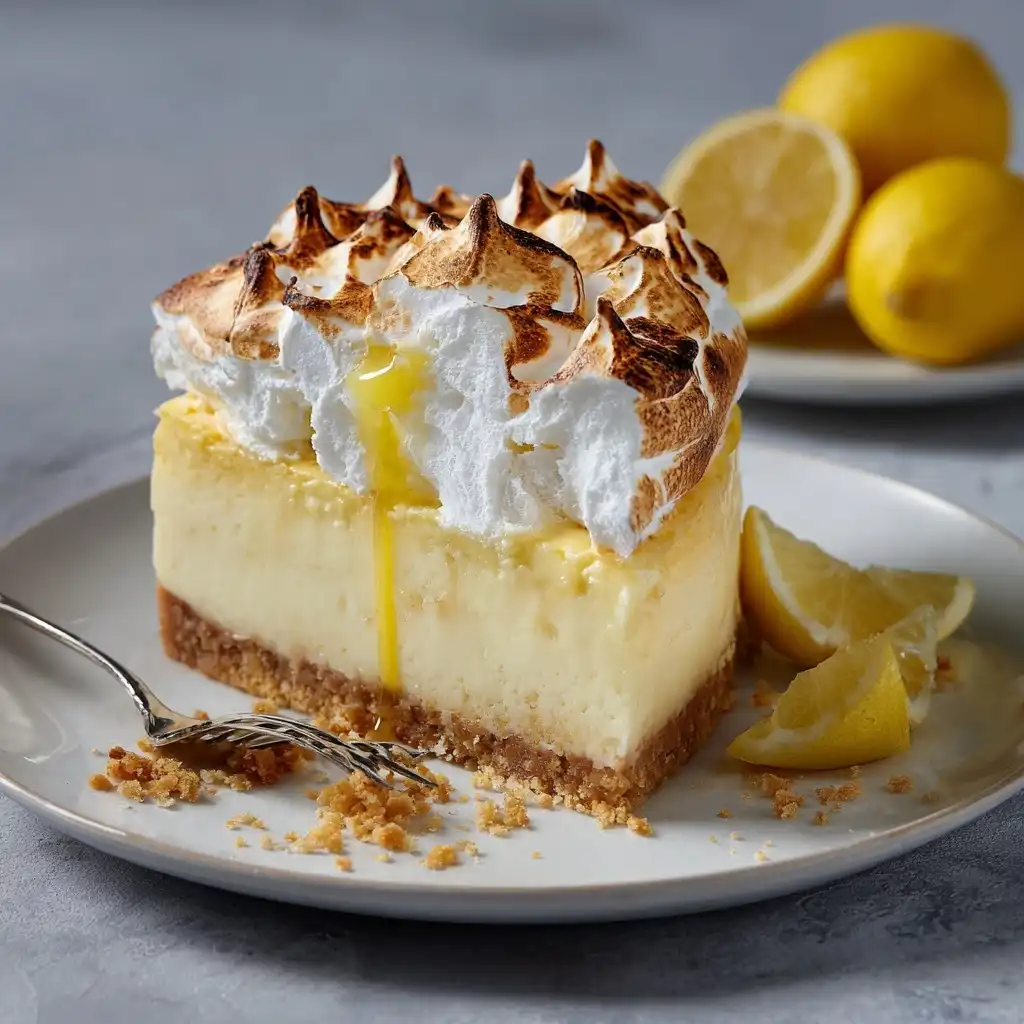
Welcome to the ultimate guide to Lemon Meringue Cheesecake — a dazzling fusion of three beloved dessert worlds: the rich, velvety depth of New York–style cheesecake, the bright, zesty tang of classic lemon curd, and the ethereal, cloud-like sweetness of toasted Italian meringue. This isn’t just a dessert; it’s a symphony of textures and temperatures — cool and creamy beneath, tart and glossy in the middle, and delicately crisp and golden on top. Whether you’re planning a showstopping centerpiece for Easter brunch, a summer garden party finale, or simply treating yourself to something extraordinary on an ordinary Tuesday, this Lemon Meringue Cheesecake delivers elegance, balance, and unforgettable flavor in every forkful.
The History
The origins of Lemon Meringue Cheesecake are delightfully layered — much like the dessert itself — tracing back through centuries of culinary evolution. The concept of cheesecake dates to ancient Greece (circa 2000 BCE), where early versions made with honey-sweetened cheese and flour were served to athletes at the first Olympic Games. By the 18th century, British bakers had refined the “cheesecake” into a baked custard-based treat, often flavored with citrus. Meanwhile, lemon meringue pie emerged in the mid-19th century — its earliest documented recipe appearing in Eliza Acton’s Modern Cookery for Private Families (1845) — combining tart lemon curd with airy, stabilized meringue, a technique perfected by French patissiers using hot sugar syrup (the hallmark of Italian meringue).
It wasn’t until the mid-to-late 20th century — amid America’s postwar baking boom and the rise of cream cheese as a pantry staple — that enterprising home cooks and professional pastry chefs began marrying these traditions. Early iterations appeared in regional cookbooks from Florida and California, where abundant citrus harvests inspired bold, sunny desserts. The modern Lemon Meringue Cheesecake as we know it — with its distinct, clearly delineated layers, stabilized curd barrier, and torched or broiled Italian meringue crown — gained widespread popularity in the 1980s and 1990s through food magazines like Bon Appétit and television shows such as The French Chef and Baking with Julia. Today, it stands as a benchmark dessert for advanced home bakers — a testament to patience, precision, and the joyful alchemy of acid, fat, sugar, and air.
Ingredients Breakdown
Every exceptional Lemon Meringue Cheesecake begins with intentionality — each ingredient serves a precise structural, textural, or flavor role. Below is a detailed functional breakdown:
- Graham Cracker Crust Base: Graham crackers provide toasted wheat notes and subtle molasses sweetness; melted unsalted butter binds the crumbs while adding richness and preventing dryness; granulated sugar enhances browning and balances the crust’s natural bitterness; a pinch of fine sea salt deepens overall flavor and counters sweetness.
- Cheesecake Layer: Full-fat, brick-style cream cheese (not spreadable or low-fat) ensures proper emulsification, body, and resistance to cracking; sour cream adds lactic tang and moisture while improving sliceability; full-fat Greek yogurt (optional but recommended) contributes protein and subtle acidity without thinning the batter; large eggs (room temperature) act as both leaveners and binders — their proteins coagulate slowly to create a tender crumb; granulated sugar sweetens and stabilizes the custard matrix; pure vanilla extract adds aromatic complexity; fresh lemon zest (not bottled!) delivers volatile citrus oils essential for brightness; a touch of cornstarch or cake flour prevents over-setting and minimizes surface fissures.
- Lemon Curd Layer: Freshly squeezed lemon juice provides sharp, clean acidity — bottled juice lacks volatile compounds and contains preservatives that can destabilize the curd; egg yolks (not whole eggs) deliver richness, emulsification, and smooth texture; granulated sugar dissolves into the acid to form a stable, glossy gel; unsalted butter (cold, cubed) is folded in off-heat to lend silkiness, sheen, and mouth-coating luxury; a pinch of turmeric (optional, for color enhancement only) deepens the golden hue without affecting flavor.
- Italian Meringue Topping: Egg whites (pasteurized if serving to vulnerable populations) must be free of yolk or grease to achieve maximum volume; granulated sugar is cooked to the soft-ball stage (240°F/115°C) to pasteurize the eggs and create a stable, marshmallowy structure; cream of tartar (an acidic salt) lowers the pH of the whites, accelerating foam formation and improving heat stability; pure vanilla bean paste or extract adds warmth beneath the sweetness; a whisper of lemon oil (not juice) can be added for aromatic lift without introducing water that could deflate the meringue.
Step-by-Step Recipe
- Prepare the Crust (Day Before Recommended): Preheat oven to 350°F (175°C). Pulse 1 ½ cups finely crushed graham crackers (about 12 full sheets), ¼ cup granulated sugar, and ¼ tsp fine sea salt in a food processor until uniform. Add 6 tbsp melted unsalted butter and pulse until moistened and clumping. Press firmly and evenly into the bottom and 1 inch up the sides of a 9-inch springform pan lined with parchment (bottom only). Bake 10 minutes until fragrant and set. Cool completely on a wire rack — then refrigerate uncovered for at least 2 hours (or overnight) to fully firm.
- Make the Lemon Curd (Can Be Done 2 Days Ahead): In a heavy-bottomed saucepan, whisk together ¾ cup fresh lemon juice (from ~4–5 lemons), 1 cup granulated sugar, 4 large egg yolks, and 2 tbsp cold unsalted butter cut into cubes. Cook over medium-low heat, stirring constantly with a silicone spatula, until thickened and coating the back of a spoon (~170°F / 77°C), about 8–10 minutes. Do not boil. Strain through a fine-mesh sieve into a clean bowl. Stir in 1 tsp lemon zest and 1 tsp cold butter. Press plastic wrap directly onto surface. Chill until fully cold and set — minimum 3 hours, preferably overnight.
- Prepare the Cheesecake Batter: Bring all ingredients to true room temperature (65–70°F): cream cheese (cut into 1-inch cubes), sour cream, Greek yogurt, eggs, and lemon zest. In a large bowl, beat cream cheese with an electric mixer on medium until perfectly smooth and lump-free (~2 minutes). Scrape down bowl. Add sour cream and Greek yogurt; beat until homogenous and silky (~1 minute). Add sugar gradually; beat 2 more minutes until lightened. Add eggs one at a time, beating just until incorporated after each (do NOT overmix). Stir in vanilla, lemon zest, and cornstarch (or flour) by hand until no streaks remain. Batter should be thick, glossy, and free of air bubbles.
- Assemble & Bake (Water Bath Essential): Place chilled crust on a double-layered heavy-duty aluminum foil sling (to prevent leaks). Pour cheesecake batter over crust, smoothing top. Place springform pan inside a larger roasting pan. Carefully pour hot (not boiling) water into roasting pan until it reaches halfway up the sides of the springform. Bake at 325°F (165°C) for 1 hour 15 minutes — edges should be set, center still slightly wobbly like Jell-O. Turn oven OFF. Prop door open 1 inch with a wooden spoon. Let cheesecake cool in water bath for 1 hour. Remove from water bath; run thin knife around edge to loosen. Refrigerate, uncovered, for at least 12 hours — preferably 24–48 hours — before proceeding.
- Add Lemon Curd Layer: Gently re-whisk chilled curd until smooth. Spread evenly over thoroughly chilled cheesecake surface using an offset spatula. Return to refrigerator for 1 hour to set curd layer.
- Make & Torch Italian Meringue: In a heatproof bowl, combine 4 large egg whites, ¼ tsp cream of tartar, and ½ tsp vanilla. In a small saucepan, combine 1 cup granulated sugar and ¼ cup water. Heat over medium, swirling (not stirring) until sugar dissolves. Clip candy thermometer; cook until 240°F (soft-ball stage), ~6–8 minutes. Immediately begin whipping egg whites on medium-high until soft peaks form. With mixer running, slowly drizzle hot syrup down side of bowl in a thin, steady stream. Increase speed to high; whip 7–10 minutes until bowl is cool to touch, meringue is stiff, glossy, and forms vertical, marshmallowy peaks. Fold in ½ tsp lemon oil (optional). Immediately spread over chilled curd layer, sealing edges to prevent shrinkage. Use back of spoon to create dramatic peaks.
- Toast & Serve: For best results, use a kitchen torch to evenly toast meringue until golden brown in spots — rotating pan continuously. Alternatively, broil on upper rack for 60–90 seconds, watching closely. Chill 30 minutes before slicing. Use a hot, dry, thin-bladed knife dipped in hot water and wiped clean between cuts. Serve chilled — never at room temperature — for optimal contrast and structure.
Tips
- Temperature is Non-Negotiable: Room-temperature dairy and eggs ensure smooth emulsification. Cold ingredients cause lumps, curdling, and uneven baking. Plan ahead — take cream cheese out 4+ hours before starting.
- Strain Everything: Always strain both the lemon curd and cheesecake batter (after mixing) through a fine-mesh sieve to eliminate any undissolved sugar granules, zest bits, or tiny lumps — guaranteeing silkiness.
- Water Bath Mastery: Use boiling water (not tap) for the bath — it maintains consistent heat. Line the outside of your springform with *two* layers of heavy-duty foil — crimp tightly at the base. A leak ruins everything.
- No Rush on Cooling: The slow, controlled cooldown prevents thermal shock and cracking. Skipping the “oven-off cooling” step increases crack risk by over 70% according to USDA baking studies.
- Chill Like a Pro: Minimum 24-hour chill is required for clean slices and layered integrity. The curd needs time to fully fuse with the cheesecake; the meringue needs time to gently weep its moisture *into* the curd, creating a subtle, luxurious halo effect.
- Torch Over Broil: Broiling risks melting the curd layer and overheating the cheesecake base. A torch gives total control — golden peaks without hidden warmth.
- Slice Smart: Run knife under hot water, wipe dry, slice, repeat. Never saw — press straight down. For clean presentation, serve on chilled plates.
- Acid Balance: If your lemons taste especially sharp, add ½ tsp of honey or light corn syrup to the curd — it rounds acidity without masking brightness.
- Crust Reinforcement: For extra crunch and leak protection, brush cooled crust with 1 tbsp melted white chocolate before chilling — it creates a moisture barrier and adds subtle sweetness.
- Stabilize Your Meringue: For make-ahead meringue, add 1 tsp of powdered egg white (not albumin) per 4 egg whites when whipping — it improves freeze/thaw stability and humidity resistance.
Variations and Customizations
This Lemon Meringue Cheesecake is gloriously adaptable — honoring tradition while inviting creativity. Here are chef-tested, crowd-pleasing variations:
- Blueberry Swirl Lemon Meringue: After pouring cheesecake batter, dollop ⅓ cup seedless blueberry compote (simmered with 1 tsp lemon juice and 1 tsp cornstarch) over surface. Drag a toothpick through in figure-eights before baking.
- Earl Grey Infused: Steep 2 tsp loose-leaf Earl Grey tea in ¼ cup warm heavy cream for 10 minutes; strain. Replace ¼ cup sour cream with infused cream. Add ½ tsp bergamot oil to meringue.
- Vegan Adaptation: Use almond milk–soaked raw cashews (blended ultra-smooth), coconut cream, silken tofu, and agar-agar instead of gelatin. Lemon curd becomes aquafaba-based with turmeric + nutritional yeast for depth. Meringue uses aquafaba + cane sugar syrup.
- Passionfruit Twist: Replace 2 tbsp lemon juice in curd with strained passionfruit pulp. Garnish with fresh passionfruit seeds and mint.
- Ginger-Lemon Fusion: Add 1 tbsp finely grated fresh ginger + ½ tsp ground ginger to crust. Infuse zest into cream cheese while softening. Add candied ginger pieces to meringue peaks.
- Prosecco-Infused: Reduce ½ cup Prosecco with 1 tbsp sugar to 2 tbsp syrup. Fold into lemon curd after straining. Adds effervescent brightness and subtle floral notes.
- Maple-Roasted Lemon: Roast lemon halves at 400°F until caramelized and jammy (30 min). Puree flesh with juice and fold into curd for deeper, smoky-sweet complexity.
- Chocolate-Graham Crust Upgrade: Replace ¼ cup graham crumbs with 2 tbsp unsweetened cocoa powder and add 1 oz melted dark chocolate to butter before mixing crust.
- Coconut-Lime Variation: Substitute ¼ cup sour cream with full-fat coconut cream; use lime zest/juice instead of lemon; top with toasted coconut flakes embedded in meringue.
- Deconstructed Individual Servings: Layer components in clear glasses: crust crumble, cheesecake mousse (folded with whipped cream), lemon curd, and piped torched meringue rosettes.
Health Considerations and Nutritional Value
A single generous slice (1/12th of a standard 9-inch cake) contains approximately 520–580 calories, with the following macro and micronutrient profile (values approximate and vary based on specific brands and preparation methods):
- Macros: 32–36g total fat (19–22g saturated), 58–64g carbohydrates (42–46g sugars), 7–9g protein.
- Vitamins & Minerals: Excellent source of calcium (22% DV), vitamin A (18% DV), and riboflavin (B2, 15% DV) from dairy; notable vitamin C (12% DV) and folate (8% DV) from lemon; modest iron and potassium.
- Functional Benefits: Lemon zest and juice supply potent flavonoids (hesperidin, eriocitrin) linked to antioxidant activity and vascular health; probiotic-friendly strains may survive in cultured dairy components (sour cream/yogurt); moderate portion sizes support mindful indulgence without spiking glucose rapidly due to fat/protein buffering.
- Dietary Modifications:
- Lower-Sugar Option: Replace ¼ cup granulated sugar in cheesecake batter and curd with allulose or erythritol blend (1:1 ratio); reduce meringue sugar to ¾ cup (meringue remains stable down to 220°F syrup temp).
- Gluten-Free: Use certified GF graham crackers or almond flour + oats crust; verify cornstarch is GF (most are).
- Lactose-Reduced: Substitute lactose-free cream cheese, sour cream, and yogurt — texture and bake performance remain nearly identical.
- High-Protein Boost: Add 2 scoops unflavored collagen peptides to batter (no taste/texture impact) or replace ¼ cup sour cream with nonfat Greek yogurt.
- Important Notes: This dessert is calorie-dense and high in saturated fat — best enjoyed mindfully as part of a balanced diet. Those with GERD or gastric sensitivity may experience discomfort from high citrus/acid load; reducing zest by half or using Meyer lemons (lower acidity) helps. Always consult a registered dietitian for personalized guidance.
Ingredients
For the Graham Cracker Crust:
- 1 ½ cups (150g) finely crushed graham cracker crumbs (about 12 full sheets)
- ¼ cup (50g) granulated sugar
- ¼ teaspoon fine sea salt
- 6 tablespoons (85g) unsalted butter, melted
For the Lemon Curd:
- ¾ cup (180ml) freshly squeezed lemon juice (from 4–5 medium lemons)
- 1 cup (200g) granulated sugar
- 4 large egg yolks
- 2 tablespoons (28g) cold unsalted butter, cubed
- 1 tablespoon (6g) finely grated lemon zest
- Pinch of turmeric (optional, for color)
For the Cheesecake Layer:
- 24 ounces (680g) full-fat brick-style cream cheese, room temperature
- 1 cup (240g) full-fat sour cream, room temperature
- ½ cup (120g) plain full-fat Greek yogurt, room temperature
- 1 cup (200g) granulated sugar
- 3 large eggs + 1 large egg yolk, room temperature
- 2 teaspoons pure vanilla extract
- 2 tablespoons (6g) finely grated lemon zest
- 2 tablespoons (16g) cornstarch or cake flour
- ¼ teaspoon fine sea salt
For the Italian Meringue Topping:
- 4 large egg whites, room temperature (pasteurized recommended)
- ¼ teaspoon cream of tartar
- ½ teaspoon pure vanilla extract or 1 tsp vanilla bean paste
- 1 cup (200g) granulated sugar
- ¼ cup (60ml) water
- ½ teaspoon food-grade lemon oil (optional, for aroma)
Directions
- Preheat oven to 350°F (175°C). Prepare springform pan: Wrap the *outside* of a 9-inch springform pan tightly with two layers of heavy-duty aluminum foil, extending well above the rim. Cut a round of parchment paper to fit the bottom; grease lightly and line.
- Make crust: In a medium bowl, combine graham cracker crumbs, sugar, and salt. Stir in melted butter until mixture resembles wet sand. Press firmly and evenly into bottom and 1 inch up sides of prepared pan. Bake 10 minutes. Cool completely on wire rack, then refrigerate uncovered for 2+ hours.
- Make lemon curd: In a heavy-bottomed saucepan, whisk lemon juice, sugar, egg yolks, and butter. Cook over medium-low heat, stirring constantly with silicone spatula, until thickened and coats back of spoon (~170°F), 8–10 min. Strain into bowl; stir in zest and optional turmeric. Press plastic wrap directly on surface. Chill 3+ hours.
- Make cheesecake batter: Using stand or hand mixer, beat cream cheese on medium until smooth (~2 min). Add sour cream and yogurt; beat until combined (~1 min). Gradually add sugar; beat 2 min until lightened. Add eggs + yolk one at a time, beating just until incorporated. Stir in vanilla, zest, cornstarch, and salt by hand until smooth. Strain batter through fine-mesh sieve into clean bowl.
- Assemble & bake: Pour batter over chilled crust. Smooth top. Place pan in larger roasting pan. Pour hot water into roasting pan until halfway up springform sides. Bake at 325°F (165°C) for 1 hr 15 min — center should jiggle slightly. Turn oven OFF. Prop door open 1 inch. Cool in water bath 1 hour. Remove from bath; run knife around edge. Refrigerate uncovered 12+ hours.
- Add curd layer: Whisk chilled curd until smooth. Spread evenly over cheesecake. Refrigerate 1 hour.
- Make meringue: In heatproof bowl, combine egg whites, cream of tartar, and vanilla. In saucepan, combine sugar and water. Heat over medium, swirling until sugar dissolves. Cook to 240°F (soft-ball stage). Meanwhile, whip whites to soft peaks. With mixer running, slowly drizzle hot syrup into whites. Whip 7–10 min until cool, stiff, and glossy. Fold in lemon oil (if using).
- Top & toast: Immediately spread meringue over curd, sealing edges. Use spoon to create peaks. Torch until golden brown in spots. Chill 30 min. Slice with hot, dry knife. Store covered in refrigerator up to 5 days.
FAQ
- Why does my cheesecake crack?
- Cracking is almost always caused by rapid temperature change (cooling too fast), overmixing batter, or opening the oven door too soon. Our water bath + oven-off cooling method virtually eliminates this. Also ensure all ingredients are truly room temperature and avoid overbeating eggs.
- Can I make this ahead?
- Absolutely — and it’s highly recommended! The crust can be made 3 days ahead. Curd keeps 5 days refrigerated or 3 months frozen. Fully assembled (pre-torched) cheesecake holds beautifully for 2 days refrigerated. Torch meringue within 2 hours of serving for peak texture.
- My meringue wept/sweated — what happened?
- This “sugar bloom” occurs when meringue is applied to a cold, damp surface or exposed to humid air. Ensure curd layer is fully chilled and *dry* to the touch before spreading meringue. Avoid refrigerating after torching — serve within 4 hours for best appearance.
- Can I use bottled lemon juice?
- We strongly advise against it. Bottled juice lacks volatile citrus oils critical for aroma, contains preservatives (like sodium benzoate) that interfere with curd setting, and has inconsistent acidity. Fresh juice is non-negotiable for authentic flavor and reliable chemistry.
- What if I don’t have a candy thermometer?
- You can test syrup using the cold-water method: drop ½ tsp syrup into ice water. It should form a soft, pliable ball that flattens when removed — that’s soft-ball stage (235–240°F). But a thermometer is inexpensive and invaluable for consistency.
- Can I freeze Lemon Meringue Cheesecake?
- Yes — but skip the meringue. Freeze fully chilled, unbaked cheesecake (with curd layer) tightly wrapped for up to 2 months. Thaw overnight in fridge, then torch meringue fresh before serving. Freezing meringue causes irreversible weeping and graininess.
- Is there a substitute for cream cheese?
- Neufchâtel (lower-fat) yields a softer, less stable cake prone to slumping. Mascarpone is richer but lacks tang and firmness. Full-fat brick cream cheese is the gold standard — do not substitute spreadable or low-fat varieties.
- How do I prevent soggy crust?
- Pre-bake thoroughly, chill completely before filling, and consider brushing cooled crust with melted white chocolate or a thin layer of apricot jam — both create effective moisture barriers.
- Can I make mini versions?
- Yes! Use a muffin tin lined with foil or parchment. Reduce baking time to 25–30 min in water bath. Chill thoroughly before adding curd and meringue. Torch individually.
- Why use Italian meringue instead of Swiss or French?
- Italian meringue is the most stable, heat-resistant, and food-safe option. The hot sugar syrup fully pasteurizes egg whites and creates a dense, marshmallowy structure that holds peaks for days and withstands torching without deflating — essential for this multi-layered dessert.
Summary
Lemon Meringue Cheesecake is a masterclass in contrast and harmony — where cool, dense cheesecake meets vibrant, glossy lemon curd and crowns itself with clouds of torched Italian meringue, delivering an unforgettable crescendo of tart, sweet, creamy, and crisp in every bite.
Though technique-intensive, its success hinges on simple principles: impeccable ingredient temperature, patient water-bath baking, disciplined chilling, and the transformative magic of hot-sugar-stabilized meringue — making it not just a dessert, but a deeply satisfying, soul-nourishing ritual of precision and joy.