Introduction
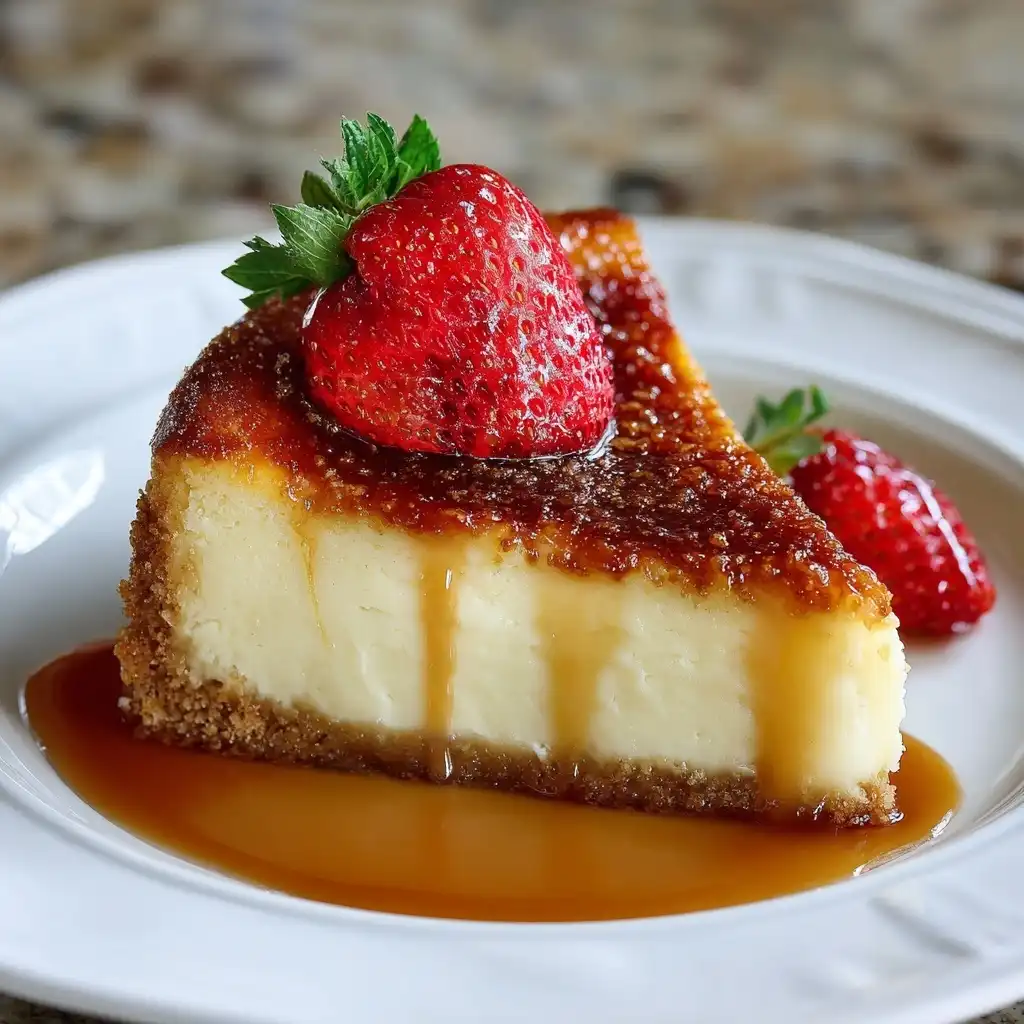
Creme Brulee Cheesecake is a decadent, dreamlike fusion dessert that marries the velvety richness of New York–style cheesecake with the iconic crackling caramelized sugar crust of classic French crème brûlée. This hybrid masterpiece delivers the best of both worlds: the dense, creamy, luxuriously smooth texture of a perfectly baked cheesecake, elevated by the dramatic, brittle, golden-brown sugar top that shatters with a delicate tap of a spoon—releasing subtle notes of burnt sugar, vanilla, and toasted depth. Far more than just a novelty, this dessert represents culinary innovation at its most indulgent—thoughtfully balanced, technically refined, and irresistibly elegant. Whether served at an upscale dinner party, a special-occasion brunch, or as a showstopping finale to a holiday feast, Creme Brulee Cheesecake commands attention—not only for its visual drama but also for its layered complexity of flavor and contrasting textures.
The History
The origins of Creme Brulee Cheesecake lie not in a single moment of invention, but in the slow, delicious convergence of two deeply rooted dessert traditions. Crème brûlée itself dates back to at least the 17th century, with documented appearances in both French (as “crème brûlée”) and English (as “burnt cream”) cookbooks—including François Pierre de la Varenne’s seminal Le Cuisinier François (1651) and later Hannah Glasse’s The Art of Cookery Made Plain and Easy (1747). Its hallmark—the torched or broiled sugar crust—was historically achieved using heated iron rods (“fire irons”) before modern culinary torches existed.
Cheesecake, by contrast, boasts an even older lineage—tracing back to ancient Greece, where honey-sweetened cheese cakes were served to athletes during the first Olympic Games in 776 BCE. The American “New York” style emerged in the early 20th century, refined by immigrant bakers and popularized by establishments like Lindy’s and Junior’s—characterized by its dense, ultra-creamy body, rich dairy base, and restrained sweetness.
The fusion began gaining traction in high-end patisseries and fine-dining kitchens in the late 1990s and early 2000s, as chefs sought to reinterpret classics through cross-genre experimentation. Pioneering pastry chefs—including Thomas Keller (whose version appeared in Bouchon Bakery) and Dominique Ansel—helped legitimize the hybrid by solving its core technical challenges: preventing curdling while incorporating crème brûlée’s custard elements, achieving structural integrity without sacrificing silkiness, and engineering a sugar crust that adheres flawlessly to a chilled, fat-rich surface. Today, it stands as a beloved signature dessert across boutique bakeries, Michelin-starred restaurants, and ambitious home kitchens alike—a testament to how tradition and innovation can coexist—and caramelize—beautifully.
Ingredients Breakdown
Every element in this recipe has been meticulously selected for function, flavor synergy, and textural integrity. Below is a comprehensive analysis of why each ingredient matters:
- Full-Fat Cream Cheese (32 oz / 900 g, room temperature): The backbone of structure and tang. Using block-style, full-fat (not low-fat or spreadable) ensures proper emulsification, prevents graininess, and delivers the dense, luxurious mouthfeel essential to New York–style cheesecake. Room temperature is non-negotiable—it allows for smooth incorporation without overmixing or air pockets.
- Granulated Sugar (1 ½ cups / 300 g): Provides sweetness, aids in aeration during mixing, and contributes to the cake’s tender crumb. A portion is reserved for the brûlée topping, where its purity and fine crystal size ensure even melting and crisp shattering.
- Sour Cream (1 cup / 240 g, full-fat, room temperature): Adds acidity to balance richness, introduces moisture without thinning batter, and enhances tenderness via lactic acid’s gentle protein relaxation. Must be full-fat and room temperature to prevent splitting.
- Heavy Cream (¾ cup / 180 mL, cold): Enriches body and contributes to the custard-like silkiness. Cold cream helps stabilize the batter when folded in last—preventing overworking and preserving density.
- Large Egg Yolks (4, room temperature): Critical for emulsification, richness, and that unmistakable crème brûlée silk. Yolks contain lecithin, which binds fat and water, yielding a smoother, more cohesive batter than whole eggs alone. Room temperature prevents shocking the warm cream cheese mixture.
- Large Eggs (3, room temperature): Provide structure and lift. Used in conjunction with yolks, they offer the ideal ratio for a firm-yet-supple set—too few eggs yield a fragile, soufflé-like texture; too many cause rubberiness.
- Pure Vanilla Extract (2 tsp) + Vanilla Bean Paste or Seeds from 1 Split Bean: Depth, warmth, and aromatic complexity. Real vanilla—not imitation—is essential. Scraping the seeds from a whole bean adds visible specks and a floral, almost buttery nuance that elevates the entire profile.
- Fine Sea Salt (¾ tsp): Not merely for seasoning—salt heightens sweetness perception, suppresses bitterness, and balances the dairy’s natural lactic tang. Fine grain ensures even distribution without salty pockets.
- Graham Cracker Crust (1 ½ cups crumbs / ~200 g, 6 tbsp unsalted butter, ¼ cup sugar, pinch salt): Offers a sturdy, slightly sweet, buttery foundation with textural contrast. Graham crackers provide gentle caramel notes and just enough structure to support the heavy filling. Butter must be melted and cooled slightly to avoid greasiness.
- Demerara or Turbinado Sugar (⅔ cup / 130 g) for Brûlée Topping: Chosen specifically for its large, moisture-resistant crystals. Unlike granulated sugar, Demerara melts more slowly and evenly under high heat, forming a thicker, more dramatically shatter-prone crust with nuanced molasses-like undertones. It also resists premature dissolving during chilling.
Step-by-Step Recipe
This method prioritizes precision, patience, and process control—key to avoiding cracks, weeping, or separation.
- Prepare the Crust: Preheat oven to 325°F (163°C). Pulse graham crackers in a food processor until fine crumbs form. Mix with melted butter, sugar, and salt until resembling wet sand. Press firmly and evenly into the bottom and 1 inch up the sides of a 9-inch springform pan lined with parchment on the bottom and wrapped *tightly* in double layers of aluminum foil (to prevent water seepage during the water bath). Bake for 10 minutes. Cool completely on a wire rack—do not skip cooling, or the hot crust will melt the filling.
- Make the Filling Base: In a stand mixer fitted with the paddle attachment, beat softened cream cheese on medium speed for 2–3 minutes until completely smooth and glossy—scraping bowl and paddle frequently. Add sugar gradually in three additions, beating 1 minute after each until fully incorporated and airy. Scrape down thoroughly. Add sour cream and mix on low until just combined—no more than 30 seconds. Overmixing here incorporates excess air, inviting cracks.
- Incorporate Eggs with Precision: Add egg yolks one at a time, mixing on low just until yolk disappears—about 15 seconds per yolk. Then add whole eggs one at a time, again mixing only until blended. Pause and scrape after each addition. Never increase speed beyond low—this minimizes air entrapment and ensures uniform emulsification.
- Infuse Flavor & Finish Batter: Add vanilla extract, vanilla bean seeds (or paste), and salt. Mix on lowest speed for 20 seconds. Finally, pour in cold heavy cream in a slow, steady stream while mixing on low. Continue just until streaks disappear—typically 20–30 seconds. Overmixing now will create bubbles that rise and burst during baking, causing surface flaws. Immediately strain batter through a fine-mesh sieve into a large heatproof bowl—this removes any undissolved sugar granules, lumps, or overbeaten bits for ultimate silkiness.
- Water Bath Setup (Bain-Marie): Place the prepared springform pan inside a larger roasting pan. Carefully pour the strained batter into the crust. Fill the outer roasting pan with hot (not boiling) water until it reaches halfway up the sides of the springform pan. Use a kettle with a spout for controlled pouring and to avoid splashing water into the batter.
- Bake Low & Slow: Transfer the nested pans to the preheated oven. Bake for 1 hour 20 minutes–1 hour 35 minutes. The cheesecake is done when the edges are puffed and set, but the center (about the size of a silver dollar) jiggles gently like Jell-O when nudged—not sloshes. A toothpick inserted 1 inch from the edge should come out clean or with moist crumbs—not wet batter.
- Cool Gradually (Critical!): Turn off the oven. Crack the oven door open 2 inches with a wooden spoon and let the cheesecake cool inside for 1 full hour. This gradual temperature drop prevents thermal shock and surface cracking. Then carefully remove from water bath, run a thin knife around the inner edge to loosen, and cool completely on a wire rack—at room temperature—for another 2 hours.
- Chill Thoroughly: Refrigerate uncovered for *at least 12 hours*, preferably 24–48 hours. This slow, deep chill allows proteins to fully relax, fats to solidify uniformly, and flavors to meld. Do not rush this step—the texture and sliceability depend on it.
- Brûlée the Top: At least 30 minutes before serving, remove cheesecake from fridge. Pat the surface *very gently* with a paper towel to remove any condensation. Sprinkle Demerara sugar evenly in a ⅛-inch-thick layer over the entire surface. Let sit at room temperature for 10 minutes—this allows surface moisture to evaporate further, ensuring optimal caramelization. Using a kitchen torch held 3–4 inches away, move in slow, concentric circles until sugar melts, bubbles, and turns deep amber—about 3–5 minutes total. Rotate pan for even coverage. Let harden at room temperature for 15 minutes before slicing.
Tips
- Room Temperature Is Non-Negotiable: All dairy and eggs must be truly room temperature (68–72°F)—not just “out of the fridge for 30 minutes.” Cold ingredients cause uneven emulsification, lumps, and curdling. To speed up softening, cut cream cheese into ½-inch cubes and leave on counter for 45–60 minutes. For eggs, place in warm (not hot) water for 5–7 minutes.
- Straining Is Your Secret Weapon: Skipping the fine-mesh sieve step is the #1 cause of grainy or inconsistent texture. It catches tiny unmixed bits, air bubbles, and undissolved sugar—ensuring flawless silk.
- Water Bath Water Temperature Matters: Use hot tap water (120–140°F), never boiling. Boiling water causes violent steam fluctuations that may crack the surface or splash into batter. If unsure, microwave 4 cups water for 2 minutes before pouring.
- Prevent Leaks Religiously: Double-wrap the springform pan base in heavy-duty foil, extending well up the sides and crimping tightly. Test for leaks by placing wrapped pan in sink and filling with water for 2 minutes before baking.
- No Peek Policy: Resist opening the oven door during the first 75 minutes of baking. Sudden temperature drops cause catastrophic cracking. Trust your timing and visual cues.
- Patience with the Torch: Don’t rush the brûlée. Torching too quickly creates hot spots—some areas burn while others remain sandy. Keep the flame moving steadily. If sugar darkens too fast, pull back slightly. A second, lighter pass fixes unevenness.
- Knife Technique for Clean Slices: Dip a long, thin, straight-edged knife in hot water, wipe dry, slice, then repeat for every cut. Never saw—press straight down. Wipe knife between slices for pristine edges.
- Storage Wisdom: Store covered (but *not* sealed airtight—condensation ruins the crust) in fridge for up to 5 days. Do *not* freeze after torching—freeze only unbaked or pre-chilled (pre-brûlée) versions. To freeze, wrap tightly in plastic + foil and thaw overnight in fridge before torching.
Variations and Customizations
This recipe serves as a master canvas—adaptable for seasonal ingredients, dietary preferences, and creative flair—without compromising structural integrity.
- Lavender-Honey Crème Brûlée Cheesecake: Infuse 1 cup of the heavy cream with 1 tbsp culinary-grade dried lavender over gentle heat for 15 minutes; strain and cool before adding. Replace ¼ cup granulated sugar with local wildflower honey (reduce other sugar by 2 tbsp to balance moisture). Finish with edible lavender buds sprinkled atop the torched sugar.
- Bourbon-Maple Brûlée Cheesecake: Add 2 tbsp real maple syrup and 1 tbsp aged bourbon to the batter after vanilla. Use maple sugar (instead of Demerara) for the brûlée layer for deeper, woodsy caramel notes. Garnish with candied pecans.
- Matcha-Yuzu Crème Brûlée Cheesecake: Whisk 1 ½ tsp high-grade ceremonial matcha powder into the sugar before adding to cream cheese. Replace 2 tbsp sour cream with yuzu juice (or Meyer lemon + grapefruit blend). Dust brûlée sugar with matcha before torching for vibrant green contrast.
- Chocolate-Dipped Rim & Salted Caramel Swirl: After baking and chilling (but before torching), dip the outer ½-inch rim of the cheesecake in tempered dark chocolate. While still tacky, press flaky sea salt onto the chocolate. Before baking, swirl in ⅓ cup thick, cooled salted caramel sauce using a toothpick—avoid over-swirling to maintain marbling.
- Gluten-Free Adaptation: Substitute graham cracker crust with a blend of 1 ¼ cups almond flour, ¼ cup coconut flour, 3 tbsp brown sugar, 6 tbsp melted butter, and pinch xanthan gum. Ensure all other ingredients (vanilla, baking powder if used elsewhere) are certified GF.
- Lighter Dairy Version: Replace sour cream with full-fat Greek yogurt (strained overnight) and use 1% milk instead of heavy cream—but increase cream cheese to 36 oz and add 1 extra egg yolk to compensate for reduced fat and binding power.
- Decadent Toppings (Post-Torch): Serve with roasted stone fruit compote, crème fraîche spiked with orange zest, espresso-soaked amaretti crumbles, or a quenelle of blackberry basil sorbet.
Health Considerations and Nutritional Value
While inherently indulgent, mindful preparation allows for greater nutritional awareness and potential modifications for specific dietary needs. Per standard slice (1/12 of 9-inch cake, excluding optional toppings):
- Calories: ~620–680 kcal — primarily from healthy dairy fats, complex carbohydrates (from crust), and protein.
- Fat: ~44–48 g (28–32 g saturated) — mostly from cream cheese, sour cream, butter, and heavy cream. Contains conjugated linoleic acid (CLA), shown in studies to support metabolic health when consumed in moderation.
- Protein: ~12–14 g — high-quality complete protein from dairy sources, supporting satiety and muscle maintenance.
- Carbohydrates: ~42–46 g (34–38 g sugars) — naturally occurring lactose plus added sucrose. The Demerara topping contributes ~10 g of the total sugar content.
- Vitamins & Minerals: Excellent source of calcium (28% DV), vitamin A (22% DV), riboflavin (B2, 18% DV), and phosphorus (20% DV). Contains trace zinc and selenium.
- Dietary Notes: Naturally low in sodium (180 mg/slice) when using unsalted butter and controlling added salt. Contains no artificial preservatives, colors, or hydrogenated oils when made from scratch. Lactose content is moderate (~6 g/slice); those with mild intolerance may tolerate it well due to fermentation by lactic acid bacteria in sour cream and cream cheese.
- Mindful Modifications: Reduce total sugar by ¼ cup (replace with 2 tbsp inulin fiber for bulk and prebiotic benefit). Use grass-fed dairy for higher omega-3 and vitamin K2 content. Add 1 tsp ground flaxseed to crust for fiber and lignans. For keto adaptation: replace graham crust with almond-coconut flour blend, use erythritol + monk fruit blend (1:1 sugar replacement), and omit heavy cream—substitute with mascarpone + MCT oil infusion.
As with all desserts, portion control and frequency matter most. Enjoying one slice mindfully—as part of a balanced meal with fiber-rich berries or a leafy green salad—supports overall dietary harmony far more than restrictive labeling ever could.
Ingredients
For the Graham Cracker Crust:
- 1 ½ cups (150 g) graham cracker crumbs (about 12 full sheets)
- 6 tablespoons (85 g) unsalted butter, melted and cooled
- ¼ cup (50 g) granulated sugar
- ¼ teaspoon fine sea salt
For the Cheesecake Filling:
- 32 ounces (900 g) full-fat brick cream cheese, room temperature
- 1 ½ cups (300 g) granulated sugar
- 1 cup (240 g) full-fat sour cream, room temperature
- ¾ cup (180 mL) cold heavy cream (36–40% fat)
- 4 large egg yolks, room temperature
- 3 large eggs, room temperature
- 2 teaspoons pure vanilla extract
- Seeds scraped from 1 whole vanilla bean (or 1 tablespoon vanilla bean paste)
- ¾ teaspoon fine sea salt
For the Brûlée Topping:
- ⅔ cup (130 g) Demerara or turbinado sugar
Directions
- Preheat oven to 325°F (163°C). Grease the bottom and sides of a 9-inch springform pan. Line the bottom with parchment paper. Wrap the *outside* of the pan tightly with two layers of heavy-duty aluminum foil—ensure no gaps or tears.
- In a medium bowl, combine graham cracker crumbs, melted butter, ¼ cup sugar, and salt. Stir until evenly moistened. Press mixture firmly into the bottom and 1 inch up the sides of the prepared pan. Bake for 10 minutes. Remove and cool completely on a wire rack—minimum 45 minutes.
- In the bowl of a stand mixer fitted with paddle attachment, beat cream cheese on medium speed for 2–3 minutes until smooth, creamy, and free of lumps—scraping bowl and paddle often.
- Add sugar in three additions, beating 1 minute after each until fully incorporated and lightened in color. Scrape bowl thoroughly between additions.
- Add sour cream and mix on low speed for 30 seconds, just until combined.
- Add egg yolks one at a time, mixing on low for 15 seconds after each until fully absorbed. Scrape bowl after each addition.
- Add whole eggs one at a time, same method—low speed, 15 seconds, scrape bowl.
- Add vanilla extract, vanilla bean seeds (or paste), and salt. Mix on lowest speed for 20 seconds.
- With mixer running on lowest speed, slowly drizzle in cold heavy cream. Mix only until fully incorporated and no streaks remain—20–30 seconds max. Do not overmix.
- Immediately strain batter through a fine-mesh sieve into a large heatproof bowl or 4-cup liquid measuring cup. Discard any solids caught in sieve.
- Pour batter over cooled crust. Tap pan firmly on counter 3 times to release air bubbles.
- Place springform pan inside a large roasting pan. Carefully pour hot water (120–140°F) into roasting pan until water reaches halfway up sides of springform pan.
- Transfer to preheated oven. Bake for 1 hour 20 minutes to 1 hour 35 minutes, until edges are set and center jiggles gently like Jell-O when nudged.
- Turn off oven. Prop door open 2 inches with a wooden spoon. Let cheesecake cool in oven for 1 hour.
- Remove from water bath. Run a thin knife around inner edge to loosen. Cool completely on wire rack—about 2 hours.
- Refrigerate uncovered for minimum 12 hours, ideally 24–48 hours.
- At least 30 minutes before serving, remove from fridge. Gently pat surface with paper towel to remove condensation. Let sit 10 minutes at room temperature.
- Sprinkle Demerara sugar evenly over entire surface in a consistent ⅛-inch layer.
- Using a kitchen torch, hold flame 3–4 inches from surface and move in slow, overlapping circles until sugar melts, bubbles, and turns deep amber—approximately 3–5 minutes. Rotate pan for even coverage.
- Let stand at room temperature for 15 minutes to fully harden before slicing and serving.
FAQ
- Can I make this without a kitchen torch?
- Yes—but results will differ. A broiler can work: chill cheesecake fully, sprinkle sugar, and place on top rack 6 inches from heating element. Broil on HIGH for 1–3 minutes, watching *constantly*. Rotate pan every 30 seconds. Success depends on broiler strength and evenness—many ovens produce spotty, overly darkened patches. A torch remains strongly recommended for control and consistency.
- Why did my cheesecake crack?
- Cracking most commonly occurs from rapid temperature changes (opening oven too soon, cooling too quickly), overmixing (trapping air), or overbaking (drying out the center). Our step-by-step cooling protocol—oven-off cooling + gradual room-temp cooling + extended refrigeration—addresses all three root causes.
- Can I use a different crust?
- Absolutely. Digestive biscuits, speculoos (Biscoff), shortbread, or even crushed amaretti work beautifully. Adjust butter quantity to 5–7 tbsp depending on crumb absorbency. Avoid oily cookies like Oreos unless you reduce butter by 1 tbsp—they add excess fat that can weep.
- My sugar didn’t harden properly—why?
- Most often due to residual surface moisture. Always pat dry *gently* before sugaring, allow 10-minute rest pre-torch, and use Demerara—not granulated—which resists dissolving. Also ensure your torch flame is blue (not yellow), indicating proper oxygen mix and sufficient heat.
- Can I prepare this ahead of time?
- Yes—this dessert thrives on advance prep. Bake and chill up to 3 days ahead. Torch no more than 2 hours before serving for optimal crunch. For events, bake, chill, and torch day-of—or torch individual portions just before service for maximum drama.
- Is there a way to make it dairy-free?
- A fully authentic version isn’t possible without dairy, but a credible alternative exists: use high-fat cultured coconut cream (chilled overnight, solid part only), soaked cashew cream, and vegan cream cheese (e.g., Kite Hill or Miyoko’s). Expect a softer set and milder tang—torch with organic cane sugar. Texture and flavor will differ, but richness remains.
- What if I don’t have a water bath?
- Do not skip it. A water bath (bain-marie) is essential for even, gentle, humid heat—preventing curdling, drying, and cracking. If you lack a roasting pan, use a large Dutch oven or disposable aluminum roasting tray. No substitute replicates its effect.
- Can I freeze Creme Brulee Cheesecake?
- Yes—if frozen *before* torching. Fully bake, cool, and chill. Wrap *tightly* in plastic wrap, then heavy-duty foil. Freeze up to 3 months. Thaw overnight in fridge. Torch only after complete thawing and surface drying. Never freeze after torching—the sugar layer becomes sticky and loses integrity.
Summary
Creme Brulee Cheesecake is a masterclass in harmonizing two iconic desserts—delivering the dense, velvety luxury of New York–style cheesecake crowned with the audacious, glass-like caramelized crust of French crème brûlée.
Its success hinges on precise technique—room-temperature ingredients, meticulous mixing, a foolproof water bath, patient cooling, and disciplined torching—transforming patience into pure, unforgettable elegance with every shattering, creamy bite.