Introduction
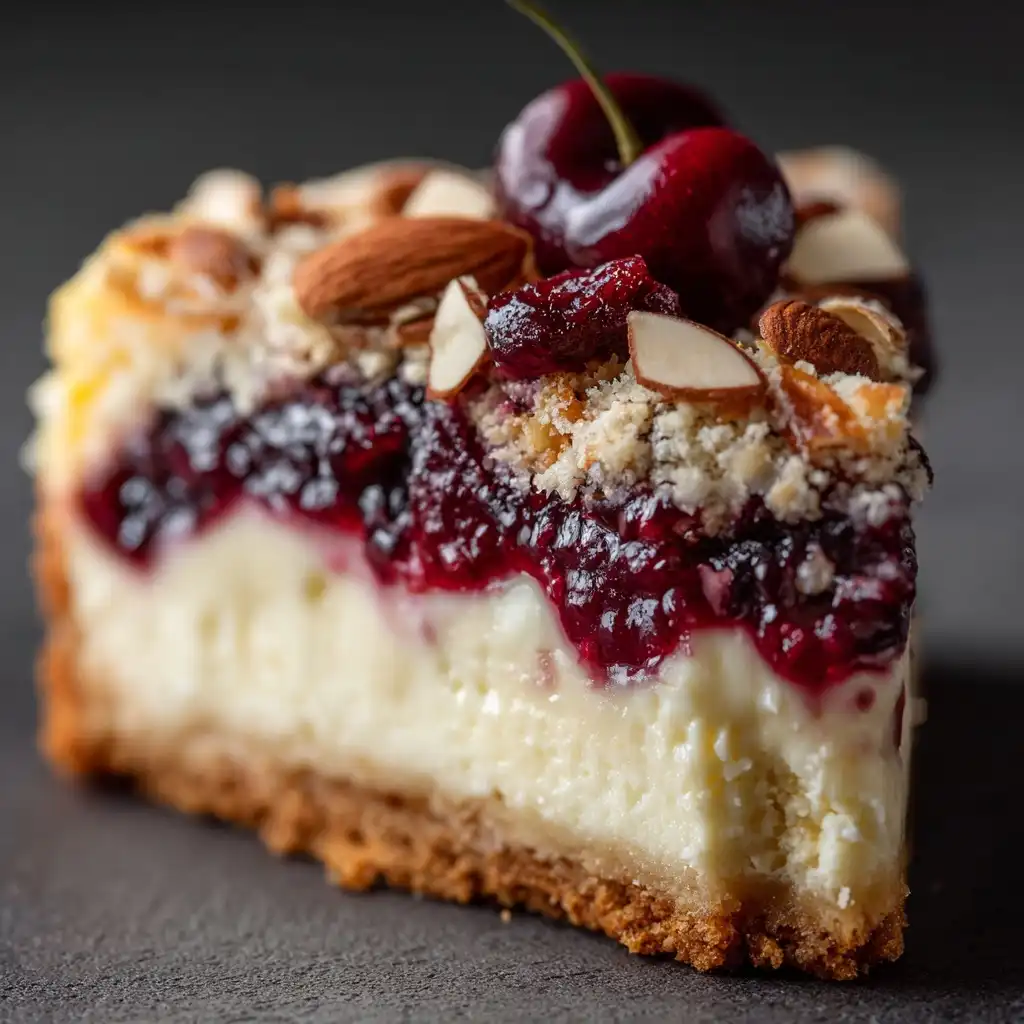
Cherry Almond Cheesecake is a luxurious, harmonious marriage of tart-sweet fruit and nutty sophistication—a dessert that transcends seasonal boundaries and elevates any occasion from casual Sunday brunch to elegant dinner party finale. With its velvety New York–style cheesecake base, fragrant almond-infused filling, and glossy, jewel-toned cherry topping, this confection delivers layered complexity in every forkful: creamy richness balanced by bright acidity, earthy depth countered by floral sweetness, and textural contrast between the tender crumb crust, dense yet airy filling, and luxuriously jammy glaze. Unlike standard fruit-topped cheesecakes, the intentional integration of almond—both in the crust and the filling—creates a resonant flavor bridge that unifies each component, transforming what could be a simple dessert into a thoughtfully composed culinary experience.
The History
While cheesecake itself traces its origins to ancient Greece (where it was served to athletes at the first Olympic Games in 776 BCE), the modern American baked cheesecake evolved through waves of European immigration—particularly German and Eastern European bakers who brought cream cheese innovations and nut-based pastry traditions in the late 19th and early 20th centuries. The pairing of cherries and almonds, however, has far older roots: in medieval European monastic gardens and Renaissance Italian confectionery, sour cherries were preserved with almond milk or almond paste for both preservation and flavor enhancement. By the mid-20th century, American home cooks began experimenting with flavored cream cheese fillings, and the rise of jarred cherry pie filling in the 1950s made fruit-topped cheesecakes widely accessible. Yet the *intentional*, dual-use of almond—ground in the graham cracker–almond flour crust *and* folded into the batter as extract, paste, or toasted slivers—emerged more deliberately in the 1980s and ’90s, championed by chefs like Nancy Silverton and food writers such as Marion Cunningham, who emphasized ingredient synergy over mere garnish. Today’s Cherry Almond Cheesecake reflects this evolution: not just a topping-on-base assembly, but a fully integrated, multi-generational homage to transatlantic baking wisdom, regional fruit abundance (especially Michigan tart cherries), and the timeless allure of nut-and-fruit pairings found in everything from Black Forest cake to Middle Eastern ma’amoul.
Ingredients Breakdown
Every element in this recipe serves both functional and sensory purpose—no ingredient is merely decorative or conventional. Let’s explore them in detail:
- Graham Cracker Crust Base: Standard graham crackers provide structure and caramelized sweetness, but we enhance them with toasted almond flour (not blanched—retaining natural oils and deeper flavor) for added nuttiness, moisture retention, and subtle graininess that contrasts beautifully with the ultra-smooth filling.
- Unsalted Butter: Melted and cooled—not hot—to bind the crust without prematurely melting the almond flour’s delicate oils. European-style butter (82–84% fat) is preferred for richer mouthfeel and superior browning.
- Granulated Sugar: Not just for sweetness—crucial for crust crispness and structural integrity during baking and cooling.
- Cream Cheese: Full-fat, brick-style, room-temperature Philadelphia or Vermont Creamery. Low-moisture, high-fat content ensures minimal water separation and maximum density. *Never use whipped, reduced-fat, or spreadable varieties.*
- Full-Fat Sour Cream: Adds tang, tenderness, and moisture while lowering pH to inhibit bacterial growth—critical for food safety during the long bake-and-cool cycle.
- Heavy Whipping Cream (36–40% fat): Provides lush, satiny texture and helps emulsify the batter. Ultra-pasteurized is acceptable, but avoid ultra-high-temp (UHT) versions which can impart a slight cooked flavor.
- Large Eggs: Added one at a time, fully incorporated before the next, to ensure stable emulsion and prevent air pockets. Room temperature is non-negotiable—cold eggs cause lumps and destabilize the batter.
- Granulated Sugar (for filling): Fine-grain for rapid dissolution; coarse sugar risks graininess. Also contributes to proper set and slight caramelization during baking.
- Pure Almond Extract: Not imitation—must be alcohol-based, cold-pressed, and free of coumarin (a banned compound in some countries). Use sparingly: 1½ tsp is the ideal threshold before bitterness emerges.
- Almond Paste (optional but recommended): A small amount (2 oz) blended into the batter adds incomparable depth, body, and marzipan-like resonance—far beyond what extract alone achieves. Look for Solo or Odense brands, softened at room temperature before folding in.
- Vanilla Bean Paste or Pure Extract: Complements almond without competing—vanilla’s phenolic compounds amplify almond’s benzaldehyde notes. Seeds from 1 scraped Tahitian or Madagascar bean add visual elegance and aromatic nuance.
- Sour Cherry Pie Filling: Preferably homemade (see Variations) or high-quality canned (like Traverse Bay or King Orchard)—avoid corn syrup–laden, artificially colored versions. Tart cherries’ high pectin and acidity cut through fat and activate natural fruit enzymes for optimal glaze sheen.
- Almond Slivers or Sliced Almonds: Toasted separately in a dry skillet until golden and fragrant—never raw—then cooled completely before garnish. Adds crunch, aroma release upon biting, and visual sophistication.
- Cherry Brandy or Kirsch (optional finishing touch): A single teaspoon stirred into warm cherry glaze deepens complexity and bridges fruit and nut profiles with subtle ester notes.
Step-by-Step Recipe
- Prep & Preheat: Position oven rack in center position. Preheat oven to 350°F (177°C). Wrap exterior of a 9-inch springform pan *tightly* with two overlapping sheets of heavy-duty aluminum foil (shiny side in), extending well above the pan’s rim to prevent water seepage. Place pan inside a larger roasting pan.
- Make the Crust: In a food processor, pulse 1½ cups graham cracker crumbs (about 12 full sheets), ¼ cup toasted almond flour, 3 tbsp granulated sugar, and ¼ tsp fine sea salt until uniformly combined. Add 6 tbsp melted, cooled unsalted butter and pulse until mixture resembles wet sand and holds together when pinched. Press firmly and evenly into bottom and 1 inch up sides of prepared springform pan using the back of a measuring cup. Freeze for 20 minutes.
- Bake the Crust: Bake chilled crust at 350°F for 10 minutes. Remove, gently tap pan on counter to settle crumbs, and cool completely on wire rack (≈30 min). Reduce oven temp to 325°F (163°C).
- Prepare Water Bath: Fill roasting pan with 1 inch of just-boiled water (≈2 quarts). Carefully place foil-wrapped springform pan into water bath—water should reach halfway up pan’s sides. Set aside.
- Beat Cream Cheese Base: In stand mixer fitted with paddle attachment, beat 24 oz (three 8-oz bricks) full-fat cream cheese on medium-low for 2 minutes until completely smooth and no lumps remain. Scrape bowl thoroughly. Add 1 cup full-fat sour cream and ½ cup heavy cream; beat 1 minute until homogenous.
- Incorporate Sweeteners & Flavorings: Add 1¼ cups granulated sugar and beat on medium for 2 minutes until dissolved and slightly fluffy. Scrape bowl. Add 1½ tsp pure almond extract, 1 tsp vanilla bean paste (or 1½ tsp pure extract), and 2 oz softened almond paste (cut into small cubes). Beat on low 30 seconds, then medium 1 minute until fully incorporated and glossy.
- Add Eggs Methodically: With mixer on low, add eggs one at a time, beating just until yolk disappears (≈15 seconds per egg). Scrape bowl after each addition. *Overmixing at this stage causes cracks and air pockets.* Batter should be thick, pourable, and satiny—not foamy.
- Fill & Smooth: Pour batter over cooled crust. Tap pan sharply 4 times on counter to release air bubbles. Run offset spatula around edge to detach batter from pan wall—prevents cracking during shrinkage.
- Bake with Precision: Carefully transfer roasting pan with water bath into preheated 325°F oven. Bake 1 hour 20 minutes–1 hour 35 minutes. Cheesecake is done when edges are set and center jiggles *just slightly* (like Jell-O) when gently shaken—not liquidy, not firm. Internal temperature at center should read 150–152°F (65–67°C) on instant-read thermometer.
- Cool Gradually (Critical!): Turn off oven. Crack oven door open 1 inch with wooden spoon. Let cheesecake sit in oven for 1 hour. Then remove from water bath, run thin knife around edge to loosen, and cool on wire rack at room temperature for 2 hours. Refrigerate uncovered for at least 12 hours—ideally 24–48 hours—for full texture development and clean slicing.
- Prepare Cherry Topping: While cheesecake chills, make glaze: In small saucepan, combine 2 cups pitted tart cherries (fresh, frozen, or high-quality canned), ⅓ cup granulated sugar, 2 tbsp lemon juice, 1 tsp cornstarch slurry (1 tsp cornstarch + 1 tsp cold water), and optional 1 tsp kirsch. Simmer 8–10 minutes until thickened and glossy. Cool completely, then strain through fine-mesh sieve to remove skins/pits if desired. Chill until ready to use.
- Final Assembly: Just before serving, spread cooled cherry glaze evenly over chilled cheesecake surface. Garnish with toasted almond slivers arranged in concentric circles or scattered artfully. For clean slices, dip knife in hot water and wipe dry between cuts.
Tips
- Room Temperature Is Non-Negotiable: Cream cheese, sour cream, heavy cream, and eggs must all be at true room temperature (68–72°F / 20–22°C) for 2+ hours—not just “out of the fridge.” Cold ingredients create lumps, poor emulsion, and uneven baking.
- Scrape Religiously: Use flexible silicone spatula to scrape bowl, paddle, and spatula *after every step*—especially post-egg additions. Undissolved sugar or unmixed almond paste causes gritty texture or flavor bursts.
- Water Bath Mastery: Always use boiling water—not warm or cold—to maintain thermal stability. If water level drops below halfway during baking, carefully add more boiling water with ladle.
- No Rush on Cooling: Skipping the oven-cool step or refrigerating while warm guarantees condensation, sweating, and cracked surfaces. Patience = perfection.
- Crust Reinforcement: For extra-sturdy crusts prone to crumbling, brush cooled, baked crust with 1 beaten egg white before chilling—creates a moisture barrier.
- Crack Repair (If It Happens): Don’t panic. Chill fully, then cover crack generously with cherry glaze—it becomes an intentional “rustic seam.” Or pipe whipped cream rosettes along the line for elegant camouflage.
- Slicing Science: Use a long, thin, non-serrated knife. Heat in hot water for 10 seconds, wipe *completely* dry, slice with gentle downward pressure (no sawing), and reheat/wipe between each cut.
- Storage Wisdom: Keep covered tightly with plastic wrap directly touching surface (prevents drying) or under inverted cake dome. Lasts 5 days refrigerated. Freezes beautifully for up to 3 months—wrap twice in plastic, then foil, thaw overnight in fridge.
Variations and Customizations
This recipe is a canvas—not a cage. Here are inspired, chef-tested adaptations:
- Gluten-Free Version: Substitute gluten-free graham-style crackers (like Pamela’s) + ¼ cup GF oat flour for almond flour in crust. Ensure all extracts and toppings are certified GF. Add ½ tsp xanthan gum to batter for elasticity.
- Vegan Adaptation: Use soaked raw cashews (2 cups), silken tofu (1 cup), coconut cream (¾ cup), almond butter (¼ cup), maple syrup (⅔ cup), lemon juice (3 tbsp), and 2 tsp almond extract. Set with agar-agar (2 tsp bloomed in ¼ cup water) instead of eggs. Crust: GF oats + almond flour + coconut oil + maple syrup.
- White Chocolate–Almond Swirl: Melt 4 oz high-quality white chocolate (32% cocoa butter). Cool to 85°F. Dollop over batter before baking and swirl gently with toothpick—not too much, or it bleeds.
- Black Cherry–Bourbon Variation: Replace sour cherries with sweet black cherries + 2 tbsp bourbon in glaze. Add ½ tsp smoked sea salt to crust.
- Amaretto Infusion: Replace 2 tbsp heavy cream with amaretto liqueur in batter. Boost almond extract to 2 tsp. Garnish with candied amaretto cherries.
- Raw No-Bake Option: Blend 2 cups soaked cashews, ⅓ cup maple syrup, ⅓ cup almond butter, ¼ cup lemon juice, 2 tsp almond extract, pinch salt. Press into almond-date crust. Chill 8+ hours. Top with raw cherry chia jam (cherries + chia seeds + lemon + maple).
- Mini Mason Jar Cheesecakes: Halve recipe; layer crust (2 tsp), filling (3 tbsp), and glaze (1 tsp) in 4-oz jars. Bake in water bath at 325°F for 28–32 minutes. Chill 6+ hours.
- Flourless Almond Crust Upgrade: Replace graham crackers with 1 cup almond flour, ¼ cup coconut flour, 3 tbsp maple syrup, 3 tbsp melted coconut oil, ¼ tsp cinnamon, pinch salt. Press and bake same as original.
- Seasonal Fruit Rotations: Swap cherry glaze for blueberry-lavender compote (spring), peach–cardamom coulis (summer), spiced pear–ginger reduction (fall), or blood orange–rosewater curd (winter)—always balancing acidity and sweetness to complement almond’s intensity.
Health Considerations and Nutritional Value
A single generous slice (1/12 of 9-inch cake, ≈220g) contains approximately:
- Calories: 485 kcal
- Total Fat: 32 g (19 g saturated, 10 g monounsaturated—primarily from almonds and dairy)
- Cholesterol: 135 mg (32% DV)
- Sodium: 240 mg (10% DV)
- Total Carbohydrates: 42 g (including 30 g sugars—22 g naturally occurring from cherries, 8 g added)
- Dietary Fiber: 1.5 g (from almond flour & graham crumbs)
- Protein: 8 g (from dairy, almonds, eggs)
Nutritional Highlights & Considerations:
- Almond Benefits: Rich in vitamin E (a potent antioxidant), magnesium (supports nerve/muscle function), and heart-healthy monounsaturated fats. Toasting enhances bioavailability of certain polyphenols.
- Cherry Advantages: Tart cherries contain anthocyanins—anti-inflammatory compounds linked to improved sleep (melatonin), reduced muscle soreness, and cardiovascular support. Their lower glycemic index (22) vs. sweet cherries (36) makes them a smarter fruit choice for blood sugar management.
- Cream Cheese Reality: While high in saturated fat, full-fat dairy is associated in recent meta-analyses with neutral or even protective effects on cardiovascular health when consumed as part of a balanced diet—unlike refined carbohydrates or trans fats.
- Portion Mindfulness: Due to calorie density, savoring one thoughtful slice (paired with herbal tea or sparkling water) aligns with mindful eating principles better than multiple smaller servings.
- Allergen Notes: Contains dairy, eggs, tree nuts (almonds), and gluten (unless modified). Cross-contamination risk exists in shared facilities.
- Lower-Sugar Options: Reduce granulated sugar in filling to 1 cup (saves 40 kcal/slice); replace cherry glaze sugar with monk fruit–erythritol blend (1:1 ratio); increase lemon juice for brightness without added sweetness.
- Probiotic Potential: Using cultured sour cream and full-fat yogurt (substituted for ¼ cup sour cream) introduces live active cultures—though heat during baking reduces viability, residual strains may survive in outer layers.
Ingredients
Makes one 9-inch cheesecake (12–16 servings)
For the Crust:
- 1½ cups (150g) graham cracker crumbs (about 12 full 2.5”x2.5” squares)
- ¼ cup (25g) finely ground toasted almond flour (not blanched)
- 3 tablespoons (38g) granulated sugar
- ¼ teaspoon fine sea salt
- 6 tablespoons (85g) unsalted butter, melted and cooled
For the Cheesecake Filling:
- 24 ounces (680g) full-fat brick-style cream cheese, at room temperature (3 standard 8-oz packages)
- 1 cup (240g) full-fat sour cream, at room temperature
- ½ cup (120ml) heavy whipping cream (36–40% fat), at room temperature
- 1¼ cups (250g) granulated sugar
- 1½ teaspoons pure almond extract (alcohol-based, not imitation)
- 1 teaspoon vanilla bean paste (or 1½ tsp pure vanilla extract)
- 2 ounces (57g) almond paste, softened to room temperature
- 4 large eggs, at room temperature (≈200g total weight in shells)
For the Cherry Glaze:
- 2 cups (300g) pitted tart cherries (fresh, frozen & thawed, or high-quality canned in juice—not syrup)
- ⅓ cup (67g) granulated sugar
- 2 tablespoons (30ml) fresh lemon juice
- 1 teaspoon cornstarch mixed with 1 teaspoon cold water (slurry)
- Optional: 1 teaspoon kirsch or cherry brandy
For Garnish:
- ¼ cup (25g) sliced or slivered almonds, toasted until golden and fragrant
- Optional: edible dried rose petals or mint sprigs
Directions
- Preheat & Prepare Pan: Adjust oven rack to center position. Preheat oven to 350°F (177°C). Wrap exterior of 9-inch springform pan tightly with two overlapping sheets of heavy-duty aluminum foil, ensuring coverage extends at least 3 inches above rim. Place pan inside a large roasting pan (at least 16″x13″).
- Make Crust: In food processor, combine graham cracker crumbs, toasted almond flour, sugar, and salt. Pulse 5–6 times until uniform. Add melted, cooled butter and pulse 8–10 seconds until mixture resembles damp sand and clumps when squeezed. Press firmly and evenly into bottom and 1 inch up sides of foil-wrapped pan using flat-bottomed measuring cup or glass. Freeze 20 minutes.
- Bake Crust: Bake frozen crust at 350°F for 10 minutes. Remove, tap gently on counter, and cool completely on wire rack (≈30 minutes). Reduce oven temperature to 325°F (163°C).
- Prepare Water Bath: Boil kettle. Carefully pour 1 inch (≈2 quarts) of boiling water into roasting pan. Set aside.
- Beat Cream Cheese: In stand mixer with paddle attachment, beat cream cheese on medium-low 2 minutes until perfectly smooth. Scrape bowl. Add sour cream and heavy cream; beat 1 minute until blended.
- Add Sugar & Flavorings: Add sugar; beat medium 2 minutes until dissolved and slightly aerated. Scrape bowl. Add almond extract, vanilla paste, and almond paste; beat low 30 sec, then medium 1 min until glossy and seamless.
- Incorporate Eggs: With mixer on low, add eggs one at a time, beating just until yolk disappears (≈15 sec each). Scrape bowl after each. Do NOT overmix.
- Fill Pan: Pour batter over cooled crust. Tap pan sharply 4 times on counter. Run thin spatula around edge to detach batter.
- Bake: Carefully place roasting pan with water bath into preheated 325°F oven. Bake 1 hour 20 minutes to 1 hour 35 minutes—until edges are set and center jiggles slightly. Internal temp: 150–152°F.
- Cool Slowly: Turn off oven. Crack door open 1 inch with wooden spoon. Leave cheesecake inside 1 hour. Remove from water bath, run knife around edge, cool on rack 2 hours. Refrigerate uncovered ≥12 hours (preferably 24–48).
- Make Glaze: Combine cherries, sugar, lemon juice, and slurry in saucepan. Bring to simmer over medium heat. Cook 8–10 min, stirring, until thickened and glossy. Stir in kirsch if using. Cool completely, then strain if desired. Chill.
- Finish & Serve: Spread chilled glaze evenly over cheesecake. Garnish with toasted almonds. Slice with hot, wiped knife. Store covered in refrigerator up to 5 days.
FAQ
- Can I make this without a water bath?
- No—this is non-negotiable for crack-free, velvety texture. The steam moderates oven temperature, prevents rapid expansion/contraction, and ensures gentle, even cooking. Skip it, and you risk fissures, dry edges, and rubbery center.
- Why does my crust crumble when I cut?
- Three likely causes: (1) Not enough butter—measure precisely; (2) Insufficient pressing—use firm, even pressure with flat tool; (3) Cutting while too cold—let sit at room temperature 10–15 minutes before slicing.
- Can I use sweet cherries instead of tart?
- You can—but balance is critical. Sweet cherries lack acidity to cut richness. Reduce sugar in glaze by 25%, add 1 extra tbsp lemon juice, and include ¼ tsp grated lemon zest for brightness.
- My cheesecake sank in the center—is it ruined?
- Not at all. Slight settling is normal during cooling. As long as it’s fully chilled and slices cleanly, it’s perfect. Over-beating eggs or opening oven too soon can exaggerate sinking—but flavor remains exceptional.
- Is there a substitute for almond paste?
- Yes—but with trade-offs. Replace with ¼ cup finely ground blanched almonds + 2 tbsp honey (adds moisture and binding). Avoid marzipan—it’s sweeter and contains more sugar, altering texture.
- Can I freeze the whole cheesecake?
- Absolutely. After full chill (48 hrs), wrap *tightly* in plastic wrap (pressing to eliminate air pockets), then double-wrap in heavy-duty foil. Freeze ≤3 months. Thaw overnight in refrigerator—do NOT thaw at room temperature.
- What if I don’t have almond flour?
- Grind raw, skin-on almonds in food processor until fine (≈1 min), then sift. Re-process any coarse bits. Toast *after* grinding for best flavor and to prevent burning. Never use store-bought “almond meal”—it’s too coarse and oily.
- Can I make this ahead for Thanksgiving?
- Yes—and highly recommended! Bake and chill 2 days ahead. Apply glaze and garnish the morning of serving. Flavors deepen and textures harmonize beautifully over 48 hours.
- Why did my glaze turn cloudy or separate?
- Cloudiness comes from undissolved cornstarch—always use cold-water slurry, not dry powder. Separation happens if glaze cools too fast or is stirred vigorously while hot. Reheat gently and whisk smoothly.
- Can kids help make this?
- Yes—with supervision! They can measure crumbs/sugar,