Introduction
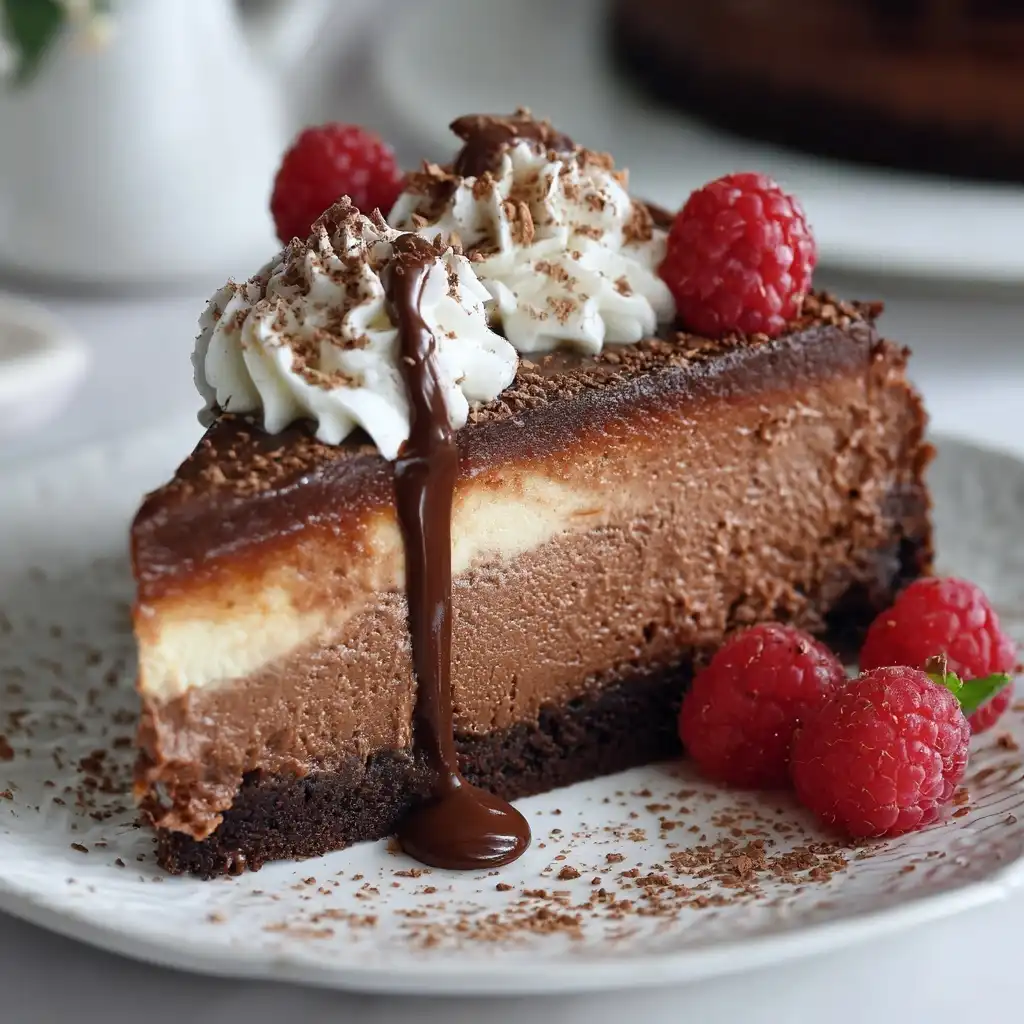
Indulge in the ultimate chocolate fantasy—Triple Chocolate Cheesecake. This decadent, velvety dessert isn’t just a treat; it’s an experience—a luxurious symphony of rich cocoa, smooth milk chocolate, and intense dark chocolate, all built upon a luscious, creamy New York–style cheesecake base and crowned with a glossy, multi-layered chocolate finish. Whether you’re celebrating a milestone, hosting a dinner party, or simply treating yourself to pure, unapologetic luxury, this dessert delivers unparalleled depth, texture, and satisfaction. Its name says it all: three distinct forms of chocolate—cocoa powder in the filling, melted milk chocolate folded into the batter, and a dark chocolate ganache glaze—each playing a unique role in crafting a harmonious, deeply resonant chocolate profile that lingers long after the last bite.
The History
The evolution of Triple Chocolate Cheesecake is a delicious convergence of two iconic dessert lineages: the ancient roots of cheese-based sweets and the relatively modern obsession with layered chocolate intensity. Cheesecake itself traces back over 2,000 years—to ancient Greece—where simple mixtures of fresh cheese, honey, and flour were served at Olympic games. It migrated through Roman conquests, evolved in medieval Europe with the advent of cream cheese (first mass-produced by William Lawrence in 1872 in Chester, New York), and exploded in popularity with the rise of the New York–style baked cheesecake in the early 20th century—dense, tall, crack-resistant, and luxuriously creamy.
Meanwhile, chocolate’s journey—from sacred Mesoamerican beverage (xocolātl) to European aristocratic indulgence—culminated in the Industrial Revolution’s innovations: solid eating chocolate (Fry & Sons, 1847), milk chocolate (Daniel Peter & Henri Nestlé, 1875), and cocoa powder processing (van Houten, 1828). By the late 20th century, American bakers began experimenting with “triple chocolate” concepts in brownies and cakes—layering cocoa, milk, and dark chocolate for maximum impact. The first documented Triple Chocolate Cheesecake recipes appeared in gourmet food magazines and high-end bakery menus in the mid-1990s, notably featured by chefs like Gale Gand (Chicago) and Martha Stewart’s test kitchens. It gained viral traction in the 2010s via food blogs and Instagram, where its dramatic cross-section—crumbly Oreo crust, ivory cheesecake layer, molten milk chocolate ribbon, and obsidian-dark ganache top—became an aesthetic and gustatory icon. Today, it stands as a benchmark of modern dessert craftsmanship: technically demanding yet emotionally irresistible.
Ingredients Breakdown
Every component of Triple Chocolate Cheesecake serves a precise structural, textural, and flavor purpose—no ingredient is arbitrary. Below is a meticulous functional analysis:
- Graham Cracker Crust (Base Layer): Graham crackers provide toasted wheat notes and subtle sweetness; granulated sugar enhances caramelization and crispness; unsalted butter binds and adds richness while ensuring shortbread-like snap—not chewiness. A pinch of kosher salt balances sweetness and deepens flavor perception.
- Cheesecake Filling (Core Layer): Full-fat brick-style cream cheese (Philadelphia brand recommended) ensures stability, tang, and dense creaminess—low-fat versions cause wheying, cracking, and graininess. Sour cream contributes acidity, tenderness, and moisture retention; heavy cream adds fluidity and silkiness without diluting flavor. Granulated sugar dissolves fully during mixing for smoothness; brown sugar (light or dark) introduces molasses complexity and slight chew. Pure vanilla extract (not imitation) rounds out dairy notes and lifts chocolate aroma. High-quality Dutch-process cocoa powder (e.g., Valrhona Cocoa Powder or Cacao Barry Extra Brute) delivers deep, nuanced, non-bitter chocolate essence—its alkalized pH improves dispersion and color intensity. Large eggs (room temperature) act as emulsifiers and structural scaffolding—adding them one at a time prevents curdling. Egg yolks specifically enrich mouthfeel and lend golden hue and custard-like tenderness.
- Milk Chocolate Ribbon (Middle Swirl): High-cocoa-content milk chocolate (35–45% cacao, e.g., Callebaut Milk Chocolate Callets or Guittard Milk Chocolate) provides creamy sweetness and caramelized dairy notes. Tempered or gently melted (not overheated past 115°F/46°C) to preserve viscosity and sheen. A small amount of neutral oil (grapeseed or coconut) may be added for optimal swirl definition and melt-in-mouth fluidity.
- Dark Chocolate Ganache (Top Layer): 68–72% dark chocolate (e.g., Scharffen Berger, Lindt Excellence, or Valrhona Guanaja) supplies bold, complex bitterness, red fruit acidity, and tannic structure to counterbalance sweetness. Heavy cream (not half-and-half or milk) ensures proper emulsion, gloss, and firm set. A touch of corn syrup (½ tsp) inhibits sugar crystallization for mirror-like shine and prevents blooming. Unsalted butter (cold, cubed) added post-emulsion imparts satiny richness and temperature stability.
- Optional Garnishes: Flaky sea salt (Maldon) heightens contrast and triggers salivary response; edible gold leaf elevates visual opulence; chocolate curls (made from tempered dark chocolate) add textural intrigue and artisanal flair; espresso-dusted cocoa powder intensifies chocolate aroma without adding liquid.
Step-by-Step Recipe
- Prep the Pan & Oven: Preheat oven to 325°F (163°C). Wrap the *outside* of a 9-inch springform pan tightly with two overlapping layers of heavy-duty aluminum foil—this prevents water seepage during the critical water bath step. Place pan inside a large roasting dish or disposable aluminum tray.
- Make the Crust: Pulse 1 ½ cups graham cracker crumbs (about 12 full sheets), ¼ cup granulated sugar, and ¼ tsp kosher salt in a food processor until fine. Add 6 tbsp melted unsalted butter and pulse until mixture resembles wet sand. Press firmly and evenly into bottom and 1 inch up sides of prepared pan using the back of a measuring cup. Bake 10 minutes until fragrant and set. Cool completely on wire rack—do not skip cooling; warm crust causes filling separation.
- Prepare the Water Bath: Fill roasting dish with 1–2 inches of *very hot* tap water (not boiling)—this stabilizes oven temperature and prevents surface cracks. Place on lowest oven rack.
- Beat Cream Cheese Base: In a large bowl of stand mixer fitted with paddle attachment, beat 24 oz (3 standard blocks) full-fat cream cheese at medium speed for 2 minutes until perfectly smooth, scraping bowl frequently. Add 1 cup granulated sugar + ¼ cup light brown sugar; beat 2 more minutes until fluffy and lump-free. Scrape down. Add 1 cup sour cream, ½ cup heavy cream, and 2 tsp pure vanilla extract; beat 1 minute until homogenous.
- Incorporate Dry Ingredients: Sift together ⅔ cup Dutch-process cocoa powder, ¼ tsp fine sea salt, and ¼ tsp instant espresso powder (optional but highly recommended for depth); whisk into batter on low speed just until no streaks remain—overmixing develops gluten and causes toughness.
- Add Eggs Methodically: With mixer on low, add 4 large room-temperature eggs one at a time, beating 20 seconds after each addition until *just* incorporated—no visible yolk ribbons. Then add 2 large room-temperature egg yolks, beating 15 seconds each. Batter should be thick, glossy, and aerated—not runny or broken.
- Swirl in Milk Chocolate: Melt 6 oz high-quality milk chocolate with 1 tsp neutral oil in microwave (30-sec bursts, stirring between) or double boiler until smooth and ~110°F. Let cool 2 minutes. Pour in zigzag pattern over batter. Use a thin skewer or chopstick to drag through batter in figure-eight motions—create loose, organic marbling (not over-swirled). Avoid touching crust edge.
- Bake in Water Bath: Carefully pour batter into cooled crust. Gently tap pan on counter twice to release air bubbles. Place roasting dish with hot water onto oven’s lowest rack. Carefully slide cheesecake into center of water bath. Bake 1 hour 20 minutes–1 hour 35 minutes—until edges are puffed and set, center jiggles only slightly like Jell-O (not liquid), and internal temperature reads 150–152°F (65–67°C) on instant-read thermometer inserted 1 inch from center.
- Slow-Cool Crucial Phase: Turn OFF oven. Crack oven door open 1 inch with wooden spoon handle. Let cheesecake cool undisturbed in oven for 1 hour. Remove from water bath. Run thin knife around edge to loosen. Cool on wire rack at room temp 1 hour more. Refrigerate uncovered minimum 12 hours (ideally 24–48 hrs) before glazing—this allows full protein set and flavor development.
- Prepare Ganache: Chop 8 oz 70% dark chocolate finely. Heat ¾ cup heavy cream in saucepan until simmering (small bubbles at edges). Pour over chocolate; let sit 3 minutes. Whisk gently from center outward until smooth and glossy. Stir in 1 tsp light corn syrup and 2 tbsp cold unsalted butter, one cube at a time, until fully emulsified. Cool to 90–95°F (32–35°C)—warm enough to pour smoothly, cool enough to set quickly.
- Glaze & Set: Place chilled, fully set cheesecake on wire rack over parchment. Pour ganache slowly over center; tilt pan gently to spread evenly to edges. Let excess drip off. Tap rack lightly to pop air bubbles. Refrigerate uncovered 3 hours minimum—or overnight—for flawless, mirror-like finish.
- Unmold & Serve: Run warm knife around perimeter. Release springform clasp. Lift off side band. Slide thin metal spatula under crust to transfer to serving platter. Chill 15 minutes before slicing. Use a hot, dry knife (dipped in hot water and wiped clean between cuts) for pristine slices.
Tips
- Room Temperature Is Non-Negotiable: Cold cream cheese = lumps; cold eggs = curdled batter; cold sour cream = poor emulsion. Remove all dairy and eggs from fridge 3+ hours ahead. If rushed, cut cream cheese into cubes and let sit 90 minutes; submerge eggs in warm water 15 minutes.
- Sift Cocoa—Always: Dutch-process cocoa is notoriously clumpy. Sifting with salt and espresso powder ensures even dispersion and eliminates gritty texture.
- Water Bath Precision: Use *hot* (not boiling) water—it prevents thermal shock. Ensure foil is double-wrapped and seams are overlapped. If water leaks in, don’t panic—just pat crust dry with paper towel and continue baking.
- Underbake Slightly: Err on the side of a soft jiggle—overbaking causes shrinkage, cracking, and grainy texture. The residual heat carries the center to perfect set during slow-cooling.
- No Rush on Chilling: Skipping the 24-hour chill yields a fragile, soupy slice. Cold sets proteins, firms fats, and allows flavors to meld—transforming good into transcendent.
- Ganache Temperature Matters: Too hot → melts cheesecake layer and creates dull finish. Too cold → sets too fast, causing streaks and matte appearance. Use candy thermometer; if unsure, let sit 5 minutes longer.
- Knife Discipline: Wipe, rinse, and reheat knife before *every* slice. One dirty cut ruins presentation. For clean edges, chill sliced cake 10 minutes before serving.
- Crack Repair Hack: If minor cracks appear, conceal with extra ganache drizzle, chocolate shards, or a dusting of cocoa + flaky salt—imperfections become intentional artistry.
Variations and Customizations
This recipe is a master canvas—elevate, adapt, or personalize without compromising integrity:
- Gluten-Free: Swap graham crackers for GF chocolate wafers (Canyon Bakehouse) or almond flour–cocoa crust (1 cup almond flour + ¼ cup cocoa + 3 tbsp sugar + 5 tbsp melted butter).
- Vegan Adaptation: Use soaked cashews (2 cups) blended with coconut cream, maple syrup, and aquafaba instead of eggs; coconut oil–based “cream cheese” (Kite Hill); and dairy-free dark/milk chocolates (Enjoy Life, Pascha). Requires 2-hour freeze-set instead of bake.
- Boozy Infusion: Add 2 tbsp bourbon, Grand Marnier, or espresso liqueur to ganache; or swirl 1 tbsp Kahlúa into milk chocolate ribbon before swirling.
- Spiced Complexity: Add ½ tsp ground cinnamon + ¼ tsp cayenne to cocoa mixture for Mexican chocolate warmth; or infuse cream with star anise and orange peel for ganache.
- Crust Innovations: Oreo (24 cookies + 5 tbsp butter), Biscoff (1 ½ cups + 6 tbsp butter), or dark chocolate cookie crust (Chocolove or Tate’s) for deeper base notes.
- Texture Layers: Press ½ cup toasted hazelnuts or espresso beans into ganache before chilling; or embed a hidden layer of salted caramel (½ cup, cooled) between filling and ganache.
- Mini Version: Bake in lined muffin tins (2 tbsp crust, ¼ cup filling, 1 tsp milk chocolate, 1 tsp ganache). Reduce bake time to 22–25 mins. Chill 8 hours minimum.
- White Chocolate Variation: Replace milk chocolate ribbon with high-quality white chocolate (35% cocoa butter), infused with 1 tsp vanilla bean paste and pinch of cardamom.
Health Considerations and Nutritional Value
Triple Chocolate Cheesecake is, by nature, a celebratory, energy-dense dessert—not intended for daily consumption—but understanding its nutritional composition empowers mindful enjoyment:
- Caloric Profile (per standard slice, 1/12th of 9-inch cake): ~680–750 kcal. Primary sources: saturated fat (38–42g), total fat (48–52g), carbohydrates (52–58g), sugars (40–44g), protein (10–12g).
- Fat Quality: While high in saturated fat (from cream cheese, butter, chocolate), it contains beneficial monounsaturated fats (from cocoa butter, nuts in optional garnishes) and conjugated linoleic acid (CLA) from grass-fed dairy (if used). Dark chocolate contributes heart-healthy flavanols—up to 150mg per 1-oz serving—if 70%+ cacao is used.
- Sugar Context: Contains refined sugars (granulated, brown), but the inclusion of fiber-rich cocoa (3–4g per serving) and healthy fats slows glucose absorption—lower glycemic impact than many fruit-based desserts.
- Allergens & Sensitivities: Contains dairy (milk, cream, butter), eggs, wheat (in graham crackers), and soy (often in chocolate lecithin). Always verify labels for soy, gluten, or nut cross-contamination if needed.
- Mindful Modifications: Reduce sugar by 25% in filling (compensate with extra vanilla or espresso); substitute ¼ cup sour cream with Greek yogurt (adds protein, reduces fat); use avocado oil instead of butter in crust (monounsaturated focus); opt for organic, fair-trade, low-pesticide chocolate to minimize chemical load.
- Portion Wisdom: Serving size matters—cutting into 16 slices instead of 12 reduces calories by ~15%. Pair with antioxidant-rich black coffee or unsweetened herbal tea to aid digestion and polyphenol absorption.
- Not a Health Food—But Not ‘Junk’ Either: When made with premium ingredients and enjoyed intentionally—not mindlessly—it delivers pleasure, social connection, and bioactive compounds (theobromine, magnesium, iron, zinc) that support mood and vascular function. Balance lies in frequency, portion, and context—not moralizing ingredients.
Ingredients
- For the Crust:
- 1 ½ cups (150g) graham cracker crumbs (about 12 full sheets)
- ¼ cup (50g) granulated sugar
- ¼ tsp fine sea salt
- 6 tablespoons (85g) unsalted butter, melted
- For the Cheesecake Filling:
- 24 oz (680g) full-fat brick-style cream cheese, room temperature
- 1 cup (200g) granulated sugar
- ¼ cup (50g) light brown sugar, packed
- 1 cup (240g) full-fat sour cream, room temperature
- ½ cup (120ml) heavy cream (36–40% fat), room temperature
- 2 tsp pure vanilla extract
- ⅔ cup (65g) Dutch-process cocoa powder, sifted
- ¼ tsp fine sea salt
- ¼ tsp instant espresso powder (optional but recommended)
- 4 large eggs, room temperature
- 2 large egg yolks, room temperature
- For the Milk Chocolate Ribbon:
- 6 oz (170g) high-quality milk chocolate (35–45% cacao), finely chopped
- 1 tsp neutral oil (grapeseed, refined coconut, or sunflower)
- For the Dark Chocolate Ganache:
- 8 oz (225g) 70% dark chocolate, finely chopped
- ¾ cup (180ml) heavy cream (36–40% fat)
- 1 tsp light corn syrup
- 2 tablespoons (30g) unsalted butter, cold and cubed
- For Garnish (Optional):
- Flaky sea salt (Maldon or Jacobsen)
- Chocolate curls or shavings
- Edible gold leaf
- Dusting of cocoa powder + espresso
Directions
- Preheat oven to 325°F (163°C). Prepare pan: Wrap exterior of 9-inch springform pan with two layers heavy-duty foil, sealing seams tightly. Place pan inside large roasting pan or disposable aluminum tray.
- Make crust: In food processor, pulse graham crackers until fine crumbs form. Add sugar and salt; pulse to combine. Add melted butter; pulse until mixture resembles wet sand. Press firmly into bottom and 1 inch up sides of pan. Bake 10 minutes. Cool completely on wire rack.
- Prepare water bath: Fill roasting pan with 1–2 inches of very hot tap water (120–140°F). Place on lowest oven rack.
- Make filling: Using stand mixer with paddle attachment, beat cream cheese on medium 2 minutes until smooth. Add granulated and brown sugars; beat 2 minutes until fluffy. Scrape bowl. Add sour cream, heavy cream, and vanilla; beat 1 minute until combined.
- Add dry ingredients: Sift cocoa, salt, and espresso powder over batter. Mix on low just until incorporated—no streaks.
- Add eggs: With mixer on low, add eggs one at a time, beating 20 seconds after each. Add egg yolks, beating 15 seconds each. Batter should be thick and glossy.
- Prepare milk chocolate: Melt chocolate and oil in microwave (30-sec bursts, stirring) until smooth and ~110°F. Cool 2 minutes.
- Swirl: Pour chocolate in zigzag over batter. Drag skewer in figure-eights to create loose marbling.
- Bake: Pour batter into cooled crust. Tap pan firmly twice. Place roasting pan with hot water onto oven’s lowest rack. Slide cheesecake in center. Bake 1 hr 20 min–1 hr 35 min, until edges are set and center jiggles slightly. Internal temp: 150–152°F.
- Cool slowly: Turn OFF oven. Crack door 1 inch with spoon. Cool 1 hour inside. Remove from water bath. Loosen edges with knife. Cool on rack 1 hour. Refrigerate uncovered ≥12 hours (ideally 24–48 hrs).
- Make ganache: Chop chocolate. Heat cream until simmering. Pour over chocolate; wait 3 minutes. Whisk gently until smooth. Whisk in corn syrup and cold butter, one piece at a time, until emulsified. Cool to 90–95°F.
- Glaze: Place chilled cake on wire rack over parchment. Pour ganache over center; tilt to spread. Tap rack to remove bubbles. Refrigerate uncovered ≥3 hours.
- Unmold & serve: Run warm knife around edge. Release clasp. Lift off side band. Transfer to platter. Chill 15 minutes. Slice with hot, clean knife.
FAQ
- Can I make this without a water bath?
- No—water bath is essential for gentle, even heat, preventing cracks, curdling, and dry edges. Skip it, and you risk structural failure. Foil wrapping makes cleanup easy.
- Why does my cheesecake crack?
- Most common causes: overmixing after eggs, cooling too quickly, opening oven too soon, or overbaking. Follow slow-cool instructions *exactly*. If cracks occur, embrace them—ganache hides beautifully.
- Can I use regular (natural) cocoa powder?
- You can—but results suffer. Natural cocoa is acidic and lighter in color/flavor. Dutch-process provides richer color, smoother mouthfeel, and better dispersion. If substituting, add ¼ tsp baking soda to neutralize acidity.
- How do I prevent a soggy crust?
- Ensure crust is fully cooled before adding batter. Double-foil wrap prevents water intrusion. If water leaks, gently dab crust edge with paper towel before baking.
- Can I freeze Triple Chocolate Cheesecake?
- Yes! Un-glazed, fully chilled cheesecake freezes well for up to 3 months. Wrap tightly in plastic + foil. Thaw overnight in fridge, then glaze and chill again before serving.
- What if my ganache is lumpy or separated?
- Lumps mean chocolate wasn’t finely chopped or cream wasn’t hot enough. Separation means water contamination or overheating. Fix by whisking in 1 tsp hot cream or ½ tsp room-temp butter until smooth. Strain if needed.
- Can I use low-fat cream cheese or sour cream?
- Strongly discouraged. Reduced-fat dairy lacks sufficient fat solids, causing weeping, graininess, and poor structure. Full-fat is non-negotiable for texture and stability.
- How far in advance can I make this?
- Crust: 3 days ahead (store airtight at room temp). Filled & baked: Up to 3 days ahead (refrigerated, unglazed). Glazed: Best served within 3 days. Ganache keeps 1 week refrigerated—reheat gently before pouring.
- Is there a way to reduce sweetness without ruining texture?
- Yes—reduce granulated sugar to ¾ cup and omit brown sugar. Compensate with 1 tsp espresso powder and extra ½ tsp vanilla. Never reduce eggs or dairy—they’re structural, not sweeteners.
- Why does my cheesecake taste eggy?
- Overbeating eggs incorporates too much air, creating a rubbery, custard-like texture. Beat eggs *just* until incorporated—no more. Also, ensure eggs are truly room temperature to avoid scrambling when mixed into warm batter.
Summary
Triple Chocolate Cheesecake is a masterclass in chocolate layering—featuring a crisp graham cracker crust, a profoundly rich cocoa-infused New York–style filling, a silky milk chocolate ribbon swirled throughout, and a glossy, bittersweet dark chocolate ganache top—all achieved through precise technique, quality ingredients, and patient chilling.
It’s a dessert that honors tradition while embracing innovation: technically rigorous enough to challenge seasoned bakers, yet universally beloved for its deep, resonant chocolate harmony, luxurious texture, and unforgettable presence on any table.