Introduction
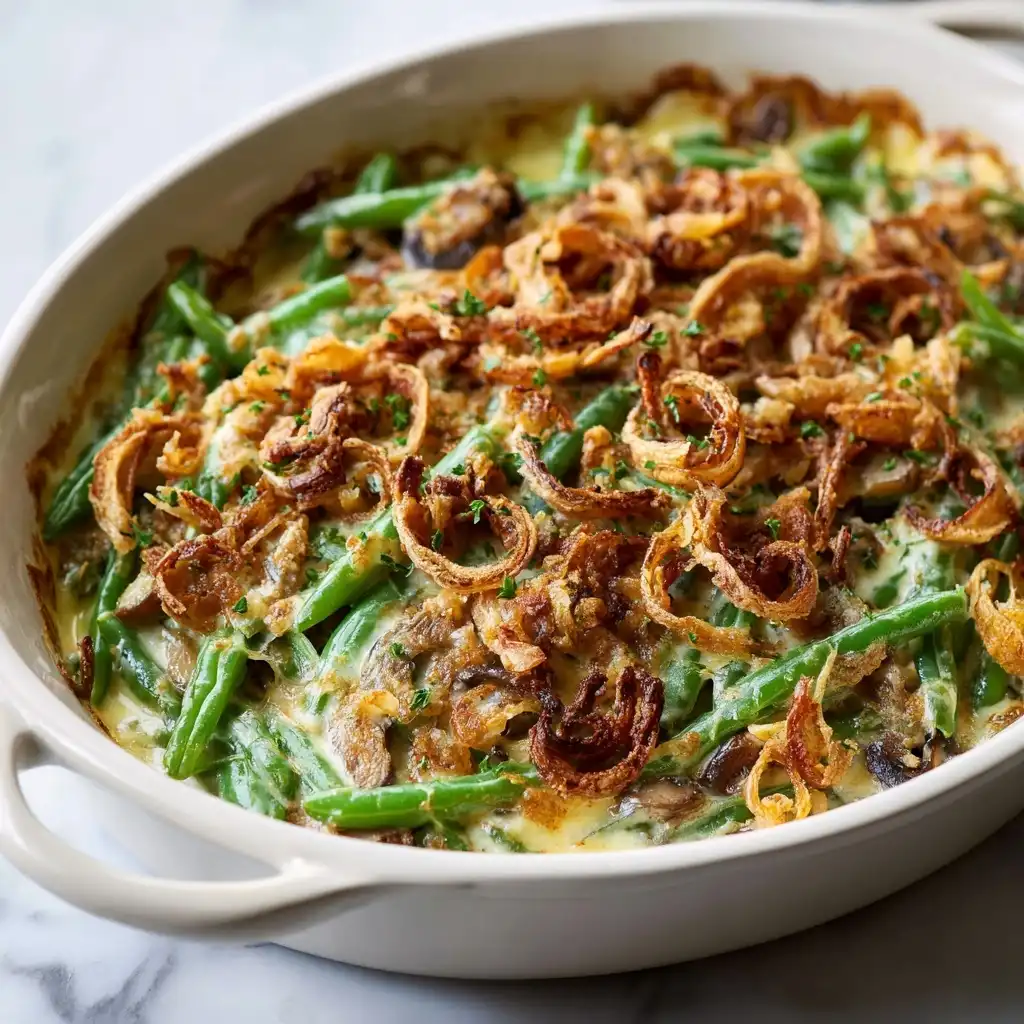
Green Bean Casserole is more than just a side dish—it’s a cherished American culinary tradition, especially synonymous with holiday gatherings, potlucks, and family dinners. Born from mid-century ingenuity and pantry practicality, this creamy, savory, and satisfying casserole has endured for over seven decades not because it’s trendy, but because it’s deeply comforting, remarkably adaptable, and universally beloved. Making it “from scratch” elevates the experience dramatically: swapping canned soup for a rich, velvety homemade mushroom sauce; using fresh, crisp green beans instead of frozen or canned; and crafting golden, shatteringly crisp fried onions rather than relying on store-bought versions. This comprehensive guide walks you through every nuance—from its surprising cultural origins and botanical background of green beans to precise technique notes, nutritional insights, and dozens of thoughtful variations—so you can master Green Bean Casserole not as a relic of convenience cooking, but as a proudly artisanal, deeply flavorful centerpiece worthy of any table.
The History
Green Bean Casserole was invented in 1955 by Dorcas Reilly, a home economist working in the Campbell Soup Company’s test kitchen in Camden, New Jersey. Tasked with developing simple, reliable recipes that showcased Campbell’s condensed cream of mushroom soup—a product launched in 1934—the team sought dishes requiring minimal ingredients, no special equipment, and under 30 minutes of active prep time. Reilly’s creation—featuring green beans, cream of mushroom soup, milk, soy sauce, black pepper, and French-fried onions—was designed explicitly for the modern, postwar American homemaker navigating time constraints, limited refrigeration, and evolving grocery access. It debuted in a 1955 Associated Press feature titled “The Season’s New Dishes” and was included in Campbell’s iconic 1960s recipe pamphlets distributed at supermarkets nationwide. Remarkably, Reilly never copyrighted the recipe; she considered it “the people’s recipe.” By the late 1960s, it had become a Thanksgiving staple, appearing in over 20 million American homes annually—and today, Campbell’s estimates it’s served at roughly 20 million Thanksgiving meals each year. Beyond its commercial roots, the casserole reflects broader food history: green beans (Phaseolus vulgaris) were domesticated in Mesoamerica over 7,000 years ago and brought to Europe by Spanish explorers; their popularity in the U.S. surged after WWII due to improved canning, freezing, and interstate distribution. The casserole’s endurance speaks to its uncanny balance of simplicity and soulfulness—a true edible heirloom passed down not through generations of families alone, but through shared cultural memory, church cookbooks, newspaper clippings, and now, digital archives.
Ingredients Breakdown
Every element in a from-scratch Green Bean Casserole serves a distinct functional and sensory purpose—understanding *why* each ingredient matters empowers you to adjust with confidence.
- Fresh Green Beans (1 lb / ~450g): Choose slender, vibrant, firm beans with a slight “snap” when bent. Haricots verts (French green beans) offer superior tenderness and delicate flavor but standard stringless varieties like Blue Lake or Kentucky Wonder work beautifully. Avoid wax beans for this application—they lack structural integrity and turn mushy. Fresh beans provide bright chlorophyll-driven flavor, fiber-rich texture, and visual appeal impossible to replicate with frozen or canned alternatives. Blanching preserves color, removes raw bitterness, and ensures even cooking in the final bake.
- Cremini or Baby Bella Mushrooms (12 oz / ~340g): Far superior to white button mushrooms in depth and umami, creminis add earthy, meaty complexity. Their firmer texture holds up during sautéing and thickening, unlike delicate oyster or shiitake, which can become slimy. Slice uniformly (¼-inch thick) for consistent browning and moisture release. Don’t skip the high-heat sear—it triggers the Maillard reaction, building foundational savoriness for the entire sauce.
- Unsalted Butter (6 tbsp / 85g): Used in two stages: first for sautéing mushrooms (enhancing fat-soluble flavor extraction), then for the roux (providing richness and mouthfeel). Unsalted allows precise sodium control—critical since soy sauce and fried onions contribute significant salt.
- All-Purpose Flour (¼ cup / 30g): The thickener for the velvety mushroom sauce. A roux (butter + flour cooked 1–2 minutes) eliminates raw flour taste and creates a stable, glossy, clingy sauce that won’t separate during baking. Wondra flour is an excellent low-lump alternative if precision is a concern.
- Whole Milk (1½ cups / 360ml) + Heavy Cream (¼ cup / 60ml): Milk provides body and dairy sweetness; heavy cream adds luxurious silkiness and prevents curdling. Evaporated milk (1¾ cups) is a superb shelf-stable alternative that intensifies caramelized notes. Avoid skim or low-fat milk—they yield thin, watery sauces prone to breaking.
- Dry Sherry (2 tbsp / 30ml): A non-negotiable depth-builder. Its nutty, oxidative character bridges the earthiness of mushrooms and brightness of beans. Substitute dry vermouth or a splash of white wine vinegar + ½ tsp sugar if needed—but sherry is transformative. Never use “cooking sherry” (loaded with salt and preservatives).
- Low-Sodium Soy Sauce (1 tbsp / 15ml): Adds fermented umami and subtle saltiness without overpowering. Tamari or coconut aminos work for gluten-free needs. Omit only if avoiding soy entirely—replace with ½ tsp Worcestershire sauce (check for anchovies) or 1 tsp miso paste whisked into warm milk.
- Fresh Thyme (1 tsp finely chopped) + Black Pepper (1½ tsp freshly ground): Thyme’s floral-earthy notes harmonize with mushrooms; coarse black pepper adds aromatic heat that blooms during baking. Pre-ground pepper lacks volatility and impact.
- Garlic (2 cloves, minced): Sautéed gently—not browned—to infuse the butter base with pungent sweetness. Raw garlic would scorch in the roux; roasted garlic adds mellow depth but changes the profile significantly.
- Homemade Crispy Onions (2 cups / ~100g): Made from sweet yellow onions (Vidalia or Walla Walla), thinly sliced, soaked in buttermilk (for tenderness), dredged in seasoned flour/cornstarch, and double-fried until golden and hollow-crisp. They deliver textural contrast, allium sweetness, and savory crunch absent in commercial versions (which often contain TBHQ, artificial flavors, and excessive sodium).
- Optional Enhancements: A grating of aged Gruyère or Parmigiano-Reggiano (¼ cup) stirred into the sauce pre-bake adds nutty complexity; a handful of toasted slivered almonds or hazelnuts folded in with onions lends elegance; a drizzle of truffle oil post-bake imparts decadence.
Step-by-Step Recipe
Makes 8–10 servings | Total time: 1 hour 20 minutes (includes blanching, sauce-making, and baking)
- Prep & Blanch the Green Beans: Trim stem ends. Bring a large pot of well-salted water (2 tbsp kosher salt per gallon) to a vigorous boil. Prepare an ice bath (large bowl with equal parts ice and cold water). Blanch beans for 4–5 minutes until bright green and crisp-tender. Immediately transfer to ice bath for 2 minutes. Drain thoroughly in a colander, then pat *completely dry* with clean kitchen towels (excess water dilutes the sauce). Set aside.
- Make Homemade Crispy Onions (Start First—They Take Time): Peel and thinly slice 2 large sweet yellow onions (⅛-inch thick). Soak in 1 cup buttermilk + 1 tsp hot sauce for 20 minutes. In a shallow dish, combine 1 cup all-purpose flour, ¼ cup cornstarch, 1 tsp onion powder, ½ tsp garlic powder, 1 tsp smoked paprika, 1 tsp black pepper, and 1½ tsp kosher salt. Heat 2 inches of neutral oil (peanut or avocado) to 325°F (163°C) in a heavy Dutch oven. Drain onions, dredge in flour mixture, shaking off excess. Fry in batches at 325°F for 2 minutes until pale gold and soft. Remove, drain on wire rack. Increase oil temp to 375°F (190°C). Refry onions in batches for 45–60 seconds until deep golden and ultra-crisp. Drain on rack; cool completely. Store in airtight container up to 3 days.
- Sauté the Mushrooms: In a wide, heavy-bottomed skillet (12-inch), melt 2 tbsp butter over medium-high heat. Add mushrooms in a single layer (work in batches if needed). Cook undisturbed 3 minutes until deeply browned underneath. Stir and continue cooking 4–5 more minutes until shrunken, dry, and deeply caramelized. Transfer to a bowl; set aside.
- Build the Roux & Sauce: In same skillet, reduce heat to medium. Melt remaining 4 tbsp butter. Add minced garlic; cook 30 seconds until fragrant. Whisk in flour; cook 1½ minutes, whisking constantly, until golden and nutty. Gradually whisk in warm milk (heated separately to prevent lumps), then cream. Simmer 3–4 minutes, whisking frequently, until thickened to coat the back of a spoon. Whisk in sherry, soy sauce, thyme, 1 tsp black pepper, and 1 tsp kosher salt. Fold in sautéed mushrooms. Simmer 2 more minutes. Taste and adjust: more salt? A pinch of white pepper for lift? A squeeze of lemon juice (½ tsp) to brighten?
- Combine & Assemble: In a large mixing bowl, gently fold blanched green beans into mushroom sauce until evenly coated. Transfer to a 9×13-inch baking dish (preferably ceramic or enameled cast iron for even heating). Smooth top. Refrigerate uncovered 20 minutes (this helps sauce adhere and prevents bubbling over).
- Bake to Perfection: Preheat oven to 375°F (190°C). Bake uncovered 25 minutes until edges bubble vigorously and center is hot (165°F internal temp). Remove, sprinkle *generously* with crispy onions (reserve ¼ cup for garnish). Return to oven 8–10 minutes until onions are deep golden and sauce is bubbling robustly around edges. Let rest 12–15 minutes before serving—this allows sauce to re-thicken slightly and prevents scalding.
Tips
- Dry Beans Relentlessly: Water is the enemy of sauce adhesion. After blanching, lay beans in a single layer on triple-layered paper towels and press gently. Even a film of moisture creates steam pockets and diluted sauce.
- Control Mushroom Moisture: If mushrooms release excessive liquid while sautéing, tilt pan and spoon it out *before* proceeding. Wet mushrooms make a watery, gray sauce—not rich and mahogany.
- Roux Patience Pays Off: Don’t rush the flour-butter cook time. Undercooked roux tastes chalky; overcooked turns dark and bitter. Golden blond is ideal—like peanut butter.
- Warm Dairy is Non-Negotiable: Cold milk hitting hot roux = instant lumps. Heat milk/cream mixture in microwave (1 min) or small saucepan until steaming (not boiling).
- Under-Bake Slightly: Casseroles continue cooking from residual heat. Pull it out when the center is *just* hot and bubbling—overbaking dries beans and toughens sauce.
- Rest Before Serving: That 15-minute rest isn’t optional. It transforms the texture from loose and saucy to cohesive and luxuriously clingy. Serve too soon, and it weeps.
- Use the Right Pan: Avoid thin metal pans—they scorch the bottom. Ceramic, stoneware, or enameled cast iron distributes heat gently and promotes even browning.
- Double-Fry Onions for Magic: The first fry cooks them; the second fries them to ethereal crispness. Skipping the first fry yields burnt, shrunken onions.
- Season in Layers: Salt the blanching water, season the roux base, adjust the finished sauce, and finish with flaky sea salt on top. Each layer builds dimension.
- Make-Ahead Mastery: Blanch beans and make sauce (cool completely) up to 2 days ahead. Store separately in fridge. Assemble cold, then bake. Crispy onions must be made day-of or stored airtight at room temp.
Variations and Customizations
This casserole is a canvas—not a cage. Here are 15+ rigorously tested adaptations, each preserving structural integrity and flavor harmony:
- Gluten-Free: Use GF all-purpose flour blend (Bob’s Red Mill 1:1 works perfectly) for roux and crispy onions. Ensure tamari or coconut aminos replace soy sauce. Thicken with 1 tbsp arrowroot + 1 tbsp cold water added at end of sauce simmer.
- Vegan: Sauté mushrooms in olive oil. Use 1½ cups unsweetened oat or cashew milk + ¼ cup refined coconut oil (solid state) for “butter,” and 2 tbsp nutritional yeast for umami. Replace sherry with apple cider vinegar + maple syrup. Top with crispy shallots or baked tofu bits.
- Herbes de Provence: Swap thyme for 1 tsp Herbes de Provence + ½ tsp lemon zest in sauce. Garnish with fresh parsley and lemon wedges.
- Truffle Elegance: Stir 1 tsp white truffle oil into finished sauce. Top with shaved black truffle and Gruyère crisps.
- Smoky Chipotle: Add 1 tsp chipotle purée (canned chipotles in adobo, blended smooth) to sauce. Garnish with pickled red onions.
- Prosciutto & Sage: Crisp 4 oz prosciutto until crunchy; crumble into sauce. Add 1 tbsp fresh sage leaves (chopped) with thyme. Top with prosciutto crumbles and fried sage.
- Wild Mushroom Medley: Replace half creminis with dried porcini (¼ oz soaked in ½ cup hot water; chop stems, reserve liquid for sauce) and fresh oyster mushrooms.
- Asian-Inspired: Replace sherry with dry sake, soy sauce with tamari, thyme with 1 tsp grated ginger + 1 scallion (green part, sliced). Top with sesame-ginger crispy onions.
- Creamy Gouda: Stir 1 cup shredded smoked Gouda into warm sauce. Top with extra Gouda and crispy onions.
- Brunch Version: Add 4 whisked eggs + ¼ cup sour cream to sauce. Bake 35–40 mins until set. Top with chives and poached egg.
- Low-Carb/Keto: Use 2 lbs green beans (no blanching—roast 15 mins at 425°F first), replace flour with 2 tbsp xanthan gum, use heavy cream only, omit onions—top with crushed pork rinds.
- Instant Pot Base: Sauté mushrooms/garlic in IP, make roux, add liquids, pressure cook 5 mins. Stir in beans, then broil with onions.
- Sheet Pan Hack: Toss blanched beans with sauce, spread on parchment-lined sheet pan, top with onions, bake at 400°F for 20 mins—crisper edges, less hands-on time.
- Kid-Approved: Puree ½ cup sauce with 1 tbsp cream cheese for extra creaminess. Mix in ¼ cup shredded cheddar. Top with mild crispy onions and cheddar straws.
- Gourmet “Deconstructed”: Serve components separately: warm herb-infused beans, velvety mushroom coulis, and a bowl of golden onions. Guests assemble their own.
Health Considerations and Nutritional Value
A from-scratch Green Bean Casserole offers meaningful nutritional advantages over its canned-soup counterpart—without sacrificing satisfaction. Per standard serving (¾ cup casserole + 2 tbsp onions):
- Calories: ~210 kcal (vs. 280+ in traditional version—reduced by eliminating condensed soup’s added sugars and excess sodium, and controlling oil in onions)
- Protein: 6g (from mushrooms, dairy, and trace bean protein—supports satiety and muscle maintenance)
- Fiber: 4.5g (nearly 18% DV—primarily from green beans’ insoluble fiber, promoting gut motility and microbiome diversity)
- Vitamins & Minerals: Excellent source of Vitamin K (45% DV—critical for blood clotting and bone health), Vitamin C (25% DV—antioxidant and collagen synthesis), Folate (15% DV—cell repair), and Manganese (30% DV—enzyme cofactor). Mushrooms contribute ergosterol (vitamin D precursor) when exposed to UV light.
- Healthy Fats: Uses unsaturated fats from butter (in moderation) and optional nuts/seeds. Avoid hydrogenated oils in commercial onions—homemade uses heart-healthy avocado or peanut oil.
- Sodium Control: Traditional versions hit 600–800mg/serving. Our recipe: ~320mg (using low-sodium soy, no-salt-added broth options, and precise seasoning). Easily reduced to <250mg by omitting added salt and using unsalted butter.
- Glycemic Impact: Low glycemic load (GL≈4)—beans’ fiber and protein slow glucose absorption. Ideal for metabolic health.
- Considerations: Lactose-intolerant individuals can use lactose-free milk or oat milk. Those monitoring saturated fat can reduce butter to 4 tbsp and increase mushrooms for umami. For histamine sensitivity, omit sherry and aged cheeses; use fresh herbs only.
- Functional Benefits: Green beans contain quercetin (anti-inflammatory flavonoid) and silicon (supports connective tissue). Mushrooms provide beta-glucans (immune-modulating polysaccharides). Garlic and thyme offer antimicrobial allicin and thymol.
This isn’t “health food”—it’s nutrient-dense comfort food, where every ingredient contributes measurable wellness benefits alongside profound gustatory pleasure.
Ingredients
For the Casserole:
- 1 pound (450g) fresh green beans, trimmed
- 6 tablespoons (85g) unsalted butter, divided
- 12 ounces (340g) cremini mushrooms, stemmed and sliced ¼-inch thick
- 2 cloves garlic, minced
- ¼ cup (30g) all-purpose flour
- 1½ cups (360ml) whole milk, warmed
- ¼ cup (60ml) heavy cream
- 2 tablespoons (30ml) dry sherry
- 1 tablespoon (15ml) low-sodium soy sauce
- 1 teaspoon (1g) finely chopped fresh thyme leaves
- 1½ teaspoons (2g) freshly ground black pepper, plus more to taste
- 1 teaspoon (6g) kosher salt, plus more for blanching water
For the Homemade Crispy Onions:
- 2 large sweet yellow onions (Vidalia or Walla Walla), peeled and sliced ⅛-inch thick
- 1 cup (240ml) buttermilk
- 1 teaspoon hot sauce (optional)
- 1 cup (120g) all-purpose flour
- ¼ cup (30g) cornstarch
- 1 teaspoon onion powder
- ½ teaspoon garlic powder
- 1 teaspoon smoked paprika
- 1 teaspoon freshly ground black pepper
- 1½ teaspoons (9g) kosher salt
- Neutral frying oil (peanut, avocado, or grapeseed), for frying
For Assembly & Finish:
- Flaky sea salt, for finishing
Directions
- Blanch the Green Beans: Fill a large pot with water, add 2 tablespoons kosher salt, and bring to a rolling boil. Prepare a large bowl of ice water. Add green beans and boil for 4–5 minutes until bright green and crisp-tender. Using a slotted spoon, immediately transfer beans to the ice bath. Let chill for 2 minutes, then drain thoroughly in a colander. Spread beans on clean kitchen towels and pat *completely dry*. Set aside.
- Prepare Crispy Onions: In a medium bowl, combine onions, buttermilk, and hot sauce. Soak 20 minutes. In a shallow dish, whisk together flour, cornstarch, onion powder, garlic powder, smoked paprika, black pepper, and salt. Heat 2 inches of oil in a heavy Dutch oven or deep fryer to 325°F (163°C). Drain onions, dredge in flour mixture (shake off excess), and fry in batches for 2 minutes until pale gold and soft. Drain on a wire rack set over paper towels. Increase oil temperature to 375°F (190°C). Refry onions in batches for 45–60 seconds until deep golden and extremely crisp. Drain on rack; cool completely. Store in an airtight container at room temperature.
- Sauté Mushrooms: In a 12-inch heavy skillet, melt 2 tablespoons butter over medium-high heat. Add mushrooms in a single layer. Cook undisturbed 3 minutes. Stir and cook 4–5 more minutes until deeply browned, shrunken, and dry. Transfer to a bowl.
- Make the Sauce: Reduce heat to medium. Melt remaining 4 tablespoons butter in same skillet. Add garlic; cook 30 seconds. Whisk in flour; cook 1½ minutes, whisking constantly, until golden. Gradually whisk in warm milk and cream. Simmer 3–4 minutes, whisking frequently, until thickened. Whisk in sherry, soy sauce, thyme, 1 teaspoon black pepper, and 1 teaspoon salt. Fold in mushrooms. Simmer 2 more minutes. Taste and adjust seasoning.
- Assemble: In a large bowl, gently fold blanched beans into sauce. Transfer to a 9×13-inch ceramic or enameled cast iron baking dish. Smooth top. Refrigerate uncovered 20 minutes.
- Bake: Preheat oven to 375°F (190°C). Bake uncovered 25 minutes until bubbling vigorously. Sprinkle generously with crispy onions (reserve ¼ cup). Return to oven 8–10 minutes until onions are deep golden and sauce bubbles robustly. Rest 15 minutes. Finish with flaky sea salt.
FAQ
- Can I use frozen green beans?
- Yes—but with caveats. Use *uncooked* frozen cut beans (not canned or pre-cooked). Skip blanching; thaw completely, then squeeze *aggressively* in a towel to remove all moisture. Expect slightly softer texture. Fresh is strongly recommended for optimal snap and flavor concentration.
- Why does my sauce break or look greasy?
- Most commonly: 1) Adding cold dairy to hot roux (causes lumps and separation), 2) Overheating the sauce after adding cream (curdles), or 3) Under-reducing the roux (raw flour repels fat). Always warm dairy, simmer gently after adding cream, and cook roux fully.
- Can I make this ahead and freeze it?
- Yes—assemble *without* onions, cover tightly, and freeze up to 3 months. Thaw overnight in fridge. Bake covered with foil at 350°F for 45 minutes, uncover, add onions, and bake 15 more minutes. Texture remains excellent.
- What’s the best mushroom substitute if I dislike mushrooms?
- Roasted diced fennel bulb (12 oz, tossed with olive oil, salt, roast at 425°F for 25 mins) provides savory-sweet depth and structural integrity. Or use 2 cups chopped roasted cauliflower florets for neutral umami.
- My crispy onions turned soggy after baking. Why?
- Sogginess occurs when: 1) Onions weren’t fully cooled before storing (traps steam), 2) Baked while cold (condensation forms), or 3) Added too early. Always add *room-temp* onions in the final 10 minutes of baking.
- Is there a way to lighten this without losing richness?
- Absolutely. Replace half the milk with unsweetened almond milk, use 2% milk instead of whole, reduce butter to 4 tbsp, and add ¼ cup pureed