Introduction
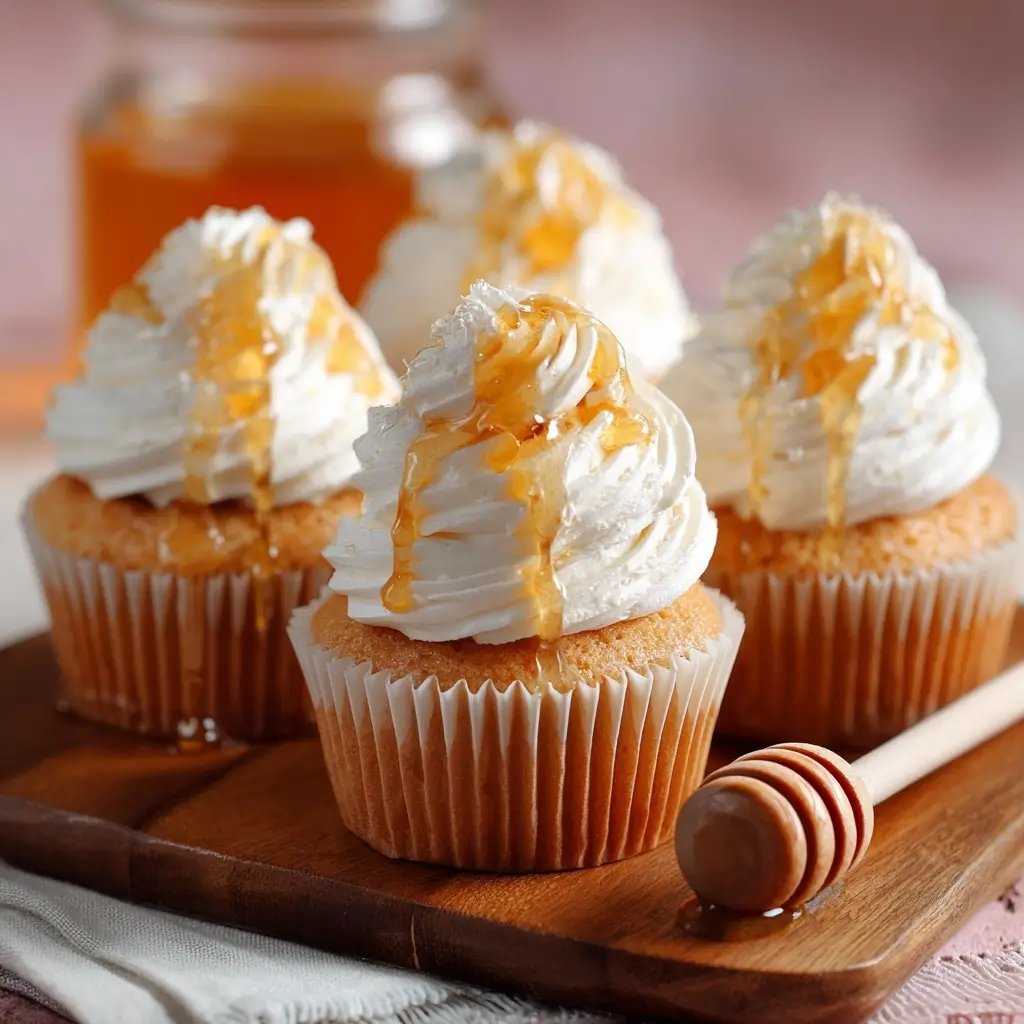
Yogurt Honey Vanilla Cupcakes are a masterclass in understated elegance and wholesome indulgence—tender, moist, delicately fragrant, and naturally sweetened with the floral richness of raw honey and the creamy tang of cultured yogurt. Unlike traditional cupcakes that rely heavily on butter and refined sugar, this version embraces balance: yogurt lends moisture, structure, and a subtle lactic brightness; honey contributes nuanced sweetness, humectant properties (keeping cupcakes soft for days), and antioxidant depth; while pure vanilla bean paste or high-quality extract infuses each bite with warm, aromatic complexity. These cupcakes are as at home at a Sunday brunch table as they are gracing a minimalist wedding dessert spread—and their versatility makes them an ideal canvas for seasonal toppings, dietary adaptations, and creative flavor layering.
The History
The evolution of the Yogurt Honey Vanilla Cupcake is not marked by a single origin story but rather by the quiet convergence of global baking traditions and modern wellness sensibilities. Yogurt-based cakes trace their roots to Eastern European and Middle Eastern cuisines—think Greek tsoureki-adjacent quick loaves, Turkish yoğurtlu kek, and Armenian madzoon desserts—where fermented dairy was long prized for its leavening power and digestive benefits. Honey, humanity’s oldest known sweetener, has been baked into cakes since ancient Egypt, Mesopotamia, and Vedic India—not only for sweetness but also for preservation, ritual symbolism, and perceived vitality. The marriage of yogurt and honey gained renewed traction in the late 20th century through the “health-conscious baking” movement, notably popularized by chefs like Martha Stewart (who featured honey-yogurt muffins in her 1990s publications) and food writers such as Claudia Roden, who documented Levantine adaptations. The vanilla element—once a luxury reserved for royal courts and apothecaries—became democratically accessible after the 19th-century cultivation boom in Madagascar and Réunion. Today’s Yogurt Honey Vanilla Cupcake represents a thoughtful synthesis: honoring ancestral techniques while embracing contemporary values—less refined sugar, more functional ingredients, and reverence for clean, pronounceable components.
Ingredients Breakdown
Every ingredient in this recipe serves both functional and sensory purposes—nothing is included merely for tradition or filler. Below is a meticulous analysis of each component’s role:
- Full-fat plain Greek yogurt (1 cup / 240g): Provides acidity to activate baking soda, contributes protein for structure, adds fat for tenderness, and delivers lactic tang that balances honey’s sweetness. Greek yogurt is preferred over regular due to its thicker consistency, higher protein content, and lower whey—preventing excess moisture and yielding a finer crumb.
- Raw, unfiltered wildflower honey (¾ cup / 255g): Acts as primary sweetener, natural humectant (retains moisture), and flavor anchor. Raw honey retains enzymes, pollen, and antioxidants lost in pasteurization. Its complex floral, herbal, or mineral notes vary by region—choose a mild, balanced variety (e.g., orange blossom or clover) for delicate vanilla synergy. Note: Honey is ~1.3x sweeter than granulated sugar, so volume is carefully calibrated to avoid cloying density.
- Unsalted butter (½ cup / 113g), melted and cooled: Adds richness, mouthfeel, and flakiness to the crumb. Melted (not browned) ensures even dispersion without solid fat pockets. Unsalted allows precise sodium control—critical when pairing with sea salt garnish or savory-tinged variations.
- Large eggs (2), room temperature: Provide emulsification, leavening (via steam and air expansion), and binding. Room temperature prevents yogurt from seizing and ensures uniform batter temperature—key for consistent rise.
- Pure vanilla bean paste (2 tsp) or high-grade extract (2½ tsp): Vanilla bean paste offers visible specks and deeper, resinous, almost woody notes from the seeds; extract provides reliable, warm sweetness. Avoid imitation vanillin—it lacks nuance and can taste medicinal when paired with honey’s complexity.
- All-purpose flour (1¾ cups / 210g), spooned & leveled: The structural backbone. Spooned-and-leveled prevents overpacking—a common cause of dense cupcakes. For gluten-free adaptations, a 1:1 certified GF blend with xanthan gum works seamlessly.
- Baking soda (½ tsp) + baking powder (1½ tsp): A dual-leavening system. Baking soda reacts instantly with yogurt’s acidity for initial lift; baking powder provides secondary, heat-activated rise—ensuring height without tunneling or collapse.
- Fine sea salt (¾ tsp): Not just for seasoning—salt enhances sweetness perception, deepens vanilla aroma, and tightens gluten networks for resilience. Flaky Maldon or Fleur de Sel is ideal for finishing.
- Optional: 1 tbsp lemon zest (finely grated): Brightens the profile, cuts richness, and lifts honey’s earthiness without adding liquid—preserving crumb integrity.
Step-by-Step Recipe
- Preheat & Prep: Position oven rack in center. Preheat to 350°F (177°C). Line a standard 12-cup muffin tin with premium parchment liners (or grease and flour if using silicone cups). Ensure all ingredients are at room temperature—cold yogurt or eggs cause separation.
- Whisk Dry Ingredients: In a medium bowl, whisk together flour, baking soda, baking powder, and salt until fully homogenized and aerated. Pass through a fine-mesh sieve for guaranteed lump-free blending—critical for even leavening.
- Combine Wet Base: In a large heatproof bowl, whisk melted butter and honey vigorously for 60–90 seconds until emulsified and slightly lighter in color. Add eggs one at a time, whisking 30 seconds after each addition until fully incorporated and glossy. Whisk in vanilla paste and lemon zest (if using).
- Incorporate Yogurt Gradually: Add yogurt in three equal portions, folding gently with a silicone spatula after each addition—just until no streaks remain. Overmixing develops gluten and causes toughness. The batter will be thick, glossy, and ribbon-like.
- Fold in Dry Ingredients: Add one-third of the dry mixture to the wet batter. Using a “fold-and-turn” motion (cut down center, sweep across bottom, lift up and over), incorporate with 8–10 folds. Repeat with remaining two portions, stopping immediately when the last trace of flour disappears. Batter should be smooth, satiny, and hold a gentle peak.
- Portion Evenly: Use a 2-oz ice cream scoop or spring-loaded cookie scoop to portion batter into lined cups—fill each ⅔ full (~3.5 oz per cup). Tap pan firmly twice on counter to release air bubbles and level tops.
- Bake with Precision: Place pan in center of preheated oven. Bake 18–21 minutes—do not open oven before 17 minutes. Cupcakes are done when tops are golden, springs back lightly when touched, and a toothpick inserted in center emerges with *moist crumbs* (not wet batter, not completely clean—this ensures optimal moisture). Rotate pan front-to-back at 12 minutes for even browning.
- Cool Strategically: Let cupcakes cool in pan for exactly 5 minutes—this sets structure and prevents sticking. Then transfer to a wire rack to cool completely (minimum 45 minutes) before frosting. Warm cupcakes melt frosting and absorb condensation, causing sogginess.
Tips
- Yogurt Matters: If using low-fat or non-Greek yogurt, add 1 extra tablespoon of flour to compensate for higher water content. Never substitute flavored or sweetened yogurt—it disrupts pH balance and adds unwanted gums or acids.
- Honey Temperature Caution: Do not heat honey above 118°F (48°C) for extended periods—this degrades enzymes and volatile aromatics. Melt butter separately, then cool before combining with honey.
- Vanilla Upgrade: Split a 2-inch piece of Madagascar bourbon vanilla bean, scrape seeds into batter, and steep the pod in the honey for 24 hours before use—then strain. This imparts unparalleled depth.
- Altitude Adjustments: Above 3,000 ft: Reduce honey by 1 tbsp, increase flour by 1 tbsp, and bake at 360°F for 16–19 minutes.
- Perfect Liners: Brush parchment liners with neutral oil (avocado or grapeseed) before filling—creates a non-stick barrier and enhances golden crust formation.
- No Overbaking!: Set a timer—and trust it. These cupcakes go from perfectly moist to dry in 60 seconds. Carry-over cooking continues for 2–3 minutes post-oven.
- Freezing Success: Cool completely, wrap individually in beeswax wrap, then place in airtight freezer bag. Freeze up to 3 months. Thaw overnight in fridge, then bring to room temp before frosting.
Variations and Customizations
This base recipe is infinitely adaptable—without compromising its signature tender crumb or aromatic harmony:
- Lemon-Honey-Yogurt: Add 2 tbsp fresh lemon juice + 1 tbsp zest to wet ingredients. Top with lemon-honey glaze (¼ cup powdered sugar + 1½ tsp lemon juice + 1 tsp honey).
- Blueberry-Lavender: Fold in 1 cup fresh or frozen (unthawed) blueberries tossed in 1 tsp flour. Add ½ tsp culinary lavender buds (crushed) to dry ingredients. Garnish with candied lavender.
- Cardamom-Orange: Replace vanilla with 1½ tsp ground cardamom + zest of 1 navel orange. Drizzle with orange-honey syrup (simmer ¼ cup honey + 2 tbsp orange juice + 1 tsp orange zest for 3 mins).
- Almond-Date: Substitute ¼ cup flour with almond flour. Fold in ½ cup finely chopped Medjool dates (soaked 10 mins in warm water, drained). Top with toasted almond slivers.
- Vegan Version: Replace eggs with 2 “flax eggs” (2 tbsp ground flaxseed + 5 tbsp water, rested 10 mins); use coconut yogurt (unsweetened, full-fat); swap butter for refined coconut oil; ensure honey alternative is maple syrup or date syrup (note: flavor shifts).
- Protein-Boosted: Add 2 scoops (60g) unflavored collagen peptides or whey isolate to dry ingredients. Increases protein without altering texture or taste.
- Mini & Jumbo Options: For mini cupcakes (24 count): Bake 11–13 minutes. For jumbo (6 count): Fill liners ¾ full; bake 24–27 minutes. Always test with toothpick.
- Savory-Sweet Herb Twist: Add 1 tsp finely minced fresh thyme or rosemary to dry mix. Pairs beautifully with goat cheese honey frosting.
Health Considerations and Nutritional Value
A single unfrosted Yogurt Honey Vanilla Cupcake (based on 12 servings) provides approximately:
- Calories: 225 kcal
- Total Fat: 9g (5.5g saturated)
- Carbohydrates: 32g (24g natural sugars from honey & yogurt)
- Fiber: 0.5g
- Protein: 4.5g
- Calcium: 85mg (9% DV)
- Probiotics: ~1 billion CFU (from live-culture yogurt—though heat reduces viability, residual strains and metabolites remain bioactive)
Nutritional Advantages:
- Natural Sweetness Profile: Honey contains fructose, glucose, and oligosaccharides—leading to a lower glycemic response than sucrose. Its polyphenols may support gut microbiota diversity.
- Dairy Benefits: Greek yogurt contributes conjugated linoleic acid (CLA), bioavailable calcium, and lactase-digested peptides beneficial for bone and metabolic health.
- Reduced Additives: No preservatives, artificial flavors, hydrogenated oils, or refined white sugar—making it suitable for clean-eating, whole-food, and many elimination diets (e.g., dairy-free option available).
- Digestive Support: The combination of prebiotic honey and probiotic yogurt creates a synbiotic effect—enhancing microbial colonization when consumed regularly.
Considerations: While nutritionally superior to conventional cupcakes, these remain a treat—not a meal replacement. Those managing diabetes should monitor portion size and pair with protein/fat (e.g., almond butter frosting) to slow glucose absorption. Individuals with bee product allergies must avoid honey entirely; maple syrup is the safest substitute.
Ingredients
- 1 cup (240g) full-fat plain Greek yogurt, room temperature
- ¾ cup (255g) raw, unfiltered wildflower honey
- ½ cup (113g) unsalted butter, melted and cooled to lukewarm
- 2 large eggs, room temperature
- 2 tsp pure vanilla bean paste (or 2½ tsp high-grade vanilla extract)
- 1¾ cups (210g) all-purpose flour, spooned and leveled
- ½ tsp baking soda
- 1½ tsp baking powder
- ¾ tsp fine sea salt
- 1 tbsp lemon zest (optional, but highly recommended)
Directions
- Preheat oven to 350°F (177°C). Line a 12-cup muffin tin with parchment cupcake liners.
- In a medium bowl, whisk together flour, baking soda, baking powder, and salt. Sift through a fine-mesh strainer into the same bowl; set aside.
- In a large heatproof bowl, whisk melted butter and honey for 60–90 seconds until smooth and slightly lightened. Add eggs one at a time, whisking 30 seconds after each until fully emulsified. Whisk in vanilla paste and lemon zest.
- Add yogurt in three additions, folding gently with a silicone spatula after each until just combined—no streaks remaining.
- Add dry ingredients in three parts, folding with a “fold-and-turn” motion just until no flour is visible. Do not overmix.
- Portion batter evenly into prepared liners—fill each ⅔ full (~3.5 oz). Tap pan firmly twice on countertop.
- Bake 18–21 minutes, rotating pan at 12 minutes, until tops are golden and a toothpick reveals moist crumbs.
- Cool in pan 5 minutes, then transfer to wire rack to cool completely before frosting.
FAQ
- Can I make these ahead of time?
- Absolutely. Unfrosted cupcakes stay moist and flavorful for up to 48 hours at room temperature in an airtight container. For longer storage, freeze as directed in Tips section.
- Why does the recipe use both baking soda AND baking powder?
- Baking soda neutralizes yogurt’s acidity and provides immediate lift; baking powder adds a second, heat-triggered rise—ensuring height, open crumb, and resilience against denseness. Omitting either results in flat, gummy, or collapsed cupcakes.
- My batter looks curdled—did I do something wrong?
- Not necessarily. Cold eggs added to warm honey-butter can cause momentary separation. Keep whisking vigorously for 20–30 seconds—the emulsion will stabilize. If yogurt was chilled, let batter rest 2 minutes before folding in dry ingredients.
- What’s the best frosting to pair with these?
- Opt for complementary, not competing, flavors: Honey-Vanilla Swiss Meringue Buttercream, Lemon-Yogurt Cream Cheese Frosting, Brown Butter Honey Ganache, or simply a dusting of flaky salt and drizzle of warmed local honey.
- Can I bake these as a sheet cake?
- Yes! Pour batter into a greased and parchment-lined 9×13-inch pan. Bake at 350°F for 32–38 minutes. Cool completely before slicing.
- Is there a way to reduce sugar further?
- You can reduce honey to ⅔ cup—but do not go lower, as honey contributes essential moisture and structure. Compensate with 1 extra tbsp yogurt and ½ tsp additional lemon juice to maintain balance.
- Why must eggs and yogurt be at room temperature?
- Cold dairy causes melted butter to re-solidify into tiny beads, disrupting emulsion and creating uneven crumb. Room temperature ensures seamless integration and stable air incorporation during mixing.
- Can I use oat milk yogurt or soy yogurt?
- Yes—but choose unsweetened, unthinned, full-fat versions. Avoid “stirred” or “drinkable” yogurts—they’re too watery. Expect slight texture variance (slightly less springy), but flavor remains excellent.
Summary
Yogurt Honey Vanilla Cupcakes redefine everyday baking with intelligent ingredient synergy—where the tang of cultured dairy, the floral depth of raw honey, and the warm resonance of real vanilla converge into a tender, luminous, and deeply satisfying treat. They honor tradition while embracing wellness, offering endless customization without sacrificing soul, structure, or sublime simplicity.
Baked with care and crowned with intention, these cupcakes are more than dessert—they’re edible comfort, mindful indulgence, and a quiet celebration of what happens when humble, honest ingredients are treated with reverence and precision.