Introduction
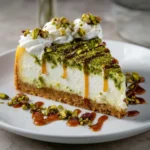
Pistachio Cream Cheesecake is a luxurious, velvety dessert that marries the rich, tangy depth of classic New York–style cheesecake with the vibrant, nutty sweetness of premium pistachios. Unlike standard cheesecakes that rely solely on cream cheese and sour cream, this elevated version infuses every layer—from the crust to the filling to the glossy finish—with the unmistakable emerald elegance and subtle earthiness of roasted pistachios. It’s a dessert that commands attention not only for its stunning natural green hue (achieved without artificial dyes when using high-quality, naturally vibrant pistachios) but also for its sophisticated balance: creamy yet light, sweet yet refreshingly herbal, decadent yet nuanced. Whether served at an intimate dinner party, a spring garden celebration, or as a showstopping centerpiece for holiday gatherings, Pistachio Cream Cheesecake transcends seasonal trends—it’s timeless, elegant, and deeply satisfying in both texture and flavor.
The History
The evolution of Pistachio Cream Cheesecake is a fascinating tapestry woven from centuries of culinary innovation across multiple continents. Cheesecake itself traces its origins to ancient Greece around 2000 BCE, where early versions made with honey-sweetened cheese and flour were served to athletes during the first Olympic Games in 776 BCE. The Romans later adopted and refined the concept, spreading cheesecake throughout their empire—and eventually into medieval Europe, where regional variations began to emerge.
Pistachios, meanwhile, have been cultivated for over 9,000 years—archaeological evidence places them among the earliest domesticated nuts in the Middle East, particularly in modern-day Syria, Iran, and Turkey. Revered in Persian poetry, Ottoman imperial banquets, and Levantine confections like baklava and ma’amoul, pistachios were historically associated with royalty, fertility, and prosperity. Their use in Western desserts accelerated in the mid-20th century as American pistachio farming—led by pioneers in California’s San Joaquin Valley—scaled production and improved roasting and shelling techniques.
The fusion of these two traditions—cream cheesecake and pistachio—gained momentum in the 1970s and ’80s, as American chefs began experimenting with global flavors and artisanal ingredients. Early iterations appeared in gourmet food magazines like Gourmet and Bon Appétit, often as “Pistachio Swirl Cheesecake” or “Pistachio Praline Cheesecake.” However, it wasn’t until the 2010s—amid the rise of farm-to-table dining, clean-label ingredient movements, and social media–driven visual food culture—that true *Pistachio Cream Cheesecake* emerged: a fully integrated, homogenous, vividly green, luxuriously smooth creation where pistachios weren’t just a garnish or swirl, but the foundational flavor driver. Today, it’s a signature offering at award-winning patisseries from Brooklyn to Beirut, symbolizing both technical mastery and cross-cultural culinary harmony.
Ingredients Breakdown
Every element of this Pistachio Cream Cheesecake is deliberately chosen—not only for flavor synergy but for functional performance, texture integrity, and nutritional authenticity. Below is a meticulous analysis of each component:
For the Crust:
- Unsalted butter (½ cup / 113 g, melted): Provides richness, binding power, and flakiness. Clarified butter can be used for deeper nuttiness and higher smoke point—but standard unsalted butter ensures optimal caramelization and structure.
- Finely ground pistachio flour (¾ cup / 90 g): Made by grinding raw, shelled, unsalted pistachios into a fine, almost powdery consistency (not oily paste). This adds nutty aroma, natural green pigments (chlorophyll and polyphenols), and subtle tannic structure—enhancing contrast against the creamy filling. Toasting the pistachios lightly before grinding deepens flavor without bitterness.
- Golden grahams or graham cracker crumbs (1¼ cups / 150 g): Chosen over traditional graham crackers for their milder sweetness, smoother grain, and golden-honey notes that complement rather than compete with pistachio. Digestive biscuits or shortbread crumbs are excellent alternatives for added buttery sophistication.
- Granulated sugar (3 tbsp / 36 g): Balances the slight bitterness of toasted pistachios and enhances browning via Maillard reaction.
- Pinch of flaky sea salt (¼ tsp): Amplifies all other flavors and cuts through richness—a non-negotiable seasoning step.
For the Pistachio Cream Cheese Filling:
- Full-fat brick-style cream cheese (three 8-oz / 226 g blocks, room temperature): Must be truly softened—not melted or microwaved—to ensure lump-free blending. Philadelphia brand is recommended for consistent fat content and pH, crucial for proper setting and tang.
- Finely ground roasted pistachios (1¼ cups / 150 g, skin-on or blanched): The heart of the recipe. Skin-on pistachios yield a more complex, slightly tannic, earthy note and richer green color; blanched yield a brighter, sweeter, pastel tone. Always grind in small batches in a high-speed blender or food processor with brief pulses to avoid overheating and oil separation.
- Heavy whipping cream (⅔ cup / 160 ml, cold): Adds fluidity and silkiness while helping emulsify the dense filling. Cold cream prevents premature softening of the cream cheese base.
- Sour cream (½ cup / 120 g, full-fat, room temperature): Contributes acidity for brightness and tenderness, plus lactic tang that balances pistachio’s inherent sweetness. Avoid low-fat versions—they introduce excess water and weaken structure.
- Granulated sugar (1 cup + 2 tbsp / 225 g): Precisely calibrated to offset tartness without cloying. A portion is reserved for the final swirl technique to control crystallization and texture.
- Eggs (3 large, room temperature, plus 1 yolk): Eggs provide structure and lift; the extra yolk adds unctuousness, emulsification, and a satiny sheen. Cold eggs cause curdling—always bring to room temperature (about 30 minutes out of the fridge).
- Vanilla extract (2 tsp, pure Madagascar Bourbon): Enhances floral-pistachio top notes and rounds out sharp edges. Avoid imitation—its harsh alcohol notes clash with delicate nut aromas.
- Almond extract (¼ tsp, pure): A secret enhancer—almond and pistachio share key aromatic compounds (benzaldehyde), so this tiny addition intensifies perceived pistachio flavor without tasting “almond-y.”
- Sea salt (¾ tsp): Critical for flavor balancing—reduces perceived sweetness and highlights umami depth in both cream cheese and pistachios.
- Unflavored gelatin (1 tsp / 3 g, bloomed in 1 tbsp cold water): Optional but highly recommended for superior sliceability, crack resistance, and refrigerated stability. Ensures the cake holds its shape even after 5 days in the fridge—without altering taste or mouthfeel.
For the Pistachio Glaze & Garnish:
- White chocolate (4 oz / 113 g, high-cocoa-butter, finely chopped): Acts as a neutral canvas for pistachio infusion. Avoid “white baking chips”—they contain palm oil and stabilizers that inhibit smooth melting and create graininess.
- Pistachio paste (3 tbsp / 45 g) or ultra-fine pistachio butter: Not peanut or almond butter—this must be 100% pistachio, no added oils or sugars. Brands like D’Oliveira or Olivier’s are ideal. Provides concentrated flavor, natural green pigment, and emulsifying power.
- Heavy cream (2 tbsp / 30 ml): Warmed gently—not boiling—to melt white chocolate smoothly and integrate the paste.
- Crushed roasted pistachios (¼ cup / 30 g, coarsely chopped): For textural contrast and visual appeal. Reserve a few whole, unsalted pistachios for final garnish.
- Edible dried rose petals or crushed saffron threads (optional, for garnish): A nod to Middle Eastern pistachio traditions—adds fragrance and regal elegance.
Step-by-Step Recipe
This method prioritizes precision, temperature control, and layered technique—designed to produce a flawlessly smooth, crack-free, vibrantly green cheesecake with professional-grade texture and shelf stability.
Step 1: Prepare the Pistachio Crust
- Preheat oven to 350°F (177°C). Wrap the *outside* of a 9-inch springform pan tightly with two layers of heavy-duty aluminum foil—ensure no gaps at the seam or bottom, as water bath leakage is the #1 cause of soggy crusts.
- In a food processor, pulse raw pistachios (unsalted, shelled) until finely ground into a flour-like consistency—about 15–20 one-second pulses. Avoid over-processing into paste. Transfer to a medium bowl.
- Add graham cracker crumbs, sugar, and sea salt. Whisk thoroughly. Drizzle in melted butter while stirring with a fork until all dry ingredients are evenly moistened and the mixture resembles wet sand.
- Press firmly and evenly into the bottom—and 1½ inches up the sides—of the prepared springform pan using the back of a measuring cup or flat-bottomed glass. Apply firm, downward pressure to compact the crust completely. Chill uncovered for at least 30 minutes (or freeze for 15) to set the butter.
- Bake crust for 12 minutes until fragrant and lightly golden. Cool completely on a wire rack—do not skip cooling; warm crust causes filling to melt and separate.
Step 2: Bloom Gelatin (if using)
- Sprinkle gelatin over 1 tablespoon cold water in a small heatproof bowl. Let sit 5 minutes until spongy. Set aside—do not stir.
Step 3: Prepare Pistachio Paste Base
- In a high-speed blender (Vitamix or Blendtec preferred), combine 1¼ cups roasted pistachios (cooled), 2 tbsp granulated sugar, and 1 tbsp heavy cream. Blend on low, then gradually increase to high for 60–90 seconds until completely smooth, scraping sides once. The paste should be thick, glossy, and hold soft peaks—like stiff Nutella. Transfer to a small bowl and refrigerate until needed (up to 2 hours).
Step 4: Mix the Cheesecake Batter
- In the bowl of a stand mixer fitted with the paddle attachment, beat softened cream cheese on medium-low for 2 minutes until completely smooth and airy—scrape bowl and paddle thoroughly. Add sour cream and beat 1 minute more until homogenous.
- Add remaining sugar (1 cup) and beat 2 minutes on medium—until lightened and fluffy. Scrape bowl well.
- Add eggs one at a time, beating on low just until incorporated (about 15 seconds per egg). Add extra yolk last. Overmixing introduces air bubbles—leading to cracks and uneven texture.
- Beat in vanilla, almond extract, and salt on low for 20 seconds. Scrape bowl.
- With mixer on lowest speed, slowly stream in cold heavy cream—mix only until just combined (no more than 15 seconds). Overmixing here causes thinning and weeping.
- Remove bowl from mixer. Using a flexible silicone spatula, fold in chilled pistachio paste in three additions—gently cutting and folding from bottom to top until uniformly green and streak-free. Do *not* stir or whisk—folding preserves air and prevents deflation.
- If using gelatin: Microwave bloomed gelatin for 8–10 seconds until fully liquefied (not boiling). Let cool 10 seconds, then drizzle into batter while folding gently—just until dispersed.
Step 5: Bake Using the Water Bath Method
- Reduce oven temperature to 325°F (163°C). Place springform pan inside a larger roasting pan. Carefully pour hot (not boiling) water into the roasting pan until it reaches halfway up the sides of the springform pan.
- Pour batter into chilled crust. Tap pan sharply on counter 3 times to release trapped air bubbles. Run a knife or offset spatula around interior edge to detach batter from pan—prevents cracking as it contracts during cooling.
- Bake for 1 hour 15 minutes–1 hour 25 minutes. Cake is done when edges are set and center jiggles *slightly* like Jell-O—never liquidy. A thermometer inserted 1 inch from center should read 150°F (66°C)—the residual heat will carry it to safe 155°F (68°C) during cooling.
- Turn off oven. Crack door open 1 inch with a wooden spoon. Let cake cool undisturbed in oven for 1 hour—this gradual temperature drop prevents dramatic contraction and surface cracks.
- Remove from water bath. Run a thin knife around inner edge again. Cool completely on wire rack (2–3 hours), then refrigerate—uncovered—for at least 12 hours (preferably 24–48) before glazing or slicing. Overnight chilling is essential for full set, clean cuts, and flavor melding.
Step 6: Prepare & Apply Pistachio Glaze
- At least 2 hours before serving, prepare glaze: In a heatproof bowl, combine chopped white chocolate and pistachio paste. Heat cream in a small saucepan until steaming (180°F / 82°C)—do not boil. Pour hot cream over chocolate-paste mixture. Let sit 2 minutes, then stir gently with silicone spatula until completely smooth and glossy.
- Let glaze cool at room temperature for 15–20 minutes until thickened slightly but still pourable (like heavy cream). Stir occasionally to prevent skin formation.
- Place thoroughly chilled cheesecake (still on springform base) on a wire rack set over parchment-lined sheet tray. Slowly pour glaze over center, letting it cascade naturally down sides. Use an offset spatula to guide excess if needed—but avoid over-spreading, which dulls shine.
- Sprinkle immediately with crushed pistachios and optional rose petals. Refrigerate uncovered for 30 minutes to set glaze.
Step 7: Unmold & Serve
- Run a long, thin metal spatula or bench scraper under hot water, dry thoroughly, and carefully slide between crust and pan base to loosen. Release springform clasp and gently lift ring away.
- For clean slices: Dip a sharp, thin-bladed knife in hot water, wipe dry, cut, then repeat between every slice. Wipe blade *every single time*—this is the single most effective technique for flawless presentation.
- Serve chilled—but not straight from the fridge. Allow to sit at room temperature for 15 minutes before serving for optimal creaminess and flavor release.
Tips
- Room temperature is non-negotiable: All dairy (cream cheese, sour cream, eggs, cream) must be at true room temperature (68–72°F / 20–22°C)—not “slightly cool.” Cold ingredients cause seizing, lumps, and poor emulsion.
- Pistachio quality dictates outcome: Use fresh, vibrant green, unsalted, roasted pistachios—preferably from California or Sicily. Stale, yellowish, or rancid nuts impart cardboard or paint-like off-notes. Store shelled pistachios airtight in freezer for up to 6 months.
- Grind in batches: Never overload your food processor or blender with pistachios. Warm friction = oil separation. Process no more than ½ cup at a time, chilling components between batches if needed.
- No over-beating: Once eggs are added, never exceed low speed. Over-aeration creates steam pockets that burst during baking—causing cracks and sinkholes.
- Water bath precision: Use hot (not boiling) water—boiling water causes violent bubbling that can seep into pan. If foil leaks, place roasting pan on a second, larger sheet pan as backup.
- Cooling patience pays: Skipping the 1-hour oven cooldown or rushing the chill time guarantees cracks, slumping, and weeping. Treat cooling like a critical recipe step—not downtime.
- Glaze timing matters: Glaze only when cake is fully cold and firm. Warm cake melts glaze; overly cold cake causes glaze to set too fast and appear dull. Ideal glaze temp: 85–90°F (29–32°C).
- Cut with confidence: A serrated knife works better than a chef’s knife for clean edges. And always—*always*—wipe and reheat between slices.
- Freeze for longevity: Fully baked, unglazed cheesecake freezes beautifully for up to 3 months. Wrap twice in plastic wrap, then in foil. Thaw overnight in fridge—glaze only after thawing and re-chilling.
- Save scraps: Trimmed crust edges or broken slices? Pulse with mascarpone and honey for pistachio “cheesecake crumble” topping for yogurt, panna cotta, or oatmeal.
Variations and Customizations
This recipe is a master template—elegant, adaptable, and deeply respectful of pistachio’s versatility. Below are inspired, tested variations ranging from subtle refinements to bold reimaginings—all designed to suit dietary needs, seasonal availability, and creative ambition.
Classic Variations
- Honey-Roasted Pistachio Crust: Replace 1 tbsp granulated sugar with 1 tbsp local wildflower honey in crust mixture. Toast crust 2 minutes longer for deeper caramelization.
- Cardamom-Infused Filling: Steep 6 green cardamom pods (crushed) in warm heavy cream for 15 minutes before adding to batter. Strain and discard pods.
- Rosewater Swirl: After pouring batter, drizzle 1 tsp food-grade rosewater mixed with 1 tsp sugar across surface. Drag a toothpick in figure-eights for delicate marbling.
Dietary-Inclusive Adaptations
- Gluten-Free: Substitute crust with 1¼ cups GF graham-style crumbs (like Schär) + ¼ cup almond flour for binding. Ensure all extracts and gelatin are certified GF.
- Lower-Sugar: Reduce total sugar to ¾ cup; replace remaining with 2 tbsp allulose (a low-glycemic, non-bitter keto-friendly sweetener that behaves like sugar in baking).
- Vegetarian Gelatin Alternative: Substitute agar-agar: dissolve 1 tsp powdered agar in 2 tbsp water, bring to simmer 2 minutes, cool 5 minutes, then fold in at end.
- Lighter Texture (No-Bake Option): Omit eggs and gelatin. Whip 24 oz cold heavy cream to stiff peaks; fold into 24 oz softened cream cheese + 1 cup pistachio paste + ⅓ cup sugar. Chill 8 hours. Less stable but ethereally light.
Global-Inspired Twists
- Iranian Saffron-Pistachio: Infuse 10 threads of premium Iranian saffron in 1 tsp warm milk for 10 minutes. Add along with vanilla. Garnish with crushed pistachios + edible gold leaf.
- Lebanese Orange Blossom: Replace almond extract with ½ tsp orange blossom water. Add zest of 1 organic navel orange to crust.
- Turkish Pomegranate Glaze: Replace white chocolate glaze with reduced pomegranate molasses (¼ cup boiled down to 2 tbsp) + 1 tsp lemon juice + 1 tsp pistachio paste. Drizzle in zigzag pattern.
- Italian Pistachio-Candied Citrus: Top with candied orange or grapefruit peel (simmered in sugar syrup) and crumbled amaretti cookies.
Textural & Layered Innovations
- Pistachio Crunch Layer: Before baking, spread ¼ cup crushed pistachios + 1 tbsp brown sugar + 1 tsp melted butter over batter surface. Creates a delightful brittle-like top.
- Chocolate-Pistachio Marbled: Reserve 1 cup batter. Fold 2 tbsp melted dark chocolate (70%) into reserved portion. Spoon alternating dollops into pan, then marble gently with a skewer.
- Layered Cheesecake Parfait: Skip springform. Layer crust, chilled filling, and glaze in clear glasses. Top with fresh figs, mint, and crumbled pistachios for individual servings.
- Mini Mason Jar Cheesecakes: Scale down: Fill 4-oz jars ¾ full with crust + filling. Bake in water bath 30–35 min. Chill 6 hours. Glaze individually.
Health Considerations and Nutritional Value
While Pistachio Cream Cheesecake is undeniably indulgent, its core ingredients offer meaningful nutritional benefits—especially when prepared with intention and quality. Understanding its composition empowers mindful enjoyment and informed customization.
Nutritional Profile (per standard slice, 1/12 of 9-inch cake):
- Calories: ~420 kcal
- Total Fat: 32 g (including 16 g saturated fat)
- Cholesterol: 115 mg
- Sodium: 280 mg
- Total Carbohydrates: 26 g (including 18 g sugars, 1 g fiber)
- Protein: 8 g
Functional Benefits of Key Ingredients:
- Pistachios: One of the most nutrient-dense tree nuts—rich in monounsaturated fats (heart-healthy), plant sterols (cholesterol-lowering), vitamin B6 (supports brain health and metabolism), copper (antioxidant enzyme cofactor), and lutein/zeaxanthin (critical for eye health). Their high potassium-to-sodium ratio supports healthy blood pressure. The vibrant green color comes from chlorophyll and polyphenols—powerful anti-inflammatory compounds.
- Cream Cheese: Contains conjugated linoleic acid (CLA), linked in studies to improved body composition and immune support. Also provides calcium and vitamin A (as retinol), essential for vision and cellular repair.
- Sour Cream: Naturally probiotic when unpasteurized (though most commercial versions are pasteurized post-culturing). Still contributes beneficial lactic acid bacteria metabolites that may support gut barrier integrity.
- Real Vanilla & Almond Extracts: Contain vanillin and benzaldehyde—phytochemicals studied for antioxidant, neuroprotective, and mild anxiolytic effects.
Considerations for Balanced Enjoyment:
- Portion Mindfulness: A 2-oz slice delivers satiety due to fat and protein—often more satisfying than larger portions of lower-fat, higher-sugar desserts.
- Sugar Awareness: While granulated sugar is used for structural reasons (interfering with protein coagulation), natural sweetness from pistachios allows for modest reductions without sacrificing texture—especially when paired with lower-glycemic sweeteners like allulose.
- Allergen Transparency: Contains tree nuts (pistachios), dairy (milk, cream, cheese), and eggs. Always disclose when serving guests with allergies.
- Not a “health food”—but a nourishing treat: When made with whole-food, minimally processed ingredients—and enjoyed as part of a varied, plant-forward diet—this cheesecake aligns with principles of intuitive eating and culinary wellness. Its richness encourages slower, more intentional consumption—an act of self-care in itself.
Ingredients
Makes one 9-inch cheesecake (12 servings)
For the Crust:
- ½ cup (113 g) unsalted butter, melted
- ¾ cup (90 g) finely ground pistachio flour (raw, unsalted pistachios, pulsed until powdery)
- 1¼ cups (150 g) golden grahams or graham cracker crumbs (about 12 full crackers)
- 3 tablespoons (36 g) granulated sugar
- ¼ teaspoon flaky sea salt
For the Pistachio Cream Cheese Filling:
- Three 8-ounce (226 g each) blocks full-fat cream cheese, room temperature
- 1¼ cups (150 g) roasted, unsalted pistachios, finely ground into paste (see Tips)