Introduction
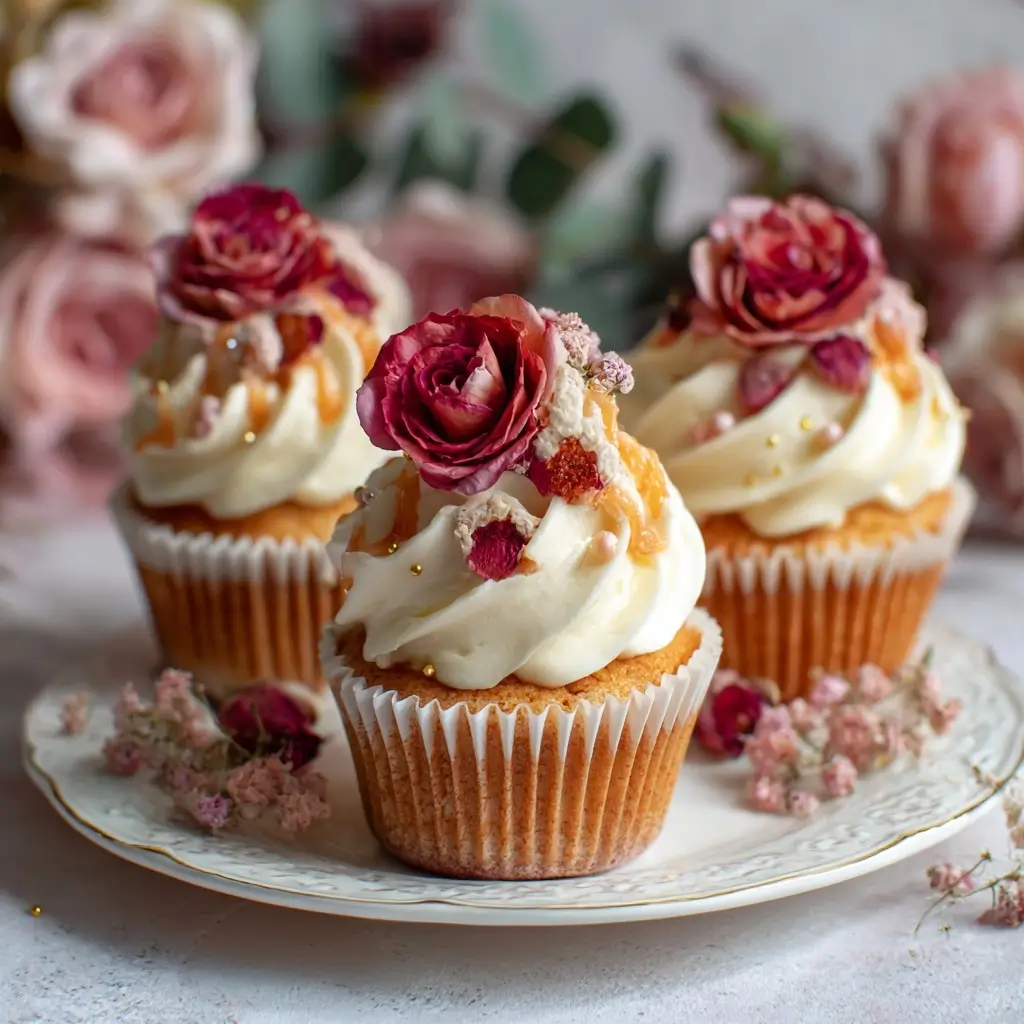
Lychee Rose Cupcakes are an exquisite fusion of East and West—a delicate, floral, and tropical dessert that transports your senses to sun-drenched orchards and fragrant Persian gardens. These elegant cupcakes harmonize the subtle sweetness and juicy translucence of fresh lychee with the refined, heady aroma of rose water and edible rose petals. Light as a whisper yet deeply evocative, they’re more than just a treat—they’re an experience: tender vanilla-almond cake cradling lychee compote, crowned with luxuriously smooth rose buttercream, and finished with glistening lychee pearls and hand-placed crystallized or organic edible rose petals. Perfect for bridal showers, spring celebrations, afternoon tea service, or simply as a moment of mindful indulgence, Lychee Rose Cupcakes embody sophistication, balance, and botanical charm.
The History
The origins of the Lychee Rose Cupcake are not rooted in ancient tradition—but rather in the poetic convergence of centuries-old culinary legacies. Lychee (Litchi chinensis) has been cultivated in southern China for over 2,000 years, revered in imperial courts and celebrated in Tang dynasty poetry for its “pearl-like” texture and “wine-scented” essence. Rose water, meanwhile, traces back to 7th-century Persia, where Persian alchemists like Avicenna pioneered steam-distillation techniques to capture the volatile aromatic compounds of damask roses—giving birth to one of the world’s first floral hydrosols. As trade routes expanded along the Silk Road, lychee traveled westward (though rarely in fresh form), while rose water permeated Mughal Indian sweets, Ottoman baklavas, and Levantine ma’amoul. The modern cupcake format—individual, portion-controlled, and highly customizable—emerged in 19th-century America, gaining global popularity post-WWII with the rise of home baking culture and decorative frosting artistry. The Lychee Rose Cupcake, therefore, is a contemporary homage: a 21st-century interpretation born from cross-cultural reverence—for lychee as nature’s candy and rose as the quintessential symbol of ephemeral beauty. Its rise in artisanal bakeries since the early 2010s reflects broader trends toward floral-forward desserts, Asian-inspired flavor pairings, and ingredient-driven minimalism.
Ingredients Breakdown
Every component of the Lychee Rose Cupcake is chosen for purpose, purity, and layered sensory impact:
- Lychee: Fresh, peeled, and pitted lychees provide natural fructose, subtle acidity, and a jelly-like tenderness that melts into the batter and compote. Canned lychees (in 100% lychee juice, not syrup) are acceptable—but avoid those preserved in heavy sucrose syrup or artificial flavors, which dull aroma and destabilize moisture balance.
- Rose Water: A cornerstone ingredient—not perfume, not imitation. Authentic rose water is steam-distilled from Rosa damascena petals, containing trace amounts of citronellol, geraniol, and nerol—compounds responsible for its complex, honeyed-floral profile. Too much overwhelms; too little fades. Opt for brands like Cortas, Al Wadi Al Akhdar, or local distillers who disclose origin and distillation method.
- Almond Flour: Adds moist density, nutty warmth, and gluten-free structure without heaviness. It enhances lychee’s fruitiness and tempers rose’s volatility—acting as a flavor bridge and textural anchor.
- Vanilla Bean Paste: Far superior to extract, paste includes actual scraped seeds suspended in thickened vanilla-infused syrup, delivering visual speckles and deeper, creamier resonance that complements both lychee’s musk and rose’s delicacy.
- Unsalted European-Style Butter (82–84% fat): High-fat butter provides superior emulsification, richer mouthfeel, and a clean, cultured backdrop—critical when working with nuanced florals. Its higher melting point also supports stable rose buttercream that holds piping definition in warm conditions.
- Organic Egg Whites (aged at room temperature): Using only whites (not whole eggs) yields a lighter, airier crumb. Aging them for 24 hours at room temp improves foam stability during whipping—key for volume and even rise.
- Edible Rose Petals: Must be organically grown, pesticide-free, and explicitly labeled “food-grade.” Avoid florist roses—they’re treated with systemic fungicides and preservatives unsafe for consumption. Damascus, centifolia, or gallica varieties offer optimal flavor: sweet, green-tinged, faintly spicy—not bitter or medicinal.
This isn’t mere ingredient listing—it’s a philosophy: each element must be *alive*, aromatic, and ethically sourced to honor the integrity of the whole.
Step-by-Step Recipe
Yield: 18 standard-sized cupcakes (bake time: 16–19 minutes)
- Prep & Prep-Ahead Strategy (Day Before Recommended): Drain and pat dry 1 cup (approx. 24–28) fresh lychees. Reserve ¼ cup for garnish (refrigerate in airtight container). Puree remaining ¾ cup with 1 tsp lemon juice and 1 tbsp lychee juice (from can or fresh extraction) until silky. Strain through fine-mesh sieve to remove fibrous bits—discard solids. Chill puree overnight to deepen flavor and stabilize viscosity. Separately, prepare rose sugar: combine ½ cup granulated sugar + 2 tsp food-grade rose water in spice grinder; pulse 30 sec until fragrant and slightly damp. Store airtight at room temp.
- Dry Ingredients Assembly: In a medium bowl, whisk together 1¾ cups cake flour (sifted twice), ½ cup rose sugar (from Step 1), 1 tsp baking powder, ¼ tsp fine sea salt, and ⅓ cup finely ground blanched almond flour. Sift mixture once more into a clean bowl—this aerates and prevents lumps.
- Wet Ingredients Emulsion: In a stand mixer fitted with paddle attachment, beat 1 cup (2 sticks) unsalted European-style butter on medium-low for 2 minutes until pale and creamy—not greasy. Add 1 tbsp vanilla bean paste + 1 tsp pure almond extract; mix 30 seconds. Gradually add 1¼ cups granulated sugar in 3 additions, beating 1½ minutes on medium-high after each until fully incorporated and fluffy. Scrape bowl thoroughly. With mixer on low, add 5 large aged egg whites one at a time—waiting until each is *just* absorbed before adding next (≈20 sec between). Never overmix at this stage—stop as soon as no streaks remain.
- Incorporating Dry & Wet: Alternate additions: Begin and end with dry mixture (3 total additions of dry, 2 of wet). Add first third dry; mix on low 15 sec until mostly blended. Add half the lychee puree (≈3 tbsp); mix 10 sec. Repeat with second third dry, remaining puree, then final third dry. Mix *only until no flour pockets remain*—batter will be glossy, pourable, and slightly thick—≈45 seconds total mixing after final addition. Overmixing = tunneling and toughness.
- Pan Preparation & Portioning: Line standard muffin tin with premium unbleached paper liners (rose-gold or ivory recommended). Use ice cream scoop (3 tbsp capacity) for uniform fill. Fill each liner ⅔ full (~45g batter). Gently tap pan on counter 3x to release air bubbles. Optional: Nestle 1 small, peeled lychee half (cut-side down) into center of each cupcake before baking for a surprise core.
- Baking Protocol: Preheat oven to 350°F (177°C) with convection OFF and rack positioned in center third. Bake 16 minutes—then rotate pan ½ turn. Continue baking 1–3 minutes more until tops spring back lightly when touched, edges are delicately golden, and a toothpick inserted ½” from edge comes out with moist crumbs (not wet batter). Do NOT open oven before 15 minutes—temperature shock collapses delicate structure. Cool in pan 8 minutes, then transfer to wire rack to cool completely (≥90 minutes) before frosting.
- Rose Buttercream (Swiss Meringue Style): Combine 1½ cups pasteurized egg whites + 2¼ cups granulated sugar in heatproof bowl of stand mixer. Set over simmering water (double boiler), whisking constantly until sugar dissolves and mixture reaches 160°F (71°C) on instant-read thermometer. Transfer bowl to mixer; whip on medium-high with clean whisk attachment until stiff, glossy, room-temp peaks form (≈10–12 min). Switch to paddle. On low, add 1¼ cups cubed, cool-but-soft (65°F) high-fat butter, 2 tbsp at a time—waiting for full absorption before next addition. Once all butter is in, increase speed to medium-high and whip 4–5 minutes until creamy, airy, and spreadable. Fold in 2 tsp rose water, 1 tsp vanilla paste, and pinch of edible dried rose petal dust (grind 3 petals in mortar). Chill 20 minutes if too soft; beat 1 minute to re-fluff if overchilled.
- Assembly & Garnish: Fit large closed-star tip (Wilton #18 or Ateco #829) with rose buttercream. Pipe tall, elegant swirls using consistent pressure and upward lift. Immediately press 1 fresh lychee pearl (halved lengthwise, seed removed) onto center of each swirl. Garnish with 2–3 whole edible rose petals—positioned asymmetrically, overlapping gently. Finish with light dusting of rose sugar using fine mesh strainer.
Tips
- Temperature Is Non-Negotiable: All dairy, eggs, and purees must be at true room temperature (68–72°F)—cold ingredients cause curdling, poor emulsion, and dense crumb. Place butter cubes on parchment 45 min pre-mixing; float eggs in warm (not hot) water for 5 min.
- Rose Water Calibration: Always taste-test rose water *before* adding—potency varies wildly by brand and batch. Add half the amount called for, whip buttercream 1 minute, taste, then adjust. Remember: rose intensifies slightly upon chilling and mingles with lychee’s esters to become more rounded—not sharper.
- Lychee Juice Extraction Hack: To maximize natural juice without added water, place peeled lychees in fine-mesh strainer over bowl and gently press with back of spoon—never crush. Let drain 10 min. This yields ~2 tbsp clear, aromatic juice—ideal for compote and syrup infusions.
- Crumb Coat Discipline: For flawless finish, apply ultra-thin crumb coat (1 tsp buttercream per cupcake), refrigerate 15 min, then apply final generous layer. This seals in moisture and prevents stray crumbs from marring the rose silk.
- Humidity Defense: In humid climates, add 1 tsp powdered egg white (not meringue powder) to buttercream—it absorbs ambient moisture and adds structural resilience without altering flavor.
- Piping Pressure Control: Hold piping bag vertically, applying steady downward pressure while slowly lifting upward in one fluid motion. Pause at peak, then pull straight up to create sharp, defined tip—no “tails” or blobs.
- Freshness Window: Best enjoyed within 12 hours of assembly. Store unfrosted cupcakes airtight at room temp ≤24 hrs; frosted cupcakes refrigerated ≤48 hrs—but bring to room temp 45 min before serving to revive texture and aroma.
Variations and Customizations
These adaptations preserve the soul of the cupcake while expanding its expressive range:
- Lychee-Rose Matcha Swirl: Fold 2 tsp ceremonial-grade matcha (sifted with 1 tbsp warm milk into paste) into ⅓ of buttercream. Alternate dollops of plain and matcha buttercream in piping bag with coupler for marbled effect—earthy bitterness beautifully offsets floral sweetness.
- Vegan Lychee-Rose: Replace butter with refined coconut oil (solid at room temp), egg whites with aquafaba (3 tbsp per white, whipped to stiff peaks), and dairy milk with lychee-infused oat milk. Use agar-based lychee gelee instead of compote for structure.
- Gluten-Free Adaptation: Substitute 1:1 gluten-free flour blend (Bob’s Red Mill GF Baking Flour) + 2 tsp xanthan gum. Add 1 extra egg white for elasticity. Almond flour remains unchanged—its natural binding properties shine here.
- Lychee-Rose Champagne Cupcakes: Replace 2 tbsp liquid in batter with chilled, dry brut champagne. Infuse buttercream with 1 tsp reduced champagne syrup (simmer ¼ cup champagne + 1 tbsp sugar until syrupy). Garnish with edible gold leaf and candied violet.
- Mini Lychee-Rose Tarts: Press almond shortbread crust into mini tart pans. Fill with lychee-rose curd (lychee puree + rose water + lemon + eggs + sugar + butter), top with torched Italian meringue, and crown with rose petal.
- Savory-Sweet Tea Pairing Variation: Infuse batter with 1 tsp crushed jasmine green tea leaves (steeped 3 min in warm milk, then strained). Frost with black sesame–rose buttercream for umami contrast.
- Allergen-Conscious Version: Nut-free? Omit almond flour; increase cake flour by ⅓ cup and add 1 tsp psyllium husk powder for binding. Soy-free? Ensure all extracts and rose water are soy-labaled. Coconut-free? Avoid coconut oil alternatives—use avocado oil butter blend.
Health Considerations and Nutritional Value
A single Lychee Rose Cupcake (standard size, ~65g unfrosted / ~110g frosted) contains approximately:
- Calories: 295 kcal (batter: 162 kcal; buttercream: 133 kcal)
- Total Fat: 15.8g (Saturated: 9.2g — primarily from butter; Monounsaturated: 4.7g — from almond flour and butter)
- Carbohydrates: 36.2g (Dietary Fiber: 0.9g; Sugars: 26.4g — 12.1g naturally occurring from lychee, rest from cane sugar and rose sugar)
- Protein: 2.8g (from egg whites, almond flour, butter)
- Vitamins & Minerals: Notable sources of Vitamin C (12% DV from lychee), Copper (11% DV from almonds/butter), Manganese (14% DV from almond flour), and small amounts of B6, potassium, and polyphenols (from rose petals and lychee oligonol).
Functional Benefits: Lychee contains oligonol—a low-molecular-weight polyphenol studied for antioxidant, anti-inflammatory, and mild vasodilatory effects. Rose water exhibits documented calming neuroactivity in aromatherapy trials and contains antimicrobial terpenes. While cupcakes aren’t medicine, their botanical ingredients contribute phytochemical diversity often missing in conventional desserts.
Considerations: Not low-sugar or low-calorie—but intentionally portion-controlled. Those managing blood glucose should note the rapid glycemic response from refined sugars; pairing with a protein-rich beverage (e.g., unsweetened almond milk) slows absorption. Vegan/vegetarian versions reduce saturated fat but may increase omega-6 if using certain oils—balance with flax or chia.
Contraindications: Avoid if allergic to rosaceae family plants (roses, strawberries, almonds, lychee—cross-reactivity documented). Rose water is generally safe at culinary doses (<5 mL per serving), but excessive intake (>15 mL/day) may cause gastric upset in sensitive individuals. Pregnant individuals should consult OB-GYN before consuming large quantities of rose water due to theoretical uterine stimulant properties (evidence is anecdotal and dose-dependent).
Ingredients
For the Lychee-Vanilla-Almond Cupcakes:
- 1¾ cups (210g) sifted cake flour (bleached preferred for tenderness)
- ½ cup (100g) rose sugar (see Step-by-Step for preparation)
- 1 tsp aluminum-free baking powder
- ¼ tsp fine sea salt
- ⅓ cup (40g) finely ground blanched almond flour
- 1 cup (227g / 2 sticks) unsalted European-style butter, cubed, 65°F
- 1 tbsp (18g) pure vanilla bean paste
- 1 tsp pure almond extract
- 1¼ cups (250g) granulated cane sugar
- 5 large egg whites (≈115g), aged at room temperature
- ¾ cup (165g) fresh or premium canned lychee puree (strained, cold)
- 1 tsp fresh lemon juice
For the Swiss Meringue Rose Buttercream:
- 1½ cups (355ml) pasteurized egg whites (≈10 large)
- 2¼ cups (450g) granulated cane sugar
- 1¼ cups (285g / 5 sticks) unsalted European-style butter, cubed, 65°F
- 2 tsp food-grade rose water (adjust to taste)
- 1 tsp vanilla bean paste
- Pinch of edible dried rose petal dust (optional, for depth)
For Garnish:
- 18 fresh lychee halves (peeled, pitted, halved lengthwise)
- 36–54 organic edible rose petals (Damascus or Centifolia)
- Rose sugar (for dusting)
Directions
- Prepare Lychee Puree & Rose Sugar: Peel and pit 24–28 fresh lychees. Reserve 6 whole lychees (for garnish). Puree remaining with lemon juice and 1 tbsp reserved lychee juice. Strain, chill overnight. Make rose sugar: blend ½ cup sugar + 2 tsp rose water until fragrant and slightly clumpy. Store airtight.
- Mix Dry Ingredients: Whisk flour, rose sugar, baking powder, salt, and almond flour. Sift twice into clean bowl.
- Cream Butter Base: In stand mixer, beat butter 2 min until creamy. Add vanilla paste and almond extract; mix 30 sec. Gradually add sugar in 3 parts, beating 1½ min on medium-high after each until fluffy.
- Incorporate Egg Whites: With mixer on low, add egg whites one at a time—waiting until fully absorbed before next. Scrape bowl.
- Alternate Dry & Wet: Add ⅓ dry mix → mix 15 sec. Add ½ lychee puree → mix 10 sec. Repeat with next ⅓ dry, remaining puree, final ⅓ dry. Mix only until uniform—do not overbeat.
- Portion & Bake: Fill lined muffin cups ⅔ full. Optional: nestle lychee half into center. Bake at 350°F (177°C) for 16 min, rotate, bake 1–3 min more until springy and lightly golden. Cool in pan 8 min, then on rack ≥90 min.
- Make Buttercream: Whisk egg whites + sugar over simmering water to 160°F. Whip to stiff, glossy, room-temp peaks (10–12 min). Switch to paddle; add butter 2 tbsp at a time. Whip 4–5 min until airy. Fold in rose water, vanilla, and petal dust.
- Decorate: Pipe buttercream using star tip. Top each with lychee half and 2–3 rose petals. Dust with rose sugar. Serve within 12 hours for peak fragrance and texture.
FAQ
- Can I use dried lychee?
- No—dried lychee is intensely sweet, chewy, and lacks the enzymatic brightness and water content essential for batter hydration and compote integrity. Rehydrated dried lychee becomes mushy and overly concentrated. Stick to fresh or high-quality canned in juice.
- Why Swiss meringue buttercream instead of American?
- Swiss meringue provides superior stability, silkier texture, and neutral base—critical when highlighting delicate rose. American buttercream’s raw sugar grit and butter-heavy profile overwhelms floral notes and doesn’t hold intricate piping in warm environments.
- My buttercream looks curdled—can I save it?
- Yes—90% of the time, this means butter was too cold. Warm bowl gently with hairdryer (5 sec at a time) while mixing on medium. Or add 1 tbsp warm (not hot) milk and beat 2 min. If too warm, refrigerate bowl 5 min, then re-beat.
- How do I store leftover rose water?
- In amber glass dropper bottle, refrigerated, tightly sealed. Discard after 6 months—or sooner if cloudiness, off-odor, or mold appears. Never store in plastic (rose compounds degrade it).
- Are canned lychees truly comparable to fresh?
- When packed in 100% lychee juice (not syrup or water), yes—especially Thai or Vietnamese brands like Hui Tong or Chaozhou. They retain enzymatic activity, bright acidity, and floral top notes. Drain well and blot dry to prevent batter dilution.
- Can I make these ahead for an event?
- Absolutely. Bake cupcakes 2 days ahead; freeze airtight (unfrosted) up to 4 weeks. Thaw overnight in fridge, then bring to room temp 2 hrs before frosting. Buttercream keeps refrigerated 1 week or frozen 3 months—re-whip to fluff before use.
- What’s the best way to peel fresh lychee?
- Score shallow “X” on stem end with paring knife. Pinch skin at X—peel downward in quarters. Pop out seed with thumb. Rinse under cool water to remove any clinging membrane.
- Why no baking soda?
- Baking soda requires acid to activate—and while lychee offers mild acidity, it’s inconsistent and insufficient for reliable leavening. Baking powder (double-acting) provides controlled, predictable rise without metallic aftertaste.
Summary
Lychee Rose Cupcakes are a masterclass in botanical harmony—where the luminous, grape-like sweetness of fresh lychee meets the velvety, honeyed elegance of damask rose water, all enrobed in a tender almond-vanilla crumb and crowned with ethereal rose buttercream.
They honor centuries of cross-continental culinary wisdom while embracing modern precision, ethical sourcing, and mindful indulgence—proving that the most unforgettable desserts don’t shout, but whisper—in petals, pearls, and perfume.