Introduction
Welcome to the enchanting world of Honey Lavender Cheesecake — a dessert that marries elegance with earthy sophistication, sweetness with serenity, and tradition with botanical innovation. More than just a confection, this cheesecake is an aromatic experience: golden honey swirls through velvety New York–style cream cheese filling, while culinary-grade lavender imparts a delicate floral whisper — never soapy, never overpowering, but profoundly calming and complex. It’s the kind of dessert that lingers in memory long after the last bite: served at bridal showers, elevated dinner parties, spring garden gatherings, or simply as a mindful indulgence on a quiet Sunday afternoon. Whether you’re a seasoned baker seeking nuance or a curious beginner drawn to its gentle allure, this recipe invites patience, presence, and poetic precision — because true lavender magic lies not in abundance, but in balance.
The History
The lineage of Honey Lavender Cheesecake is a tapestry woven across continents and centuries. Its foundation — cheesecake — traces back to ancient Greece, where early versions made with honey-sweetened cheese and wheat were served to athletes at the first Olympic Games in 776 BCE as a source of energy and stamina. The Romans later adopted and refined it, spreading cheesecake across their empire. In medieval Europe, “cheese tarts” evolved with regional variations — English cheesecakes often used curd cheese and citrus, while Italian ricotta-based versions emphasized lightness and freshness.
Lavender’s culinary roots run equally deep: the Romans bathed in lavender-infused water and flavored wines and sauces with it; medieval monks cultivated it in monastery gardens for both medicinal and gastronomic use. By the Renaissance, French and English cooks regularly infused syrups, vinegars, and desserts with dried lavender buds. However, lavender remained largely ornamental or herbal in Anglo-American baking until the late 20th century, when California’s burgeoning artisanal food movement — coupled with renewed interest in heirloom botanicals and farm-to-table pairings — catalyzed its renaissance in sweets.
Honey, too, has ancient symbolic weight — associated with immortality in Greek mythology (ambrosia was said to be made of honey and nectar) and revered in Ayurveda and Traditional Chinese Medicine for its harmonizing, grounding properties. The intentional union of raw local honey and organic food-grade lavender in modern cheesecake emerged organically (pun intended) from Pacific Northwest and Hudson Valley pastry chefs in the early 2000s — inspired by lavender farms like Sequim (Washington) and Purple Haze (New York), and driven by a desire to highlight terroir-driven, small-batch ingredients. Today, Honey Lavender Cheesecake stands as a hallmark of mindful American patisserie: a dessert rooted in antiquity, reimagined through sustainability, seasonality, and sensory intelligence.
Ingredients Breakdown
Every element in this recipe serves a precise structural, textural, or aromatic function. Understanding *why* each ingredient is included — and how it interacts with the others — is key to mastery.
For the Lavender-Infused Honey Syrup:
- Raw, unfiltered local honey (¾ cup): Not merely a sweetener — it contributes enzymatic complexity, subtle floral notes reflective of local pollen (e.g., wildflower, orange blossom, or blackberry), and natural acidity that balances richness. Pasteurized or ultra-filtered honey lacks these nuances and may crystallize unpredictably.
- Food-grade dried culinary lavender buds (1½ tsp, finely crumbled): Critical distinction — *not* craft-store or essential-oil lavender, which contains unsafe levels of camphor and cineole. Culinary lavender (Lavandula angustifolia ‘Munstead’ or ‘Hidcote’) is grown without pesticides and steam-distilled only for food use. Finely crumbled buds maximize surface area for infusion without grittiness.
- Heavy cream (2 tbsp): Adds luxurious mouthfeel and helps emulsify the honey into the batter smoothly; its fat content also tempers lavender’s potential astringency.
For the Graham Cracker Crust:
- Whole-grain graham cracker crumbs (1 ½ cups / ~150g): Provides structure and gentle caramelized sweetness. Whole grain adds fiber and nutty depth; avoid honey-sweetened graham crackers here — they introduce excess moisture and variable sugar content.
- Unsalted butter (6 tbsp / 85g), melted and cooled: Acts as binder and flavor carrier. European-style butter (82–84% fat) yields a richer, more tender crust.
- Granulated sugar (3 tbsp): Enhances browning and balances the slight bitterness of whole grain crumbs.
- Fine sea salt (¼ tsp): Amplifies all other flavors and counters sweetness.
For the Honey Lavender Cream Cheese Filling:
- Full-fat brick-style cream cheese (24 oz / 680g), room temperature: Must be truly softened (65–68°F) — cold cheese causes lumps; over-softened or warm cheese leads to air incorporation and cracking. Use Philadelphia or Kraft full-fat blocks — low-fat or whipped varieties lack stability.
- Full-fat sour cream (1 cup / 240g), room temperature: Adds tang, moisture, and tenderness. Its lactic acid helps prevent curdling and contributes to the signature dense-yet-creamy texture.
- Heavy cream (½ cup / 120ml), room temperature: Further enriches texture and improves sliceability when chilled.
- Large eggs (4), room temperature, plus 1 yolk: Eggs provide structure via protein coagulation; the extra yolk adds richness, emulsification, and sheen. Cold eggs cause temperature shock and uneven mixing.
- Granulated sugar (1 cup / 200g): Sweetens and aids in dissolving cream cheese; also stabilizes egg proteins during baking.
- Vanilla extract (1 tsp), pure, alcohol-based: Complements lavender’s floral notes without competing — avoid imitation or vanilla bean paste (which can add unwanted specks).
- Freshly grated lemon zest (from 1 medium lemon): Bright acidity cuts through fat and lifts lavender’s perfume. Never skip — it’s the aromatic bridge between honey and herb.
- Pinch of fine sea salt (⅛ tsp): Essential for flavor balance and protein denaturation control.
For the Lavender-Honey Swirl & Garnish:
- Reserved Lavender-Infused Honey Syrup (¼ cup): Reserved after straining — used cold to create elegant marbling.
- Edible dried lavender buds (¼ tsp), gently crushed: For finishing — ensures fresh aroma upon first bite.
- Drizzle of warmed local honey (1–2 tsp): Adds glossy sheen and a final burst of varietal honey character.
- Fresh edible flowers (optional: violas, borage, or chamomile): For visual poetry and layered botanical resonance.
Step-by-Step Recipe
This method prioritizes temperature control, gradual incorporation, and gentle handling — non-negotiables for crack-free, cloud-soft cheesecake.
Step 1: Prepare the Lavender-Infused Honey Syrup (Do This First — Requires 1 Hour Minimum)
- In a small, heavy-bottomed saucepan, combine honey and dried lavender buds. Warm over *lowest possible heat* (do not boil) for 8–10 minutes, stirring gently every 90 seconds. You should see tiny bubbles barely breaking the surface — think “simmering whisper.” Overheating destroys honey’s enzymes and volatilizes lavender’s delicate esters into harsh camphor notes.
- Remove from heat. Stir in heavy cream. Cover and steep off-heat for 45–60 minutes — no longer. Longer steeping risks bitterness.
- Strain through a fine-mesh chinois or triple-layered cheesecloth into a heatproof bowl, pressing gently on solids with the back of a spoon. Discard spent lavender. Chill syrup uncovered for 20 minutes to thicken slightly. Reserve ¼ cup for swirling; refrigerate remainder for future use (keeps 3 weeks).
Step 2: Bake & Cool the Crust
- Preheat oven to 350°F (177°C). Grease a 9-inch springform pan *very well*, especially the seam and bottom. Wrap exterior tightly with *two layers* of heavy-duty aluminum foil — crucial for water bath integrity.
- In a food processor, pulse graham crackers until uniformly fine (no chunks). Add sugar and salt; pulse 2x to combine. Drizzle in melted butter while pulsing continuously until mixture resembles wet sand and holds together when pinched.
- Transfer to prepared pan. Press *firmly and evenly* into bottom and 1 inch up sides using the flat bottom of a measuring cup or glass. Chill crust 20 minutes — this prevents butter from melting prematurely and causing slippage.
- Bake 10–12 minutes until fragrant and lightly golden. Cool completely on wire rack (minimum 30 minutes). Reduce oven to 325°F (163°C) for cheesecake bake.
Step 3: Mix the Filling with Meticulous Precision
- Using a stand mixer fitted with paddle attachment (or hand mixer on low speed), beat softened cream cheese on medium-low for 1 minute — just until smooth and lump-free. Scrape bowl thoroughly.
- Add sugar gradually in 3 additions, beating 20 seconds after each until *just combined*. Overbeating incorporates air — your enemy.
- Add sour cream and heavy cream; mix on low 30 seconds until homogenous. Scrape bowl.
- Add eggs *one at a time*, mixing on lowest speed just until yolk disappears (≈10 seconds per egg). Add extra yolk last. Stop *immediately* once incorporated — no extra mixing!
- With mixer off, add vanilla, lemon zest, and salt. Fold gently 5–6 times with a silicone spatula to distribute. Then fold in the *chilled* lavender-honey syrup (¾ cup) in 3 additions, folding just until streaks remain — do *not* overmix; streaks ensure beautiful marbling later.
Step 4: Water Bath Baking — The Secret to Silken Perfection
- Place springform pan inside a larger roasting pan. Carefully pour hot (not boiling) water into roasting pan until it reaches halfway up the springform’s sides (~1.5 inches).
- Pour filling into cooled crust. Tap pan firmly on counter 3x to release air bubbles. Run a knife around inner edge to loosen any batter clinging to side — prevents cracking.
- Bake at 325°F (163°C) for 75–85 minutes. Cheesecake is done when edges are set and puffed slightly, center jiggles like *firm gelatin* (not liquid) when gently shaken, and internal temperature reads 150–152°F (65–67°C) on an instant-read thermometer inserted 1 inch from center.
- Turn oven OFF. Crack door open 2 inches with wooden spoon handle. Let cheesecake rest in cooling oven for 1 hour — this slow cooldown prevents thermal shock and surface fissures.
- Remove from water bath. Run thin knife around perimeter again. Cool completely on wire rack (2 hours minimum). Refrigerate *uncovered* for at least 12 hours — ideally 24–48 hours. This chilling period allows proteins to fully relax, starches to retrograde, and flavors to harmonize.
Step 5: Swirl, Garnish & Serve
- Just before serving, remove side of springform. Place cheesecake on serving platter.
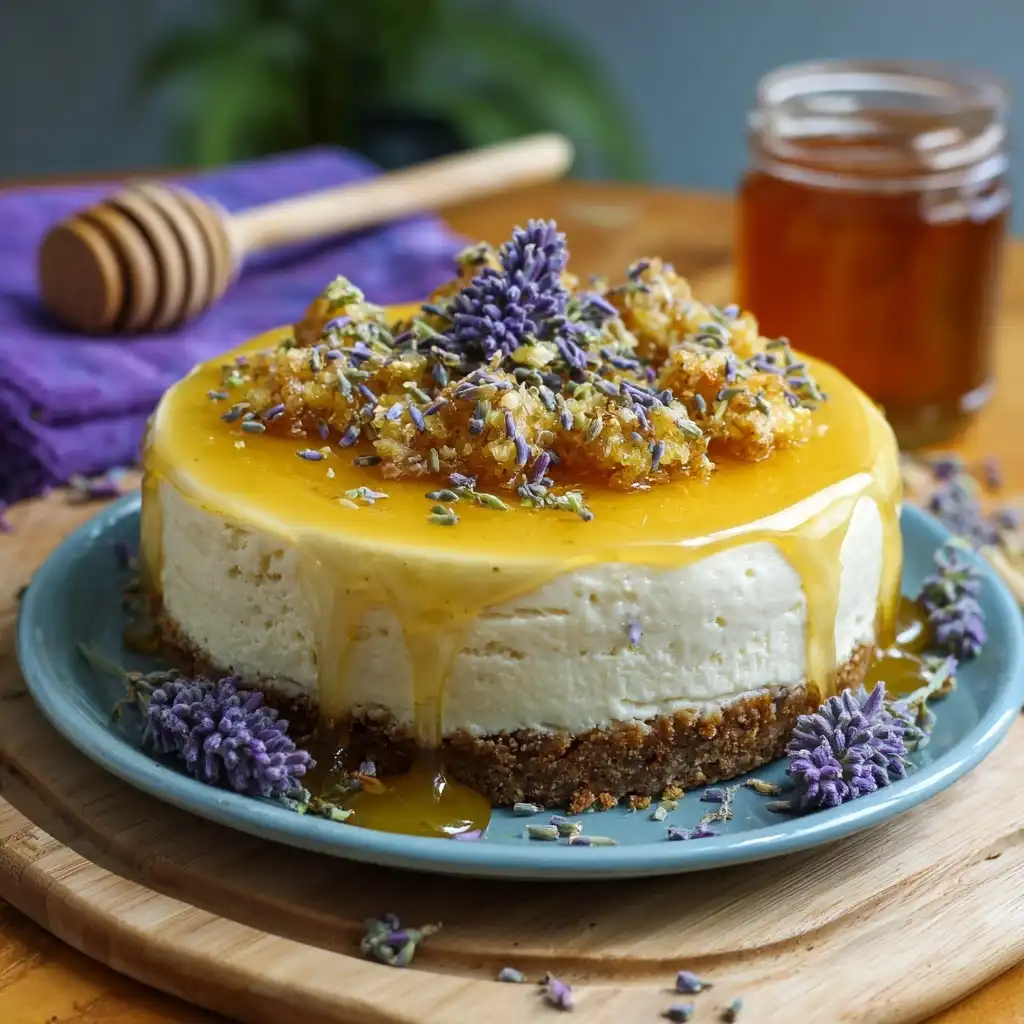
- Warm reserved ¼ cup lavender-honey syrup to fluid consistency (10 seconds in microwave). Using a small spoon, dot syrup over surface. Drag toothpick or skewer in concentric circles or figure-eights to create soft, organic marbling.
- Sprinkle crushed edible lavender buds evenly over top. Drizzle sparingly with additional warmed local honey.
- For clean slices: Dip sharp, thin-bladed knife in hot water, wipe dry, cut, repeat. Serve chilled — never straight from freezer unless frozen intentionally (see Variations).
Tips
- Room Temperature Is Non-Negotiable: All dairy and eggs must be 65–68°F. Take cream cheese out 3 hours ahead; place eggs in warm water for 10 minutes if forgotten.
- Lavender Is Potent — Less Is Infinitely More: Start with 1 tsp lavender for infusion. You can always add more next time — you cannot remove it. Taste syrup before straining: it should whisper, not shout.
- No Microwave Shortcuts for Honey: Microwaving honey alone degrades flavor and increases crystallization risk. Always infuse gently on stovetop.
- Chill Your Bowl & Beaters: When whipping cream or making garnishes, cold tools yield better volume and stability.
- Water Bath Water Must Be Hot, Not Boiling: Boiling water creates violent steam that can seep under foil and waterlog crust. Use tap water heated to 160–170°F (71–77°C).
- Thermometer = Your Best Friend: Visual cues vary by oven. A digital probe eliminates guesswork and guarantees perfect doneness.
- Patience With Chilling Pays Off Tenfold: Skipping the 24-hour chill results in weeping, crumbling, and muted flavor. This is a dessert that improves daily for 3 days.
- Crust Troubleshooting: If crust crumbles when slicing, it wasn’t pressed firmly enough or was underbaked. If soggy, foil wasn’t sealed properly or water leaked in.
- Crack Prevention Triad: (1) Gentle mixing, (2) Water bath, (3) Gradual cooling. Any one missing increases crack risk exponentially.
- Storage Wisdom: Keep covered with inverted cake plate or plastic-wrapped cardboard circle (not cling film directly on surface — it sticks and mars finish). Freeze only *after* full 48-hour chill — wrap double in parchment + foil. Thaw overnight in fridge.
Variations and Customizations
This recipe is a canvas — adaptable for dietary needs, seasonal inspiration, and creative expression — without sacrificing integrity.
Dietary Adaptations:
- Gluten-Free: Substitute gluten-free graham crackers (like Schar or Pamela’s) or 1 ½ cups almond flour + 2 tbsp coconut sugar + 6 tbsp melted butter + ¼ tsp xanthan gum.
- Lower-Sugar: Replace granulated sugar with ¾ cup erythritol + 2 tbsp monk fruit blend (tested for baking); reduce honey syrup to ½ cup; add 1 tsp apple cider vinegar to batter to balance pH.
- Vegan: Use cashew cream cheese base (soaked raw cashews, coconut cream, lemon juice, agar-agar, and lavender-honey syrup substitute made with date paste + lavender infusion); crust from toasted walnuts + oats + coconut oil.
- Lighter Texture: Substitute ½ cup cream cheese with ½ cup Greek yogurt (full-fat, strained) — adds tang and reduces density while maintaining structure.
Flavor & Texture Twists:
- Lavender-Honey-Ginger: Add 1 tbsp finely grated fresh ginger + 1 tsp crystallized ginger (minced) to filling; garnish with candied ginger ribbons.
- Blackberry-Lavender Swirl: Puree ½ cup ripe blackberries with 1 tsp lemon juice; strain seeds. Swirl 3 tbsp into batter pre-bake alongside honey syrup.
- Toasted White Chocolate & Lavender: Fold in ½ cup finely chopped toasted white chocolate (toasted 8–10 min at 300°F) into batter after honey syrup; garnish with white chocolate curls.
- Earl Grey Infusion: Steep 2 Earl Grey tea bags in warm cream for 5 minutes before adding to batter — complements lavender’s bergamot notes.
- Smoked Honey Variation: Use small-batch smoked honey (applewood or cherrywood) for deeper, campfire-adjacent complexity — reduce lavender to 1 tsp.
Presentation & Format Innovations:
- Individual Mini Cheesecakes: Bake in lined muffin tin (foil + parchment). Reduce bake time to 22–25 minutes; chill 8 hours minimum.
- Cheesecake Bars: Spread batter into 9×13″ pan over crust. Bake 50–60 min. Cut into diamonds; garnish each with single lavender bud.
- Deconstructed Version: Layer crumbled crust, lavender-honey curd (cook syrup + lemon juice + cornstarch until thick), and airy lavender mascarpone mousse in glasses.
- Frozen Honey Lavender Cheesecake: After full chill, freeze 6+ hours. Slice frozen; let sit 8 minutes before serving for creamy-but-firm texture — ideal for summer.
- Breakfast Cheesecake Loaf: Reduce sugar to ½ cup, add 1 tsp baking powder, and bake in greased loaf pan. Top with lavender-honey glaze.
Health Considerations and Nutritional Value
While undeniably indulgent, this Honey Lavender Cheesecake offers meaningful nutritional dimensions when approached mindfully — far beyond empty calories.
Nutrient Highlights (Per Standard Slice, 1/12th of Recipe):
- Calcium & Phosphorus (≈180mg calcium, 140mg phosphorus): From full-fat dairy — critical for bone matrix formation and cellular energy (ATP) metabolism.
- Probiotics & Enzymes: Raw local honey contains naturally occurring diastase, invertase, and glucose oxidase — supporting digestive resilience and gentle antimicrobial activity. Unpasteurized sour cream contributes live cultures (L. bulgaricus, S. thermophilus) when cultured traditionally.
- Polyphenols & Antioxidants: Lavender (linalool, rosmarinic acid) and honey (flavonoids like quercetin, phenolic acids) exhibit documented anti-inflammatory, neuroprotective, and mild anxiolytic effects in clinical models — synergistic with mindful eating practices.
- Healthy Fats: Conjugated linoleic acid (CLA) from grass-fed dairy butter and cream cheese supports metabolic health and satiety signaling.
- Low Glycemic Impact (Compared to Granulated-Sugar-Only Versions): Honey’s fructose-glucose ratio (≈40:60) results in slower glucose absorption than sucrose; added fiber from whole-grain crust further moderates blood sugar response.
Mindful Consumption Guidance:
- Portion Mindfulness: At ≈380–410 kcal per slice, it’s nutrient-dense — enjoy deliberately, not mindlessly. Pair with herbal tea (chamomile or mint) to enhance relaxation response.
- Allergen Awareness: Contains dairy, eggs, gluten (unless adapted), and potential pollen exposure (local honey). Not suitable for infants under 12 months due to infant botulism risk from raw honey spores.
- Lavender Safety Note: Culinary lavender is safe in recommended doses (<1 tsp dried buds per recipe). Avoid if pregnant or nursing without consulting a healthcare provider; contraindicated with sedative medications.
- Balance Philosophy: This dessert honors Ayurvedic principles — honey (ushna) and lavender (shita) create a balancing prakriti; its grounding quality makes it ideal for vata-pacifying routines.
- Not a “Health Food” — But a Health-Affirming Choice: When made with integrity (local, raw, organic, minimally processed), it supports local agriculture, biodiversity (lavender farms support pollinators), and ritualistic nourishment — aspects increasingly linked to long-term wellness in nutritional psychology research.
Ingredients
Makes one 9-inch cheesecake (12 servings)
Lavender-Infused Honey Syrup:
- ¾ cup raw, unfiltered local honey
- 1½ tsp food-grade dried culinary lavender buds (finely crumbled)
- 2 tbsp heavy cream (36–40% fat)
Graham Cracker Crust:
- 1 ½ cups (150g) whole-grain graham cracker crumbs (about 12 full sheets)
- 6 tbsp (85g) unsalted butter, melted and cooled
- 3 tbsp granulated sugar
- ¼ tsp fine sea salt
Honey Lavender Cream Cheese Filling:
- 24 oz (680g) full-fat brick-style cream cheese, room temperature
- 1 cup (240g) full-fat sour cream, room temperature
- ½ cup (120ml) heavy cream, room temperature
- 4 large eggs + 1 large egg yolk, room temperature
- 1 cup (200g) granulated sugar
- 1 tsp pure vanilla extract
- Zest of 1 medium lemon (≈1 tbsp)
- ⅛ tsp fine sea salt
- ¾ cup chilled Lavender-Infused Honey Syrup (from above)
Swirl & Garnish:
- ¼ cup reserved Lavender-Infused Honey Syrup
- ¼ tsp edible dried lavender buds, gently crushed
- 1–2 tsp additional warmed local honey
- Fresh edible flowers (optional)
Directions
- Prepare Lavender-Infused Honey Syrup: In a small saucepan, combine honey and lavender. Warm over lowest heat 8–10 minutes without boiling. Stir in heavy cream. Cover; steep 45–60 minutes. Strain through fine-mesh sieve, pressing solids. Chill 20 minutes. Reserve ¼ cup for swirling; refrigerate remainder.
- Make Crust: Preheat oven to 350°F (177°C). Grease and foil-wrap 9-inch springform pan. Pulse graham crackers, sugar, and salt; drizzle in melted butter while pulsing until sandy. Press firmly into pan. Chill 20 min. Bake 10–12 min. Cool completely. Reduce oven to 325°F (163°C).
- Make Filling: Beat cream cheese on medium-low 1 min until smooth. Add sugar in 3 parts, beating 20 sec after each. Add sour cream and heavy cream; mix 30 sec. Add eggs one at a time (10 sec each), then yolk. Fold in vanilla, lemon zest, salt, and ¾ cup chilled syrup — stop when streaks remain.
- Bake in Water Bath: Place springform in roasting pan. Pour hot water to halfway up sides. Pour batter in. Tap pan; run knife around edge. Bake 75–85 min until center jiggles like firm gelatin (150–152°F internal temp). Turn oven OFF; crack door; cool 1 hour in oven.
- Chill & Serve: Cool 2 hours on rack. Refrigerate uncovered ≥12 hours (ideally 24–48). Before serving: remove side ring. Swirl reserved syrup. Sprinkle crushed lavender. Drizzle with honey. Slice with hot, dry knife.
FAQ
- Q: Can I use lavender essential oil instead of dried buds?
- A: Absolutely not. Culinary lavender buds contain safe, food-grade concentrations of linalool and linalyl acetate. Essential oils are 50–100x more concentrated, often adulterated, and may contain toxic compounds like camphor. Ingestion can cause nausea, vomiting, or neurological effects. Stick strictly to certified food-grade dried lavender.
- Q: Why does my cheesecake crack every time?
- A: Most commonly: (1) Overmixing after eggs are added — introduces air that expands and collapses; (2) Cooling too quickly — always use the oven-off cooldown; (3) Underbaked center — use a thermometer; (4) Foil leak in water bath — double-wrap meticulously; (5) Skipping the perimeter knife release before baking.
- Q: Can I make this without a water bath?
- A: Technically yes — but strongly discouraged. Without the humid, even heat of a water bath, surface dries and cracks form, edges overbake before center sets, and texture becomes grainy rather than satiny. If determined, reduce oven temp to 300°F and extend bake time by 15–20 min — but expect tradeoffs in luxury and reliability.
- Q: My honey syrup