Introduction
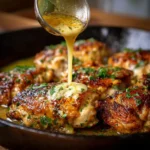
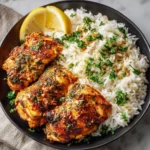
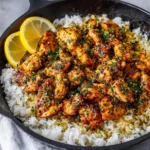
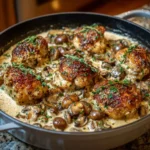
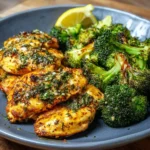
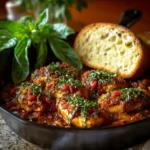
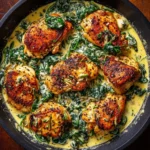
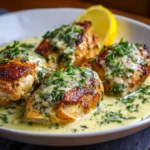
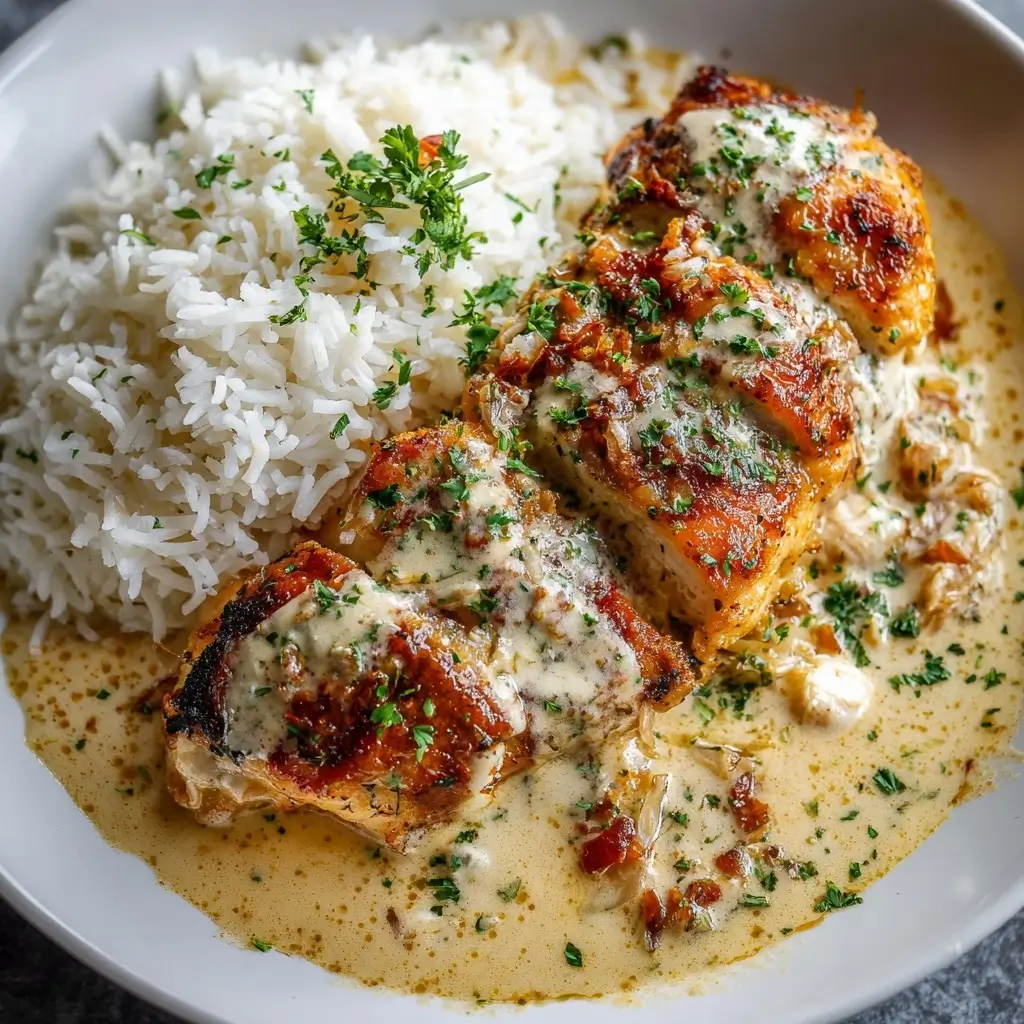
Garlic Butter Chicken with Cream Sauce is a luxurious, restaurant-worthy dish that brings comfort and elegance to any dinner table. With its velvety, rich sauce infused with aromatic garlic, golden-brown seared chicken breasts, and subtle notes of fresh herbs, this recipe strikes the perfect balance between simplicity and sophistication. Whether you’re preparing an intimate weeknight dinner for two or impressing guests at a weekend gathering, this dish delivers bold flavor, creamy texture, and undeniable depth—without requiring professional culinary skills. Its versatility, quick prep time, and pantry-friendly ingredients make it a beloved staple in home kitchens across North America, Europe, and beyond.
The History
While no single documented origin traces the exact birth of Garlic Butter Chicken with Cream Sauce, its roots lie in the confluence of classical French *sauce au beurre* techniques and mid-20th-century American home cooking innovation. French cuisine has long celebrated the marriage of butter, garlic, and cream—evident in preparations like *beurre blanc*, *sauce béarnaise*, and *chicken à la crème*. Post-World War II, American cooks embraced these rich European flavors but adapted them for accessibility: substituting heavy cream for labor-intensive reductions, using boneless, skinless chicken breasts for convenience, and simplifying emulsification through gentle simmering rather than precise whisking. The rise of food television in the 1980s and 1990s—especially shows featuring chefs like Julia Child and later Emeril Lagasse—helped popularize “garlic butter” as a signature flavor profile. By the early 2000s, food blogs and recipe-sharing platforms amplified variations of this dish, often tagged with descriptors like “creamy garlic chicken,” “restaurant-style butter chicken,” or “easy pan-seared chicken in garlic cream sauce.” Today, it stands as a modern classic—a global fusion dish reflecting both Old World technique and New World practicality.
Ingredients Breakdown
Every exceptional Garlic Butter Chicken with Cream Sauce begins with thoughtfully selected, high-quality components. Below is a detailed analysis of each ingredient’s role—not just what it does, but why it matters:
- Chicken Breasts (boneless, skinless): Preferred for their lean texture and ability to absorb flavors without overpowering the sauce. Opt for air-chilled, organic, or pasture-raised breasts when possible—they retain moisture better during cooking and yield superior tenderness. Brining (15–30 minutes in ¼ cup salt + 2 cups cold water) is highly recommended for juiciness and seasoning penetration.
- Unsalted Butter: The soul of the dish. Unsalted butter allows full control over sodium levels and ensures consistency in browning. European-style butter (82–86% fat) provides richer flavor and better emulsification in the sauce. Clarified butter may be used for higher smoke point during searing—but reserve some whole butter for finishing to restore aroma and silkiness.
- Fresh Garlic: Never substitute jarred minced garlic. Fresh cloves offer enzymatic complexity—allicin compounds develop pungency when crushed and mellowness when gently sautéed. Use a microplane grater for ultra-fine, evenly distributed garlic that integrates seamlessly into the sauce without textural grit.
- Heavy Cream (36–40% milk fat): Essential for body, sheen, and stability. Lower-fat alternatives (half-and-half, whole milk) will not thicken properly and risk curdling. For lactose-sensitive diners, full-fat coconut cream (canned, chilled, skimmed top layer) offers a viable, dairy-free alternative with surprisingly compatible richness.
- Dry White Wine (e.g., Sauvignon Blanc or Pinot Grigio): Adds acidity and dimension, cutting through the fat while enhancing umami. Alcohol fully evaporates during simmering, leaving only bright, fruity undertones. Substitute with dry vermouth or unsalted chicken broth + ½ tsp white wine vinegar if avoiding alcohol.
- Chicken Stock (low-sodium, preferably homemade or high-quality carton): Provides savory depth (*umami*) and helps deglaze the fond—the caramelized bits stuck to the pan after searing. Homemade stock yields gelatinous body; store-bought versions should be reduced by ⅓ before adding to concentrate flavor.
- Fresh Herbs (parsley, thyme, chives): Added at the end to preserve volatile oils and freshness. Flat-leaf parsley contributes grassy brightness; thyme lends earthy warmth; chives offer delicate onion nuance. Dried herbs lack vibrancy and can taste dusty—reserve them only for long-simmered applications.
- Lemon Juice (freshly squeezed): A critical finishing touch—not for sourness, but for *brightness*. Just ½–1 tsp lifts the entire sauce, balancing fat and rounding out flavor. Bottled juice lacks citric acid integrity and introduces off-notes.
- Optional Enhancers: A pinch of grated nutmeg (enhances creaminess), a splash of Dijon mustard (adds subtle tang and emulsifying power), or 1 tsp capers (for briny contrast) can elevate complexity without compromising authenticity.
Step-by-Step Recipe
- Prep & Temper the Chicken: Pat chicken breasts *extremely dry* with paper towels—moisture is the enemy of searing. Slice each breast horizontally into two even cutlets (about ½-inch thick). Place between parchment and gently pound to uniform ⅜-inch thickness—this ensures even cooking and tenderness. Season both sides generously with kosher salt and freshly ground black pepper. Let rest at room temperature for 15 minutes.
- Heat the Pan & Sear: Heat a heavy-bottomed stainless steel or cast-iron skillet over medium-high heat until shimmering (≈400°F). Add 1 tbsp high-smoke-point oil (avocado or grapeseed). Once oil ripples, place chicken cutlets without crowding—work in batches if needed. Press lightly with a spatula for 30 seconds to ensure full contact. Sear undisturbed for 4–5 minutes until deeply golden and easily releases from pan. Flip and cook 3–4 minutes more until internal temperature reaches 155°F (it will carry over to 165°F). Transfer to a wire rack set over a plate; tent loosely with foil. Rest 5 minutes—this preserves juices and prevents sauce dilution.
- Build the Aromatics Base: Reduce heat to medium-low. In same skillet, melt 3 tbsp unsalted butter. Add 4–5 finely grated garlic cloves and 1 tsp fresh thyme leaves. Sauté 60–90 seconds—just until fragrant and edges begin to turn pale gold (do NOT brown or burn garlic). Stir constantly to prevent scorching.
- Deglaze & Simmer: Pour in ½ cup dry white wine, scraping vigorously with a wooden spoon to lift all browned fond. Simmer 2 minutes until reduced by half. Add ¾ cup low-sodium chicken stock and simmer another 3 minutes until liquid reduces slightly and coats the back of a spoon.
- Emulsify the Cream Sauce: Whisk in ¾ cup cold heavy cream in a slow, steady stream. Bring to a gentle simmer (do not boil rapidly). Reduce heat to low and simmer uncovered for 5–7 minutes, stirring every 60 seconds with a silicone spatula, until sauce thickens to nappe consistency—it should coat the back of a spoon and leave a clean trail when you run your finger across it. If too thin, simmer longer; if too thick, whisk in warm stock 1 tsp at a time.
- Finish & Enrich: Remove from heat. Whisk in remaining 1 tbsp cold butter, one cube at a time, until fully incorporated and glossy. Stir in 1 tsp fresh lemon juice, 2 tbsp chopped flat-leaf parsley, and optional ½ tsp Dijon mustard. Taste and adjust seasoning—usually needs a final pinch of salt and crack of black pepper.
- Reunite & Serve: Return rested chicken to sauce, spooning generously over each piece. Let warm through gently for 60–90 seconds—do not re-boil. Garnish with extra parsley, lemon zest, and a flaky sea salt like Maldon for textural contrast.
Tips
- Patience Pays Off: Rushing the sear leads to steaming instead of browning. Wait for that deep mahogany crust—it’s where 80% of the dish’s flavor originates.
- Cold Cream, Cold Butter: Adding cold dairy to hot liquid prevents splitting and promotes smooth emulsification. Always chill cream and butter cubes before finishing.
- Low & Slow for Sauce: High heat causes cream to separate or curdle. Maintain a bare simmer—bubbles should barely break the surface.
- Rest the Chicken: Skipping the 5-minute rest guarantees dry, stringy meat. Carryover cooking finishes the job while juices redistribute.
- Sauce Consistency Check: Dip a spoon, hold it horizontally, and run your finger down the back—if the line stays clear, it’s ready. If sauce runs together, continue reducing.
- Reserve Some Garlic: For extra punch, stir in 1 raw, finely minced garlic clove *after* removing from heat—its sharpness cuts through richness beautifully.
- Pan Selection Matters: Avoid nonstick for searing—it won’t generate enough fond. Stainless or cast iron delivers superior Maillard reaction and deglazing potential.
- Make-Ahead Friendly: Sauce base (without cream and butter) can be made 2 days ahead and refrigerated. Reheat gently, then proceed with cream and finishing steps.
- Leftover Magic: Extra sauce freezes beautifully for up to 3 months. Thaw overnight in fridge, reheat slowly, and use over roasted vegetables, pasta, or fish.
Variations and Customizations
This recipe is inherently adaptable—here are chef-tested interpretations for diverse palates and dietary needs:
- Herb-Infused: Replace thyme with 1 tbsp chopped tarragon + 1 tsp dried lavender (use sparingly) for a Provence-inspired profile.
- Spicy Arrabbiata Style: Add ¼ tsp red pepper flakes with garlic; finish with 1 tbsp sun-dried tomato paste stirred into warm sauce.
- Mushroom & Shallot: Sauté 1 cup sliced cremini mushrooms and 2 finely diced shallots in butter before adding garlic—adds deep umami and earthy sweetness.
- Lemon-Caper: Stir in 2 tbsp rinsed capers and zest of 1 lemon with finishing herbs. Bright, briny, and elegant.
- Dairy-Free/Vegan Option: Use refined coconut oil instead of butter, full-fat coconut cream instead of dairy cream, and vegetable stock. Add 1 tsp nutritional yeast for cheesy depth and ½ tsp turmeric for golden hue.
- Gluten-Free: Naturally GF—but verify stock and wine labels for hidden gluten (some stocks contain hydrolyzed wheat protein).
- Keto-Friendly: Already low-carb (≈2g net carbs per serving). Boost healthy fats by adding 1 tbsp toasted pine nuts or slivered almonds.
- Sheet-Pan Version: Arrange seasoned chicken on parchment-lined sheet pan; roast at 400°F for 18–22 minutes. Meanwhile, prepare sauce stovetop, then combine and broil 1 minute for cohesive finish.
- One-Pot Pasta Integration: Cook 8 oz linguine directly in the sauce after deglazing—add 2 cups extra stock, cover, and simmer 12 minutes until pasta is al dente and sauce is absorbed.
Health Considerations and Nutritional Value
A standard serving (1 chicken breast + ⅓ cup sauce) contains approximately:
- Calories: 420–480 kcal
- Protein: 38–42 g (excellent source—supports muscle maintenance and satiety)
- Fat: 26–30 g (mostly unsaturated from butter and olive oil; includes beneficial butyric acid from grass-fed butter)
- Saturated Fat: 14–16 g (within daily limits for most adults when consumed as part of balanced diet)
- Carbohydrates: 1.5–2.5 g (naturally low—ideal for low-carb, keto, or diabetic meal planning)
- Sodium: 480–620 mg (moderate—easily reduced by using low-sodium stock and omitting added salt)
- Vitamins & Minerals: Rich in B6 and B12 (chicken), Vitamin A and K (butter), selenium (immune support), and antioxidants from garlic (allicin) and parsley (vitamin C, flavonoids).
Functional Health Benefits:
- Garlic: Clinically studied for cardiovascular support—including blood pressure modulation and antiplatelet activity.
- Butter (grass-fed): Contains conjugated linoleic acid (CLA), linked to reduced inflammation and improved metabolic health in observational studies.
- Lemon Juice: Enhances non-heme iron absorption from chicken—especially beneficial for plant-based eaters supplementing meals.
Considerations: Those managing hypertension should monitor sodium via stock and salt use. Individuals with lactose intolerance may tolerate small amounts of aged butter and heavy cream (naturally low-lactose), but coconut cream remains safest. For weight management, portion control of sauce is key—cream contributes most calories. Pair with fiber-rich sides (roasted broccoli, quinoa, or spinach salad) to balance glycemic load and promote fullness.
Ingredients
- 2 (6–8 oz) boneless, skinless chicken breasts, sliced horizontally and pounded to ⅜-inch thickness
- 1 tsp kosher salt, plus more to taste
- ½ tsp freshly ground black pepper, plus more to taste
- 1 tbsp avocado or grapeseed oil
- 4 tbsp unsalted butter, divided (3 tbsp for aromatics, 1 tbsp for finishing)
- 4–5 garlic cloves, finely grated on a microplane
- 1 tsp fresh thyme leaves (or ½ tsp dried)
- ½ cup dry white wine (Sauvignon Blanc or Pinot Grigio)
- ¾ cup low-sodium chicken stock
- ¾ cup cold heavy cream (36–40% fat)
- 1 tsp fresh lemon juice
- 2 tbsp finely chopped flat-leaf parsley
- Optional: ½ tsp Dijon mustard, 1 tsp lemon zest, flaky sea salt for garnish
Directions
- Season chicken cutlets evenly with salt and pepper. Heat oil in a large skillet over medium-high heat until shimmering. Sear chicken 4–5 minutes per side until golden and internal temperature reaches 155°F. Transfer to a wire rack; tent with foil and rest 5 minutes.
- Reduce heat to medium-low. Melt 3 tbsp butter in same skillet. Add grated garlic and thyme; sauté 60–90 seconds until fragrant.
- Pour in wine, scraping pan to release fond. Simmer 2 minutes until reduced by half.
- Add chicken stock and simmer 3 minutes until slightly reduced.
- Whisk in cold heavy cream gradually. Simmer gently 5–7 minutes until thickened to coating consistency.
- Remove from heat. Whisk in remaining 1 tbsp cold butter, lemon juice, parsley, and optional Dijon.
- Return chicken to sauce, spooning generously over each piece. Warm gently 60 seconds.
- Garnish with extra parsley, lemon zest, and flaky salt. Serve immediately.
FAQ
- Can I use chicken thighs instead of breasts?
- Absolutely—and they’re even more forgiving! Boneless, skinless thighs stay juicier and add deeper flavor. Adjust sear time to 5–6 minutes per side, and ensure internal temp reaches 165°F. Thighs also benefit from a 10-minute rest due to higher fat content.
- Why does my sauce break or look grainy?
- Most commonly caused by overheating cream (boiling instead of simmering), adding cold cream to a pan that’s too hot, or vigorous whisking that destabilizes the emulsion. Fix it by removing from heat, letting cool 1 minute, then whisking in 1 tsp cold butter or 1 tbsp warm stock. Prevention is best: keep heat low and add dairy gradually.
- Can I make this ahead and reheat?
- Yes—with caveats. Fully cooked chicken reheats well, but sauce is best prepared day-of. For meal prep: cook chicken and sauce base (up to stock addition), refrigerate separately for up to 3 days. To serve: reheat sauce base, whisk in cold cream and butter, then add chicken.
- Is there a way to lighten this dish without sacrificing flavor?
- You can substitute half the cream with evaporated milk (not condensed) for 30% fewer calories and similar richness. Also, use grass-fed butter (higher in omega-3s) and increase garlic and herbs to boost flavor without fat. Serve over cauliflower rice or zucchini noodles for lower-calorie pairing.
- What sides pair best with Garlic Butter Chicken?
- Classic complements include buttered egg noodles, mashed potatoes, or crusty artisan bread for sauce-mopping. Lighter options: roasted asparagus with lemon, garlicky sautéed spinach, herbed quinoa, or a crisp arugula salad with shaved Parmesan and lemon vinaigrette.
- Can I freeze this dish?
- Chicken freezes well for up to 3 months. Sauce (with cream) is *not recommended* for freezing—it may separate upon thawing. Instead, freeze chicken only, or freeze sauce base (without cream/butter) and finish fresh.
- How do I prevent garlic from burning?
- Grate garlic finely—it cooks faster and more evenly. Keep heat at medium-low, stir constantly, and remove from heat the *instant* you smell sweet, toasty fragrance (not acrid or bitter). If using minced garlic, reduce sauté time to 30 seconds.
- What wine should I cook with—and drink with it?
- Cook with the same dry white wine you’d enjoy drinking—Sauvignon Blanc, Pinot Grigio, or unoaked Chardonnay work perfectly. For pairing, match acidity: a vibrant, citrus-driven white enhances the lemon-garlic notes. Avoid oaky or buttery wines that compete with the sauce.
Summary
Garlic Butter Chicken with Cream Sauce is a masterclass in simple luxury—where golden-seared chicken meets a silken, aromatic sauce built from pantry staples and precise technique. Its enduring appeal lies in its balance: rich yet bright, indulgent yet approachable, elegant yet effortlessly achievable in under 30 minutes.
With customizable variations, thoughtful health insights, and foolproof tips rooted in professional kitchen wisdom, this dish transcends trend—it becomes a timeless centerpiece for everyday nourishment and celebratory moments alike.