Introduction
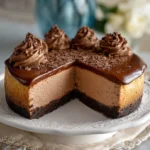
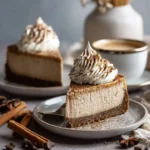
Welcome to the ultimate indulgence—Chocolate Espresso Cheesecake: a luxuriously rich, velvety-smooth dessert that marries the deep, bittersweet intensity of premium dark chocolate with the bold, aromatic complexity of freshly brewed espresso. This isn’t just a cheesecake—it’s an experience. Every forkful delivers a harmonious balance of creamy tang, roasted depth, and cocoa richness, crowned with a subtle caffeine lift that awakens the senses without overwhelming them. Whether you’re hosting an elegant dinner party, celebrating a milestone, or simply treating yourself to a moment of quiet decadence, this dessert commands attention and lingers in memory long after the last bite. Designed for both seasoned bakers and adventurous beginners, it offers structure, sophistication, and soul-satisfying comfort—all in one stunning, sliceable masterpiece.
The History
The evolution of Chocolate Espresso Cheesecake is a delicious convergence of three iconic culinary traditions: the ancient roots of cheese-based desserts, the 19th-century rise of American baked cheesecake, and the global coffee renaissance of the late 20th century. While early forms of cheesecake date back to ancient Greece (served at Olympic games as energy food), the modern New York–style baked cheesecake emerged in the 1870s thanks to William Lawrence’s accidental creation of cream cheese in Chester, NY. Chocolate entered the cheesecake canon in earnest during the mid-20th century, as cocoa powder and melted chocolate became pantry staples—and bakers began experimenting with flavor layering beyond vanilla and fruit.
Espresso’s integration was slower but inevitable: Italian immigrants brought espresso culture to North America in the 1950s, but it wasn’t until the artisanal coffee movement of the 1990s—fueled by third-wave roasters, barista craftsmanship, and growing consumer interest in origin-specific beans—that espresso transcended its role as a beverage and became a revered baking ingredient. Chefs and home bakers alike discovered that finely ground, double-brewed espresso (not instant coffee) added profound umami-like depth, cut through sweetness with natural acidity, and enhanced chocolate’s inherent fruitiness and roast notes. By the early 2000s, Chocolate Espresso Cheesecake appeared on menus at high-end patisseries from Brooklyn to Berlin—and today, it stands as a benchmark dessert for modern, globally inspired baking: equal parts tradition, technique, and terroir-driven creativity.
Ingredients Breakdown
Every element in this Chocolate Espresso Cheesecake has been meticulously selected—not just for flavor, but for functional integrity and textural synergy:
- Graham Cracker Crust Base: Whole-grain graham crackers provide gentle caramelized sweetness and structural sturdiness; unsalted butter binds and enriches; granulated sugar adds crunch and aids browning; a pinch of flaky sea salt heightens contrast and balances richness.
- Cream Cheese Filling: Full-fat, brick-style cream cheese (Philadelphia or similar) ensures dense yet supple body; sour cream contributes tang, moisture, and tenderness; heavy cream adds luxurious silkiness and prevents cracking; full-fat Greek yogurt (optional but recommended) lends subtle acidity and protein stability for ultra-fine crumb.
- Chocolate Component: 70% dark chocolate (Valrhona Guanaja, Callebaut 811, or Scharffen Berger) delivers nuanced bitterness, berry-forward acidity, and smooth melt; Dutch-process cocoa powder (Hershey’s Special Dark or Cacao Barry Extra Brute) intensifies color and earthy depth without adding excess acidity.
- Espresso Element: Freshly brewed double ristretto (30–40g yield from 18g dose) offers concentrated, syrupy intensity with low bitterness and pronounced chocolate/nut notes; cold-brew concentrate (12-hour steep, coarse grind, ratio 1:7) provides smoother, lower-acid versatility; *never* use stale, over-extracted, or burnt espresso—it will dominate and muddy the profile.
- Sweeteners & Stabilizers: Granulated sugar dissolves cleanly and supports structure; brown sugar (light or dark) adds molasses warmth and moisture retention; cornstarch (not flour) inhibits curdling and reinforces gel network; pure Madagascar bourbon vanilla paste contributes floral, woody, and creamy undertones that bridge chocolate and coffee.
- Eggs: Large, room-temperature eggs (cage-free, pasteurized if serving immunocompromised guests) act as emulsifiers and leaveners—added one at a time to ensure full incorporation and prevent air pockets.
- Finishing Touches: Flaky Maldon sea salt for finishing; edible gold leaf (optional, for luxury service); house-made dark chocolate curls (tempered 62% couverture); espresso-dusted whipped cream (heavy cream + 1 tsp cooled espresso extract + 1 tbsp powdered sugar + ½ tsp vanilla); and a drizzle of salted caramel infused with orange zest and a whisper of cardamom.
Step-by-Step Recipe
- Prepare the Crust (Day Before or Morning Of): Pulse 1 ½ cups graham cracker crumbs (about 12 full sheets), ¼ cup granulated sugar, and ¼ tsp flaky sea salt in a food processor until fine. Add 6 tbsp melted unsalted butter and pulse until mixture resembles wet sand. Press firmly into bottom and 1.5 inches up sides of a 9-inch springform pan lined with parchment (bottom and band). Chill uncovered for 30 minutes, then bake at 350°F (177°C) for 10 minutes. Cool completely on wire rack—do not remove from pan.
- Bloom the Cocoa & Espresso (Critical Step): In a small heatproof bowl, whisk together ¼ cup Dutch-process cocoa, 2 tbsp finely ground espresso beans (or 1.5 tbsp instant espresso powder), and 3 tbsp hot water (just under boiling, ~205°F). Stir vigorously for 60 seconds until glossy and fully dissolved. Let cool to room temperature—this step unlocks volatile aromatics and prevents clumping in filling.
- Melt & Temper Chocolate: Chop 8 oz dark chocolate; place in a heatproof bowl set over barely simmering water (bain-marie). Stir constantly until melted and smooth (~115°F). Remove from heat and stir in 2 tbsp unsalted butter until fully emulsified. Cool to 90°F—warm to touch but not hot—before folding in.
- Beat Cream Cheese Base: Using a stand mixer fitted with paddle attachment, beat 24 oz full-fat cream cheese (3 standard 8-oz bricks, softened 2 hours at room temp) on medium-low for 2 minutes until completely smooth and lump-free. Scrape bowl and beater thoroughly. Add ¾ cup granulated sugar + ¼ cup light brown sugar; beat 2 more minutes until pale and airy. Add 1 tsp vanilla paste; beat 30 seconds. Add eggs one at a time, beating 45 seconds after each addition—scraping bowl and beater between each. Mixture should be thick, homogenous, and free of streaks.
- Incorporate Wet Ingredients: Reduce speed to low. Add ¾ cup sour cream, ½ cup heavy cream, and ½ cup full-fat Greek yogurt (room temp); mix until just combined (~20 sec). Scrape bowl. With mixer still on low, slowly drizzle in cooled espresso-cocoa mixture, followed by tempered chocolate. Mix only until no streaks remain—overmixing introduces air and invites cracking.
- Strain & Pour: Pass entire batter through a fine-mesh sieve into a large spouted measuring cup—this eliminates any undissolved cocoa particles, unmelted chocolate bits, or egg strings. Gently pour into chilled crust. Tap pan sharply 4–5 times on counter to release trapped air bubbles.
- Water Bath Setup (Essential for Even Baking): Wrap exterior of springform pan *tightly* with two overlapping layers of heavy-duty aluminum foil (shiny side in). Place pan inside a larger roasting pan. Carefully pour hot (not boiling) water into roasting pan until it reaches halfway up springform sides (~1.5 inches). Use a kitchen towel to wipe any water off pan exterior before placing in oven.
- Bake Low & Slow: Bake at 325°F (163°C) for 75–85 minutes. Cheesecake is done when edges are puffed and set, center jiggles slightly like Jell-O (not liquid), and internal temperature reads 150–152°F on an instant-read thermometer inserted 1 inch from center. Turn off oven, crack door open 1 inch with wooden spoon, and let cool inside for 1 hour.
- Chill & Set (Non-Negotiable): Remove from water bath. Run thin knife around edge to loosen. Cool on wire rack at room temp for 1 hour. Refrigerate *uncovered* for minimum 12 hours—but ideally 24–48 hours—to allow proteins to fully relax, flavors to meld, and texture to achieve cloud-like density.
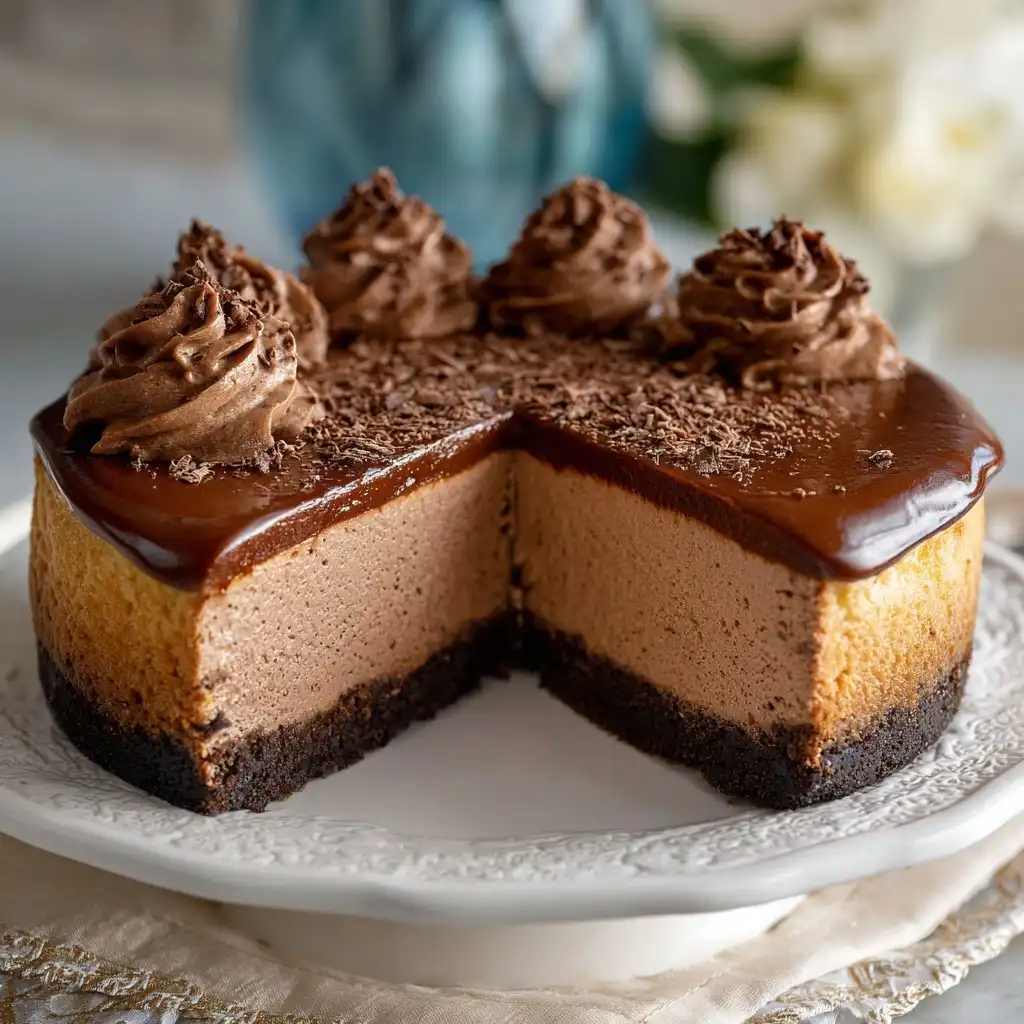
- Unmold & Finish: Run warm knife around perimeter again. Release springform collar. Slide offset spatula under crust to lift onto cake stand or serving plate. Garnish with espresso-dusted whipped cream, chocolate curls, flaky salt, and optional gold leaf. Serve chilled with a warmed knife for clean slices.
Tips
- Room Temperature Is Non-Negotiable: Cold cream cheese = lumps. Cold eggs = curdled batter. Cold sour cream = uneven emulsion. Plan ahead—remove all dairy and eggs from fridge 2–3 hours pre-baking.
- Straining Is Your Secret Weapon: Skipping the fine-mesh sieve may save 60 seconds—but risks grainy texture and visual imperfections. Always strain.
- Don’t Skip the Water Bath: It’s the single most effective tool for preventing cracks, ensuring even heat transfer, and delivering that signature silky crumb. No substitutions (steam pans, towels, etc.) replicate its physics.
- Espresso Must Be Fresh & Concentrated: Brew espresso within 15 minutes of mixing batter. If using instant, choose professional-grade (Medaglia D’Oro, Café Bustelo Supreme) — never generic “coffee mix.” Dissolve in *hot* water—not cold—to maximize solubility and aroma release.
- Patience During Cooling Prevents Collapse: Rushing the oven cooldown causes thermal shock → cracks and sinkage. That 1-hour rest in turned-off oven is as vital as baking itself.
- Chill Time = Flavor Time: While technically safe after 12 hours, waiting 36+ hours allows tannins in chocolate to mellow, espresso oils to integrate fully, and acidity to round out. The difference is profound.
- Cutting Technique Matters: Dip knife in hot water, wipe dry, slice, then repeat. Never saw—press straight down. For cleanest presentation, chill knife between slices.
- Freeze for Long-Term Storage: Unfrosted, well-wrapped cheesecake freezes beautifully for up to 3 months. Thaw overnight in fridge—never at room temp—to preserve texture.
Variations and Customizations
This recipe serves as a master template—elegant, balanced, and endlessly adaptable. Here are chef-tested, crowd-pleasing variations—each preserving structural integrity while offering distinct personality:
- Vegan Chocolate Espresso Cheesecake: Replace cream cheese with soaked & blended raw cashews (2 cups), silken tofu (12 oz), coconut cream (½ cup), maple syrup (⅔ cup), and lemon juice (2 tbsp). Use cold-brew concentrate + espresso powder for coffee depth, and aquafaba (3 tbsp whipped to soft peaks) for lift. Set with agar-agar (1 tsp dissolved in 2 tbsp water) instead of eggs. Crust: almond flour + dates + cacao nibs.
- Gluten-Free Version: Crust: GF graham crackers (like Pamela’s) or toasted oat flour + almond flour blend. Ensure cocoa, espresso, and vanilla are certified GF. No other modifications needed—the batter is naturally gluten-free.
- White Chocolate–Espresso Swirl: Reserve 1 cup batter. Melt 6 oz high-quality white chocolate (32–35% cocoa butter); cool to 90°F. Fold into reserved batter with 1 tsp additional espresso. Spoon alternating dollops into crust, then marble gently with a chopstick.
- Spiced Mexican-Inspired: Add 1 tsp ground cinnamon, ¼ tsp chipotle powder, and 2 tbsp piloncillo syrup (reducing granulated sugar by 1 tbsp) to batter. Top with candied pepitas and a dusting of ancho-chili salt.
- Boozy Affogato Style: Infuse ¼ cup heavy cream with 2 tbsp Kahlúa or Licor 43 for 2 hours pre-mixing. Strain and use in place of plain cream. Drizzle top with espresso-Kahlúa reduction (simmer ½ cup espresso + ¼ cup Kahlúa + 1 tbsp brown sugar until syrupy).
- Layered Black Forest Twist: After first chill, spread 1 cup high-quality cherry compote (tart Morello, reduced with 1 tsp balsamic) over surface. Top with second, thinner layer of plain (non-chocolate) espresso cheesecake batter. Bake together.
- Mini Mason Jar Edition: Halve recipe. Layer crushed Oreo crust + espresso ganache + cheesecake batter in 4-oz wide-mouth mason jars. Bake in water bath at 300°F for 35–40 min. Chill 8 hrs. Top with cherry coulis and whipped cream.
- No-Bake Version (Chilled Set): Replace eggs with 2 tsp unflavored gelatin (bloomed in 2 tbsp cold water), and omit baking steps. Pour into pre-baked crust. Chill 6+ hours. Less dense, more mousse-like—but equally impressive.
Health Considerations and Nutritional Value
While Chocolate Espresso Cheesecake is inherently a celebratory dessert—not a health food—its ingredients offer surprising nuance when viewed through a holistic nutrition lens. A standard 1/12th slice (approx. 210g) contains roughly:
- Calories: 485 kcal (moderate for a premium dessert—comparable to a gourmet cupcake or slice of carrot cake)
- Fat: 32g total (19g saturated)—primarily from dairy fats and cocoa butter, which contain conjugated linoleic acid (CLA) and fat-soluble vitamins A, D, E, and K2 when sourced from grass-fed dairy and minimally processed chocolate.
- Carbohydrates: 41g (28g sugars)—largely from natural lactose and sucrose; brown sugar contributes trace minerals (potassium, magnesium, iron); dark chocolate (>70%) delivers 3.5g fiber per slice.
- Protein: 8g—supportive for satiety, derived from cream cheese, Greek yogurt, and eggs.
- Caffeine: ~35–45mg per slice (equivalent to ½ shot of espresso)—a gentle, sustained lift without jitters, amplified by chocolate’s theobromine (a mild vasodilator and mood enhancer).
- Antioxidants: Rich in flavanols (epicatechin, procyanidins) from dark chocolate and polyphenols (chlorogenic acid, trigonelline) from espresso—both linked in research to improved endothelial function, cognitive support, and reduced oxidative stress.
Dietary Notes: Naturally low in sodium (<220mg/slice); contains no artificial preservatives, colors, or hydrogenated oils when made with whole-food ingredients. For those managing blood sugar: pairing with a protein-rich snack (e.g., almonds) slows glucose response. Those with lactose sensitivity may tolerate this well due to fermentation in aged cheeses and yogurt—but consult a dietitian for personalized guidance. Not suitable for nut-free or soy-free environments unless carefully reformulated (check cream cheese labels for soy lecithin).
Ingredients
Makes one 9-inch cheesecake (12–14 servings)
- For the Crust: 1 ½ cups (150g) graham cracker crumbs (about 12 full sheets, finely pulsed), 6 tablespoons (85g) unsalted butter, melted, ¼ cup (50g) granulated sugar, ¼ teaspoon flaky sea salt
- For the Filling: 24 ounces (680g) full-fat brick-style cream cheese, softened to room temperature (3 standard 8-oz packages), ¾ cup (150g) granulated sugar, ¼ cup (55g) light brown sugar, 1 teaspoon pure Madagascar bourbon vanilla paste (or 1 ½ tsp high-quality extract), 3 large eggs, room temperature, ¾ cup (180g) full-fat sour cream, ½ cup (120ml) heavy cream (36% fat), ½ cup (120g) full-fat plain Greek yogurt, ¼ cup (20g) Dutch-process cocoa powder, 2 tablespoons (12g) finely ground espresso beans or professional-grade instant espresso powder, 3 tablespoons (45g) hot water (205°F), 8 ounces (227g) 70% dark chocolate, finely chopped, 2 tablespoons (28g) unsalted butter, for chocolate tempering, 1 tablespoon (8g) cornstarch
- For Garnish (Optional but Recommended): Espresso-dusted whipped cream, dark chocolate curls, flaky sea salt, edible gold leaf
Directions
- Preheat oven to 350°F (177°C). Prepare springform pan: line bottom with parchment; wrap exterior tightly with two layers of heavy-duty foil.
- Make crust: In food processor, pulse graham crackers, sugar, and salt until fine crumbs form. Add melted butter; pulse until mixture resembles wet sand. Press firmly into bottom and 1.5″ up sides of pan. Chill 30 min, then bake 10 min. Cool completely.
- Bloom cocoa & espresso: Whisk cocoa, ground espresso, and hot water in small bowl until smooth and glossy. Cool to room temperature.
- Melt chocolate: In heatproof bowl over simmering water, melt chocolate and 2 tbsp butter, stirring until smooth and 90°F. Cool slightly.
- Beat cream cheese: Using stand mixer with paddle, beat cream cheese 2 min until smooth. Add sugars; beat 2 min until pale. Add vanilla; beat 30 sec. Add eggs one at a time, beating 45 sec after each—scraping bowl each time.
- Add dairy: On low, add sour cream, heavy cream, and Greek yogurt. Mix just until combined (~20 sec).
- Incorporate flavors: On low, slowly drizzle in cooled cocoa-espresso mixture, then tempered chocolate. Mix only until uniform—no streaks.
- Strain batter: Press through fine-mesh sieve into spouted cup. Discard any solids.
- Pour into crust. Tap pan sharply 4–5 times. Place in roasting pan; pour hot water to halfway up sides.
- Bake at 325°F (163°C) for 75–85 min, until edges set and center jiggles slightly. Internal temp: 150–152°F.
- Turn off oven. Crack door open 1″; cool inside 1 hour.
- Remove from water bath. Run knife around edge. Cool on rack 1 hour.
- Refrigerate uncovered 24–48 hours before serving.
- To serve: Loosen edges with warm knife. Release collar. Garnish. Slice with hot, wiped knife.
FAQ
- Can I use regular coffee instead of espresso?
- Yes—but with caveats. Brewed drip coffee is significantly weaker and more acidic. To substitute, reduce water by half and use *cold-brew concentrate* (1:4 ratio, 18-hour steep) for best results. Avoid French press or pour-over—they introduce sediment and inconsistent strength.
- Why did my cheesecake crack?
- Most common causes: (1) Overmixing after adding eggs, (2) Skipping the water bath, (3) Cooling too quickly (oven door slammed shut post-bake), (4) Underbaking (center still soupy), or (5) Overbaking (internal temp >155°F). Always use a thermometer and follow cooling protocol precisely.
- Can I make this ahead? How far in advance?
- Absolutely—and highly recommended. Fully baked and chilled cheesecakes improve for up to 3 days refrigerated. For longer storage: freeze unfrosted, wrapped in plastic + foil, up to 3 months. Thaw overnight in fridge. Never refreeze.
- Is there a way to reduce the sugar without ruining texture?
- You can safely reduce granulated sugar by 2–3 tbsp (to ½ cup) without affecting structure—brown sugar helps retain moisture. Do NOT eliminate sugar entirely: it’s essential for emulsification, tenderizing, and preventing curdling. For lower-glycemic options, replace ¼ cup granulated with allulose (a rare sugar with 70% sweetness, zero glycemic impact) — tested and stable.
- What kind of espresso powder do you recommend?
- Professional-grade instant espresso powders only: Medaglia D’Oro, Café Bustelo Supreme, or Williams Sonoma Reserve. Avoid “coffee mix” or Nescafé Classic—they contain fillers, sugar, and anti-caking agents that mute flavor and destabilize batter.
- My crust is soggy. How do I fix it?
- Sogginess usually means (1) crust wasn’t pre-baked long enough, (2) batter was poured while crust was still warm, or (3) water leaked into pan during bath. Ensure crust cools *completely*, and double-check foil wrap integrity. If minor seepage occurs, dab surface gently with paper towel before chilling.
- Can I use a different pan size?
- You can scale for a 10-inch pan (increase crust by 25%, bake 5–8 min longer) or make mini versions in muffin tins (line with parchment, bake 25–30 min at 325°F). Never use a 8-inch—batter will overflow and bake unevenly.
- Is this safe for pregnant people or young children?
- Yes—with qualifications. All eggs are fully cooked to 150°F+, eliminating salmonella risk. Caffeine content (35–45mg/slice) falls well below FDA-recommended limits (<200mg/day for pregnancy; <45mg/day for ages 4–6). Consult your healthcare provider for individual guidance.
Summary
Chocolate Espresso Cheesecake is a masterclass in layered luxury—where velvety New York–style cream cheese meets the bold, aromatic depth of double-brewed espresso and the complex bitterness of 70% dark chocolate, all anchored by a buttery graham cracker crust and perfected through precise technique, patient chilling, and unwavering attention to ingredient integrity.
It’s more than dessert: it’s a testament to how tradition and innovation, science and soul, bitterness and sweetness can converge into something profoundly comforting, deeply memorable, and utterly irresistible—one perfect, silken slice at a time.