Introduction
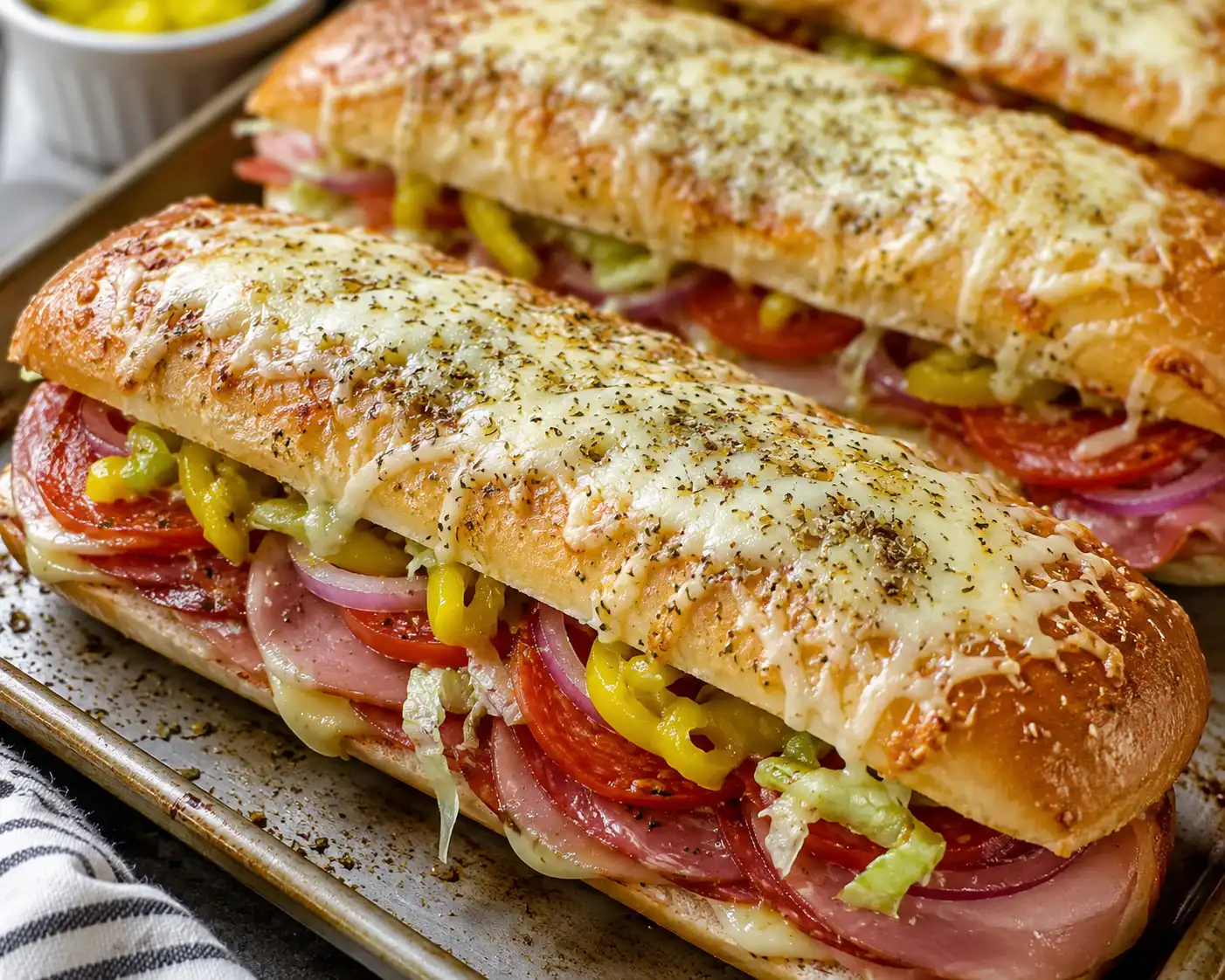
Baked Italian Grinder Sandwiches are the ultimate comfort food reimagined—crispy, golden, and brimming with bold Italian flavors. Unlike traditional cold grinders served on long rolls, this baked version transforms the classic deli favorite into a warm, hearty, shareable casserole-style dish that’s perfect for family dinners, potlucks, game-day spreads, or weekend meal prep. Think of it as a deconstructed Italian sub, layered with premium cured meats, sharp cheeses, tangy giardiniera, and herb-infused olive oil—all nestled inside a sturdy, oven-to-table loaf of Italian or French bread and baked until the crust crackles and the interior becomes luxuriously melty and aromatic. Whether you’re feeding a crowd or simply craving something deeply savory and satisfying, these sandwiches deliver restaurant-quality flavor with surprisingly simple home-kitchen execution.
The History
The origins of the “grinder” sandwich are steeped in regional lore and linguistic evolution. While often associated with New England—particularly Connecticut and Rhode Island—the term “grinder” likely emerged in the early 20th century, possibly referencing the effort required to chew through dense, overstuffed submarine rolls (hence “grinding” your teeth), or derived from Italian-American dockworkers (“grinders” of grain or metal) who packed hearty, portable lunches. The Italian grinder specifically evolved from Italian-American communities adapting Old World ingredients—cured meats like capicola, soppressata, and Genoa salami; provolone and mozzarella; roasted red peppers; and aged balsamic or olive oil—to American bread traditions. The baked adaptation is a more recent innovation, gaining traction in the 2000s through food blogs, cooking shows, and viral social media recipes that emphasized make-ahead convenience, crowd-pleasing appeal, and the irresistible allure of warm, cheesy, meat-stuffed bread. Today, baked Italian grinders symbolize culinary fusion: honoring deli heritage while embracing modern oven-baked practicality and customizable flair.
Ingredients Breakdown
Every exceptional Baked Italian Grinder Sandwich begins with intentionality—not just quantity, but quality and balance. Below is a detailed analysis of each core component and why it matters:
- Bread: A sturdy, day-old 16–24-inch Italian or French boule, ciabatta, or sourdough loaf is non-negotiable. Its tight crumb and thick, slightly chewy crust hold up to moisture without disintegrating during baking. Avoid soft sandwich loaves—they’ll turn soggy or collapse. A lightly toasted or par-baked exterior adds structural integrity and enhances caramelization.
- Cured Meats: Authenticity hinges on a harmonious trio: Genoa salami (mildly spiced, wine-cured, tender), capicola (sweet, rich, marbled with fat), and soppressata (peppery, firm, artisanal). Prosciutto cotto or mortadella can be substituted for milder notes, but avoid pre-sliced deli meats with high water content or added phosphates, which release excess moisture and dilute flavor.
- Cheeses: A dual-layer approach ensures both meltability and depth: shredded low-moisture mozzarella (for stretch and binding) plus sliced provolone dolce or sharp (for nutty, smoky complexity). Optional upgrades include fontina for creaminess or aged Asiago for umami punch. Never skip the grated Parmigiano-Reggiano—it’s stirred into the herb-oil mixture and sprinkled on top for salty, crystalline crunch.
- Vegetables & Accoutrements: Roasted red peppers add sweetness and silkiness; thinly sliced red onion brings sharpness and bite; and high-quality giardiniera (preferably Chicago-style or house-pickled) delivers essential vinegar tang and textural contrast. Fresh basil or oregano should be added *after* baking to preserve volatile oils and aroma.
- Herb-Oil Infusion: This is the flavor backbone. Extra-virgin olive oil is emulsified with minced garlic, dried oregano, dried basil, red pepper flakes, black pepper, and a splash of balsamic vinegar or lemon juice. The acidity cuts richness, while the herbs perfume every layer. Letting this mixture macerate for 30+ minutes before use deepens its impact exponentially.
Step-by-Step Recipe
- Prep the Bread: Using a serrated knife, carefully slice the loaf horizontally about ¾ of the way through—like opening a book—without cutting all the way through the bottom crust. Gently hollow out the center crumb (reserve for breadcrumbs or stuffing), leaving a ½-inch-thick shell. Lightly toast the interior with a kitchen torch or under the broiler for 2–3 minutes until dry and faintly golden—this prevents sogginess.
- Prepare the Herb-Oil Mixture: In a small bowl, combine ⅓ cup extra-virgin olive oil, 3 minced garlic cloves, 1 tsp dried oregano, 1 tsp dried basil, ¼ tsp red pepper flakes, ½ tsp freshly ground black pepper, and 1 tsp balsamic vinegar. Whisk vigorously and let sit at room temperature for at least 30 minutes to infuse.
- Layer the Fillings (Bottom Half First): Brush the bottom bread cavity generously with herb-oil. Layer evenly: half the roasted red peppers, all the red onion slices, half the giardiniera (drained well), then the full portion of Genoa salami, followed by capicola, then soppressata. Sprinkle with ¼ cup grated Parmigiano-Reggiano.
- Add Cheese & Repeat: Scatter 1 cup shredded low-moisture mozzarella over meats. Top with all the provolone slices (overlapping slightly). Drizzle with another 2 tbsp herb-oil. Repeat the vegetable layers: remaining roasted peppers, remaining giardiniera, and a final dusting of Parmigiano.
- Secure & Rest: Carefully fold the top half of the loaf over the fillings. Wrap tightly—but not constrictingly—in heavy-duty aluminum foil, sealing seams well. Let rest at room temperature for 30 minutes to allow flavors to meld and oils to penetrate.
- Bake Low and Slow: Preheat oven to 325°F (163°C). Place wrapped loaf on a parchment-lined baking sheet. Bake for 45 minutes. Unwrap carefully (steam will escape!) and bake uncovered for 15–20 more minutes until crust is deeply golden, cheese is bubbling and beginning to brown at edges, and internal temperature reaches 165°F (74°C) when probed near the center.
- Rest & Finish: Remove from oven and let rest, loosely tented with foil, for 15 minutes—this allows juices to redistribute and prevents fillings from sliding out upon slicing. Just before serving, open the loaf fully and tuck in fresh basil leaves or a drizzle of high-quality olive oil and flaky sea salt.
Tips
- Bread Selection is Critical: Choose a loaf with a thick, resilient crust and dense, closed crumb—not airy or overly porous. If using store-bought, opt for bakery-fresh over pre-sliced or plastic-wrapped loaves.
- Drain Everything Thoroughly: Pat roasted peppers, giardiniera, and even meats with paper towels to eliminate excess moisture—a single tablespoon of liquid can turn your grinder into a soggy mess.
- Meat Temperature Matters: Bring cold meats to room temperature for 15 minutes before assembling. Cold proteins contract when baked and resist melting into the cheese matrix.
- Don’t Skip the Toast Step: Par-toasting the hollowed bread interior creates a moisture barrier and jumpstarts crust development—skip this, and you risk a steamed, gummy base.
- Use a Meat Thermometer: Insert into the thickest part of the filling (avoiding cheese pockets) to confirm safe internal temperature. Under-baking risks food safety; over-baking dries out meats and toughens cheese.
- Cut Against the Grain: When slicing, use a serrated knife and saw gently—not press down—to preserve layer integrity. Cut diagonal 2-inch portions for maximum visual appeal and balanced bites.
- Make-Ahead Friendly: Assemble up to 24 hours ahead, wrap tightly, and refrigerate. Add 10–15 minutes to initial bake time if going straight from fridge to oven.
- Reheating Without Sogginess: Revive leftovers by wrapping individual slices in foil and warming in a 350°F oven for 12–15 minutes—or air-fry at 375°F for 4–5 minutes for crispier edges.
Variations and Customizations
Baked Italian Grinder Sandwiches are a masterclass in adaptability—ideal for dietary preferences, seasonal ingredients, and global inspirations. Here are thoughtfully curated variations tested for texture, flavor synergy, and structural success:
- Vegetarian Grinder: Replace meats with marinated grilled portobello caps, roasted zucchini ribbons, white bean purée (tossed with lemon zest and rosemary), and sun-dried tomatoes. Boost umami with nutritional yeast and aged Gouda instead of provolone.
- Spicy Calabrian Style: Swap standard salami for spicy ‘Nduja spread (mixed into the herb-oil), add Calabrian chiles in oil, and finish with pickled jalapeños and smoked provolone. Garnish with crushed fennel pollen.
- White Wine & Fennel Grinder: Simmer sliced fennel bulb in dry white wine and shallots until tender; cool and layer with mortadella, fontina, and shaved Pecorino. Infuse herb-oil with fennel seeds and lemon thyme.
- Breakfast Grinder: A savory morning twist: layer scrambled eggs with pancetta, caramelized onions, Gruyère, and arugula tossed in lemon vinaigrette. Add a touch of Dijon to the herb-oil.
- Gluten-Free Adaptation: Use a high-quality gluten-free artisan boule (like Schar or Canyon Bakehouse) and reinforce structure by brushing interior with egg wash before toasting. Increase initial bake time by 8–10 minutes.
- Keto/Low-Carb Version: Substitute bread with a hollowed-out, roasted cauliflower “loaf” or a tightly packed cloud bread mold. Bind fillings with extra cheese and egg wash, and bake in a parchment-lined loaf pan.
- Mini Grinders: Use individual demi-baguettes or torpedo rolls. Hollow, fill, wrap individually in foil, and bake 25–30 minutes. Perfect for kids’ lunches or appetizer platters.
- Mediterranean Fusion: Feature grilled halloumi, kalamata olives, preserved lemon, roasted eggplant, and mint-infused olive oil. Swap provolone for crumbled feta added post-bake.
Health Considerations and Nutritional Value
A single generous 4-inch slice of a classic Baked Italian Grinder Sandwich (based on a 12-serving loaf) contains approximately 480–540 calories, with 28–34g protein, 24–30g total fat (of which 10–13g saturated), 32–38g carbohydrates, and 800–1,100mg sodium. While undeniably indulgent, mindful modifications can significantly enhance its nutritional profile without sacrificing satisfaction:
- Sodium Management: Cured meats and cheeses are naturally high in sodium. Reduce overall intake by choosing lower-sodium capicola (some brands offer 30% less), rinsing giardiniera thoroughly, omitting added salt in herb-oil, and using unsalted butter for optional finishing drizzle.
- Heart-Healthy Fats: Prioritize extra-virgin olive oil (rich in monounsaturated fats and polyphenols) over blended oils or margarine. Add sliced avocado post-bake for creamy potassium and fiber.
- Fiber & Phytonutrients: Boost vegetable volume—double the roasted peppers and onions, add shredded spinach or kale (wilted first), or incorporate finely diced raw fennel for crunch and anti-inflammatory apigenin.
- Protein Quality: Opt for nitrate-free, pasture-raised, or organic meats when possible to reduce exposure to preservatives and support regenerative agriculture practices.
- Digestive Support: Fermented giardiniera provides beneficial probiotics; pairing with a side of mixed greens dressed in apple cider vinegar supports gut health and balances richness.
- Portion Awareness: Serve with a large arugula-and-lemon salad or roasted vegetable medley to increase volume, fiber, and micronutrient density per meal—promoting satiety without excess calories.
- Allergen Notes: Naturally gluten-containing (bread), dairy-heavy (cheeses), and pork-based (traditional meats). Vegan versions require plant-based cheeses with meltability (e.g., Miyoko’s or Violife) and careful label-checking for hidden casein or egg derivatives.
As with any celebratory dish, balance is key—enjoy Baked Italian Grinders mindfully as part of a varied, whole-foods-based diet, not daily fare. Their true nutritional value lies not only in macros and micros but in the joy of shared meals, cultural connection, and the art of intentional, flavorful nourishment.
Ingredients
- 1 (20–24 inch) rustic Italian or French boule loaf (approx. 1.2–1.5 lbs), day-old preferred
- ⅓ cup extra-virgin olive oil (plus extra for finishing)
- 3 large garlic cloves, finely minced
- 1 tsp dried oregano (preferably Calabrian or Sicilian)
- 1 tsp dried basil
- ¼ tsp crushed red pepper flakes (adjust to taste)
- ½ tsp freshly ground black pepper
- 1 tsp high-quality balsamic vinegar or fresh lemon juice
- 1 cup roasted red peppers, drained and patted dry
- ½ medium red onion, very thinly sliced
- ⅔ cup giardiniera (Chicago-style preferred), well-drained and roughly chopped
- 6 oz Genoa salami, thinly sliced
- 6 oz capicola (hot or sweet), thinly sliced
- 6 oz soppressata or dry salami, thinly sliced
- 1 cup low-moisture part-skim mozzarella, shredded
- 8 oz provolone cheese, sliced ⅛-inch thick (dolce or piccante)
- ½ cup freshly grated Parmigiano-Reggiano cheese (plus extra for garnish)
- Fresh basil leaves, for garnish
- Flaky sea salt, for finishing
Directions
- Preheat oven to 325°F (163°C). Line a large baking sheet with parchment paper.
- Carefully slice the loaf horizontally, about ¾ of the way through—leaving the bottom crust intact to form a hinge. Gently scoop out the inner crumb (reserve for breadcrumbs, strata, or stuffing), leaving a ½-inch-thick shell. Place loaf cut-side up on prepared sheet. Broil on upper rack for 2–3 minutes, watching closely, until interior surfaces are dry and lightly toasted. Remove and cool slightly.
- In a small bowl, whisk together olive oil, minced garlic, oregano, basil, red pepper flakes, black pepper, and balsamic vinegar. Let stand at room temperature for at least 30 minutes to infuse.
- Brush the bottom cavity of the loaf generously with 3 tbsp of the herb-oil mixture. Layer in this order: half the roasted red peppers, all red onion slices, half the giardiniera, then the Genoa salami, capicola, and soppressata—pressing gently to adhere. Sprinkle with ¼ cup Parmigiano-Reggiano.
- Scatter shredded mozzarella evenly over meats. Arrange provolone slices in overlapping rows to cover completely. Drizzle with another 2 tbsp herb-oil. Top with remaining roasted peppers, remaining giardiniera, and final ¼ cup Parmigiano.
- Fold the top half of the loaf over the fillings. Wrap *tightly but not crushingly* in two layers of heavy-duty aluminum foil, sealing all seams securely. Let rest at room temperature for 30 minutes.
- Place wrapped loaf on parchment-lined baking sheet. Bake at 325°F for 45 minutes. Carefully unwrap (watch for steam!), rotate loaf, and bake uncovered for 15–20 minutes longer, until crust is deeply golden brown, cheese is bubbling vigorously, and internal temperature reads 165°F (74°C) when inserted into center filling.
- Remove from oven and let rest, loosely tented with foil, for 15 minutes. Unwrap fully, garnish with fresh basil leaves, a light drizzle of olive oil, flaky sea salt, and additional grated Parmigiano. Slice diagonally into 2-inch portions using a serrated knife.
FAQ
- Can I make this ahead of time?
- Yes! Assemble completely (including wrapping in foil), then refrigerate for up to 24 hours. Add 10–15 minutes to the initial covered bake time if starting cold. For longer storage, freeze assembled (unbaked) grinder for up to 3 weeks—thaw overnight in fridge before baking.
- What if my bread gets too soggy?
- Sogginess almost always stems from excess moisture. Ensure all vegetables are patted bone-dry, meats are not overly wet, and the interior of the loaf is toasted before filling. Also, never skip the resting period after baking—it allows steam to reabsorb rather than weep out upon slicing.
- Can I use different cheeses?
- Absolutely—just maintain the dual-function principle: one melty (mozzarella, fontina, Monterey Jack) and one flavorful/sliceable (provolone, Swiss, Gouda, Asiago). Avoid high-moisture cheeses like fresh mozzarella or ricotta—they’ll release too much water.
- Is there a substitute for giardiniera?
- Yes—try finely chopped cornichons, capers, pickled banana peppers, or a mix of diced pickled red onions and green olives. For heat lovers, add a few drops of hot sauce to your herb-oil instead.
- Can I grill this instead of bake?
- Yes! Preheat grill to medium-low (325–350°F). Place foil-wrapped loaf directly on grates (indirect heat zone). Grill covered for 45 minutes, then unwrap and move to direct heat for 5–8 minutes per side to crisp crust. Rotate frequently to prevent burning.
- How do I reheat leftovers without drying them out?
- Wrap individual slices tightly in foil and warm in a 350°F oven for 12–15 minutes. For crispier results, air-fry at 375°F for 4–5 minutes. Never microwave—steam will make bread rubbery and cheese greasy.
- Why do you recommend day-old bread?
- Fresher bread has higher moisture content and a softer crust, which can become mushy or tear during assembly and baking. Day-old bread is drier, sturdier, and develops better flavor complexity—ideal for holding robust fillings and achieving ideal crust-to-interior contrast.
- Can kids enjoy this recipe?
- Yes—with thoughtful tweaks: omit red pepper flakes, use mild soppressata or turkey pepperoni, reduce giardiniera or swap for roasted carrots, and add a thin layer of mild provolone-only cheese before meats. Serve with a side of marinara for dipping.
- What wine pairs best with this dish?
- A vibrant, medium-bodied red like Chianti Classico, Barbera d’Alba, or Montepulciano d’Abruzzo cuts through richness with bright acidity and cherry notes. For white lovers, try an off-dry Vermentino or barrel-aged Pinot Grigio with enough body to match the herbs and oils.
Summary
Baked Italian Grinder Sandwiches are a showstopping, oven-baked celebration of Italian-American deli tradition—transforming stacked cold cuts, sharp cheeses, and vibrant pickled vegetables into a warm, crusty, shareable centerpiece that’s equal parts nostalgic and innovative.
With meticulous attention to ingredient quality, moisture control, and layered construction—and endless possibilities for customization—they deliver restaurant-worthy depth, comfort, and versatility, making every bite a delicious reminder that the best sandwiches aren’t just eaten… they’re experienced.