Introduction
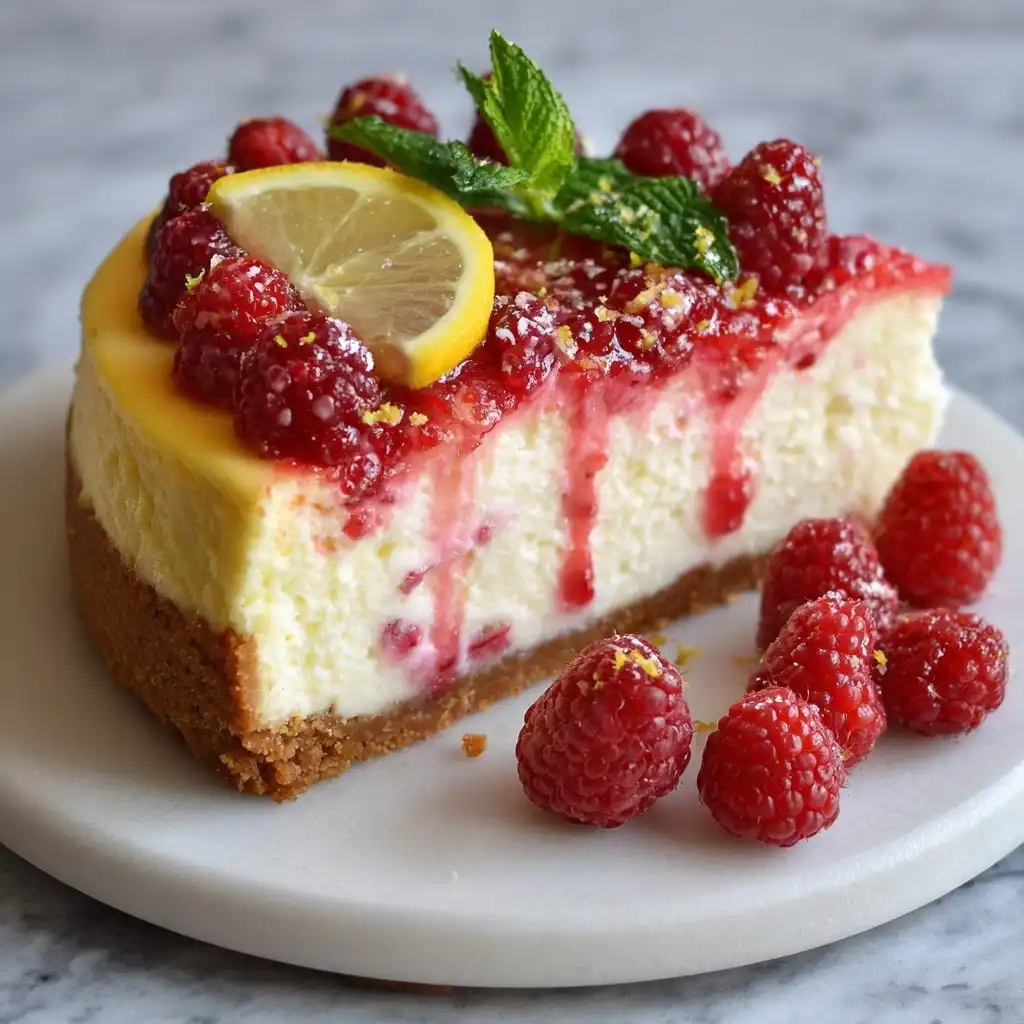
Imagine the vibrant tang of sun-ripened lemons dancing with the luscious sweetness of handpicked raspberries—now layered into a velvety, luxuriously creamy cheesecake that’s as refreshing as it is decadent. The Raspberry Lemonade Cheesecake is more than just a dessert—it’s a sensory celebration: a bright, zesty, berry-kissed twist on the classic New York style, designed to cut through richness with citrus clarity and amplify depth with the floral-fruity nuance of fresh raspberries. Whether served at a summer garden party, a bridal shower, or simply as a self-care treat on a quiet Sunday afternoon, this cake bridges the gap between nostalgic comfort and modern sophistication. Its stunning ombré swirls, glossy raspberry-lemon glaze, and delicate crumb base make it as photogenic as it is unforgettable—proof that indulgence and refreshment can coexist in perfect, harmonious balance.
The History
The evolution of the Raspberry Lemonade Cheesecake is a delicious convergence of three iconic culinary traditions. Cheesecake itself traces its origins to ancient Greece—where early versions made with honey, flour, and soft cheese were served to athletes at the first Olympic Games in 776 BCE. It traveled through Rome, migrated across medieval Europe, and found its American renaissance in late 19th-century New York, where cream cheese (invented by William Lawrence in 1872) revolutionized texture and richness. Meanwhile, lemonade—born from Persian sharbat traditions and refined in colonial America—became synonymous with summer refreshment by the 1800s. Raspberries, native to northern Eurasia and cultivated in England since the 17th century, gained popularity in U.S. home gardens post–Civil War, prized for their jewel-toned color and tart-sweet complexity. The fusion of these elements didn’t emerge en masse until the late 20th century, when food magazines and regional bakeries began experimenting with fruit-infused cheesecakes. However, it wasn’t until the rise of food blogging, Instagram aesthetics, and clean-label baking trends in the 2010s that the Raspberry Lemonade Cheesecake truly blossomed—first as a seasonal farmers’ market special in Pacific Northwest cafés, then as a viral Pinterest staple. Today, it stands as a hallmark of contemporary “bright baking”: a dessert that honors tradition while embracing acidity, freshness, and visual storytelling.
Ingredients Breakdown
Every component of this cheesecake serves a precise functional and flavor-driven purpose—no ingredient is arbitrary. Let’s explore them in detail:
- Graham Cracker Crust Base: Finely ground graham crackers provide structure and a subtle caramelized sweetness; brown sugar adds molasses depth and moisture retention; unsalted butter binds and enriches, while a pinch of flaky sea salt balances sweetness and heightens overall perception of flavor.
- Cream Cheese: Full-fat, brick-style Philadelphia-style cream cheese (at true room temperature—65–68°F) ensures smooth emulsification without curdling. Low-fat or whipped varieties introduce excess water or air, compromising density and causing cracks.
- Sour Cream & Heavy Cream: Sour cream contributes gentle acidity, tenderness, and a slight tang that mirrors lemon zest; heavy cream (not half-and-half or milk) adds luxurious fat content for silkiness and prevents dryness during baking and chilling.
- Granulated Sugar: Not only sweetens but also aids in aeration during mixing and stabilizes the protein matrix—critical for preventing weeping or graininess.
- Eggs: Large, room-temperature eggs act as emulsifiers and structural agents. Their proteins coagulate gradually during the water bath, yielding a custard-like set—not rubbery or eggy. Overmixing introduces excess air, leading to post-bake collapse.
- Fresh Lemon Juice & Zest: Juice provides sharp, volatile acidity essential for brightness; zest delivers concentrated citrus oils (limonene, citral) responsible for aromatic lift and complexity. Bottled juice lacks enzymatic freshness and often contains preservatives that dull flavor.
- Freeze-Dried Raspberries: The secret weapon. Unlike fresh or frozen berries—which add unwanted water and cause bleeding—freeze-dried raspberries retain intense flavor, vibrant color, and zero moisture. When pulsed into powder, they dissolve seamlessly into the batter, delivering pure, undiluted raspberry essence without altering texture.
- Vanilla Extract & Salt: Pure Madagascar bourbon vanilla rounds out sharp notes and enhances fruit perception; fine sea salt amplifies sweetness and unifies all elements.
- Raspberry-Lemon Glaze: A double-layered finish: a cooked raspberry coulis (simmered with lemon juice, zest, and a touch of honey for floral sweetness and pH balance) strained for silkiness, then stabilized with a whisper of gelatin for sheen and hold—never gloppy or sticky.
Step-by-Step Recipe
- Prepare the Crust (Day Before or Morning Of): Preheat oven to 350°F (175°C). Pulse 1 ½ cups graham cracker crumbs, ¼ cup packed brown sugar, 6 tbsp melted unsalted butter, and ¼ tsp flaky sea salt in a food processor until uniformly moistened. Press firmly into the bottom and 1 inch up the sides of a 9-inch springform pan lined with parchment (bottom only). Bake 10 minutes until fragrant and lightly golden. Cool completely on a wire rack—do not skip cooling; warm crust + hot filling = soggy base.
- Make the Raspberry Powder (Optional but Recommended): In a spice grinder or high-speed blender, pulse ½ cup freeze-dried raspberries into a fine, vivid pink powder (~30 seconds). Sift to remove any grit. Set aside.
- Beat Cream Cheese Mixture: Using a stand mixer fitted with paddle attachment (or hand mixer on medium-low), beat 24 oz full-fat cream cheese (room temp) and 1 cup granulated sugar on medium speed for 2 minutes until fluffy and lump-free. Scrape bowl thoroughly. Add 1 cup full-fat sour cream and ½ cup heavy cream; mix 1 minute until homogenous. Add 3 large room-temp eggs one at a time, mixing just until yolk disappears (≈15 sec per egg). Overmixing = cracks.
- Incorporate Citrus & Berries: Whisk together ⅓ cup fresh lemon juice, 2 tbsp finely grated lemon zest, 2 tsp pure vanilla extract, and ¼ tsp fine sea salt. Gently fold into batter with a silicone spatula using 3–4 broad strokes. Then fold in raspberry powder in two additions until just swirled—do not overmix; intentional marbling creates visual appeal and balanced bursts of flavor.
- Water Bath Setup: Wrap the *outside* of the springform pan tightly with two overlapping layers of heavy-duty aluminum foil (prevents leaks). Place pan inside a larger roasting pan. Pour batter in. Carefully fill roasting pan with 1–2 inches of *hot* (not boiling) water—enough to reach halfway up springform sides.
- Bake Low & Slow: Bake at 325°F (163°C) for 1 hour 15 minutes. Cake is done when edges are set but center still jiggles slightly like Jell-O (≈2-inch wobble). Turn off oven, crack door open 1 inch with a wooden spoon, and let cool inside for 1 hour—this gradual temperature drop prevents dramatic contraction and cracking.
- Chill Overnight: Remove from water bath. Run a thin knife around edge to loosen. Refrigerate uncovered for at least 12 hours (ideally 24) to fully set, develop flavor, and allow textures to harmonize. Do not rush this step—cold stabilization is non-negotiable for clean slices.
- Prepare Glaze (Day Of Serving): Simmer 1 cup fresh or thawed frozen raspberries, 3 tbsp lemon juice, 1 tbsp honey, and 1 tsp lemon zest in a small saucepan over medium heat for 6–8 minutes until berries break down. Strain through a fine-mesh sieve, pressing solids. Return liquid to pan; stir in ½ tsp unflavored gelatin bloomed in 1 tsp cold water. Heat gently (do not boil) until dissolved. Cool to lukewarm (≈90°F) before pouring.
- Glaze & Garnish: Unmold chilled cheesecake onto serving plate. Pour cooled glaze evenly over top, tilting plate to encourage flow over edges. Optional: dot with whole fresh raspberries, micro mint, edible pansies, or curls of lemon zest. Chill 30 minutes to set glaze.
- Serve: Use a hot, dry knife (dipped in hot water and wiped clean between cuts) for flawless slices. Serve chilled—but not ice-cold—to allow full aromatic release.
Tips
- Room Temperature Is Non-Negotiable: Cream cheese, eggs, sour cream, and heavy cream must all be at true room temperature (65–68°F)—leave out for 2–3 hours, not just “softened.” Cold ingredients cause lumps, poor emulsion, and uneven baking.
- No Substitutions for Freeze-Dried Raspberries: Fresh/frozen berries add too much water and bleed during baking. Jam or preserves contain pectin and sugar that destabilize the batter. Powdered raspberry gives pure, controlled, vibrant flavor and color.
- Prevent Cracks Like a Pro: Water bath + slow cool-down are key—but also avoid opening the oven during baking, don’t overbeat eggs, and never cool rapidly. If a hairline crack appears, embrace it: it disappears under glaze and adds artisanal charm.
- Parchment Paper Hack: Cut a 12-inch round of parchment, then snip slits to fit snugly into pan bottom. It lifts the entire cake cleanly—no broken edges or stuck bits.
- Acid Balance Matters: Too much lemon juice makes batter thin and prone to weeping. Too little yields flat flavor. The ⅓ cup here is precisely calibrated—taste batter pre-bake (a tiny dab!) to confirm bright but not harsh acidity.
- Chill Time Cannot Be Rushed: Under-chilled cheesecake will slide, smear, or lose shape. If you must serve sooner, freeze for 2 hours *then* refrigerate 6+ hours—but overnight remains ideal.
- Knife Technique: For professional slices: use a long, thin-bladed knife. Dip in near-boiling water, wipe *completely* dry with a clean towel, slice, repeat. Never saw—press straight down.
- Storage Wisdom: Keep covered tightly with plastic wrap (touching surface) or in an airtight container. Lasts 5 days refrigerated. Freeze unfrosted cake (wrap in plastic + foil) up to 3 months—thaw overnight in fridge before glazing.
Variations and Customizations
This recipe is a versatile canvas—here are inspired, tested adaptations for every palate and occasion:
- Vegan Raspberry Lemonade Cheesecake: Swap cream cheese for soaked cashew-cashew butter blend (2 cups raw cashews + ½ cup lemon juice + ⅓ cup maple syrup + 3 tbsp coconut oil + 2 tsp apple cider vinegar); use coconut cream instead of sour cream/heavy cream; crust with almond flour + dates + coconut oil. Set with agar-agar instead of gelatin.
- Gluten-Free Version: Use certified GF graham crackers or a blend of almond flour, oat flour, and coconut sugar for crust. Ensure all extracts and additives are GF-certified.
- Low-Sugar / Keto Adaptation: Replace granulated sugar with 1 cup erythritol + 2 tsp stevia glycerite; use keto-friendly graham crumbs (almond flour + cinnamon + monk fruit sweetener + butter); substitute sour cream with full-fat Greek yogurt (strained) and add 1 tbsp MCT oil for richness.
- Boozy Twist: Infuse glaze with 1 tbsp Chambord (raspberry liqueur) or elderflower cordial; or fold 2 tbsp limoncello into batter post-eggs for aromatic depth (reduce lemon juice by 1 tsp).
- Layered Celebration Style: Bake as mini cheesecakes in muffin tins lined with foil liners. After chilling, pipe a lemon curd + raspberry compote layer between cake and glaze for textural contrast.
- Herbal Elegance: Add 1 tsp finely chopped fresh basil or lemon verbena to glaze—or infuse cream cheese mixture with lemon-thyme oil (steep 2 sprigs in warm cream 20 min, strain).
- Chocolate-Raspberry Swirl: Melt ¼ cup white chocolate, cool slightly, then swirl into batter with a toothpick before baking—creates stunning marbled contrast and subtle sweetness.
- Deconstructed Parfait Version: Layer crushed crust, lemon-raspberry mousse (lightened with whipped cream), and fresh berry compote in glasses for no-bake elegance.
Health Considerations and Nutritional Value
While inherently indulgent, this Raspberry Lemonade Cheesecake offers meaningful nutritional benefits when enjoyed mindfully—and several smart modifications can enhance its wellness profile without sacrificing joy.
Nutrition Snapshot (per standard slice, 1/12th of cake, ~220g):
- Calories: ~425 kcal
- Total Fat: 31g (19g saturated)
- Carbohydrates: 32g (24g sugars, 1g fiber)
- Protein: 7g
- Vitamin C: ~18mg (20% DV) — from lemon juice/zest + raspberries
- Manganese: ~0.4mg (18% DV) — raspberries are exceptionally rich in this antioxidant-supportive mineral
- Calcium: ~65mg (6% DV) — from dairy components
- Phytonutrients: Ellagic acid (raspberries) and hesperidin (lemons) offer anti-inflammatory and vascular support.
Considerations & Smart Swaps:
- Lactose Sensitivity? Substitute lactose-free cream cheese and sour cream—texture and flavor remain nearly identical.
- Heart Health Focus: Replace half the butter in crust with cold-pressed avocado oil; use low-sodium butter and reduce added salt by half.
- Digestive Support: Add 1 tbsp ground flaxseed or chia seeds to crust for omega-3s and soluble fiber—adds subtle nuttiness and improves satiety.
- Blood Sugar Awareness: Pair each slice with ½ cup plain Greek yogurt or a handful of almonds to slow glucose absorption and enhance protein intake.
- Portion Mindfulness: Serve in 3-inch round cutters for elegant, modest portions—visually satisfying without overconsumption.
- Added Sugar Note: This version uses 1 cup granulated sugar—less than many bakery versions (often 1¼–1½ cups). The intense raspberry and lemon flavors mean you taste less sweetness but feel more satisfaction—a psychological win for mindful eating.
Remember: Nutrition is not just about numbers—it’s about pleasure, presence, and cultural connection. Enjoying this cheesecake consciously—with gratitude for seasonal fruit, craftsmanship, and shared moments—is itself a form of nourishment.
Ingredients
For the Graham Cracker Crust:
- 1 ½ cups (150g) graham cracker crumbs (about 12 full sheets)
- ¼ cup (50g) packed light brown sugar
- 6 tablespoons (85g) unsalted butter, melted
- ¼ teaspoon flaky sea salt
For the Raspberry-Lemon Cheesecake Filling:
- 24 ounces (680g) full-fat brick-style cream cheese, room temperature (do not use spreadable or low-fat)
- 1 cup (200g) granulated sugar
- 1 cup (240g) full-fat sour cream, room temperature
- ½ cup (120ml) heavy cream (36–40% fat), room temperature
- 3 large eggs, room temperature
- ⅓ cup (80ml) fresh lemon juice (from ~3–4 lemons)
- 2 tablespoons (6g) finely grated lemon zest
- 2 teaspoons pure vanilla extract
- ¼ teaspoon fine sea salt
- ½ cup (30g) freeze-dried raspberries, pulsed into fine powder (see Tips)
For the Raspberry-Lemon Glaze:
- 1 cup (125g) fresh or frozen unsweetened raspberries
- 3 tablespoons (45ml) fresh lemon juice
- 1 tablespoon (21g) honey or light agave nectar
- 1 teaspoon finely grated lemon zest
- ½ teaspoon unflavored powdered gelatin
- 1 teaspoon cold water
For Garnish (Optional):
- Fresh raspberries
- Lemon zest curls
- Fresh mint leaves or lemon balm
- Edible flowers (pansies, violets, borage)
Directions
- Preheat oven to 350°F (175°C). Grease the bottom and sides of a 9-inch springform pan. Line the bottom with a round of parchment paper. Wrap the *outside* of the pan tightly with two overlapping sheets of heavy-duty aluminum foil—this is critical for the water bath.
- Make the crust: In a medium bowl, combine graham cracker crumbs, brown sugar, melted butter, and sea salt. Mix with a fork until evenly moistened and clumping together. Press firmly and evenly into the bottom and 1 inch up the sides of the prepared pan. Bake for 10 minutes. Remove and cool completely on a wire rack—minimum 45 minutes.
- Prepare raspberry powder: In a clean coffee/spice grinder or high-speed blender, process freeze-dried raspberries in batches until a fine, vivid pink powder forms (≈30 seconds). Sift through a fine-mesh sieve to remove any larger particles. Set aside.
- Make the filling: Reduce oven temperature to 325°F (163°C). In the bowl of a stand mixer fitted with the paddle attachment (or using a hand mixer), beat cream cheese and sugar on medium speed for 2 minutes, scraping bowl once, until completely smooth and fluffy. Add sour cream and heavy cream; beat 1 minute until combined. Add eggs one at a time, beating on low just until incorporated after each (≈15 seconds). Scrape bowl thoroughly.
- Add citrus and raspberry: In a small bowl, whisk together lemon juice, lemon zest, vanilla, and salt. Gently pour into cream cheese mixture and fold with a silicone spatula 3–4 times until just combined. Sprinkle raspberry powder over top. Fold in gently 4–5 times until lightly marbled—do not overmix.
- Water bath assembly: Place the springform pan inside a larger roasting pan. Carefully pour batter into cooled crust. Pour hot (not boiling) water into roasting pan until it reaches halfway up the sides of the springform pan.
- Bake: Carefully transfer roasting pan to center rack of preheated oven. Bake for 1 hour 15 minutes, or until edges are set and center jiggles slightly (like Jell-O) when gently shaken. Turn off oven, crack door open 1 inch with a wooden spoon, and let cheesecake cool in oven for 1 hour.
- Chill: Carefully remove springform pan from water bath. Run a thin knife around inner edge to loosen. Cool on wire rack for 30 minutes at room temperature. Cover loosely and refrigerate *uncovered* for at least 12 hours—and ideally 24 hours—before glazing.
- Make glaze: In a small saucepan, combine raspberries, lemon juice, honey, and lemon zest. Bring to a gentle simmer over medium heat. Cook 6–8 minutes, stirring occasionally, until berries break down and mixture reduces slightly. Strain through a fine-mesh sieve into a clean bowl, pressing solids with a spatula. Discard seeds. Return liquid to saucepan. In a separate dish, sprinkle gelatin over cold water; let bloom 5 minutes. Stir bloomed gelatin into warm raspberry mixture over low heat until fully dissolved (do not boil). Remove from heat and cool to lukewarm (≈90°F), stirring occasionally—about 15–20 minutes.
- Glaze and serve: Run knife around edge again. Unlatch springform and carefully remove outer ring. Slide offset spatula or thin knife underneath parchment to lift cake onto serving platter. Pour glaze evenly over top, tilting platter to encourage even coverage and gentle drip over edges. Refrigerate uncovered for 30 minutes to set glaze. Garnish and slice with hot, dry knife.
FAQ
- Can I make this without a water bath?
- No—this is non-negotiable for this recipe. The water bath provides gentle, even, humid heat that prevents rapid expansion, cracking, and drying. Skipping it risks a dense, dry, cracked, or curdled cheesecake. If you lack a roasting pan, use a large disposable aluminum tray or Dutch oven.
- Why does my cheesecake crack even with a water bath?
- Most common causes: (1) Overmixing after adding eggs; (2) Cooling too quickly (oven door slammed shut or refrigerated while warm); (3) Opening oven door during baking; (4) Under-scraping bowl—lumps of cream cheese create weak spots; (5) Overbaking—center should jiggle. Always follow the slow cool-down step.
- Can I use frozen raspberries for the glaze?
- Absolutely—and recommended! Frozen unsweetened raspberries work identically to fresh in the glaze and are often more affordable and available year-round. No need to thaw first—just add directly to saucepan.
- My glaze is cloudy or separated. What went wrong?
- Cloudiness usually means the gelatin was overheated (boiling destroys its setting power) or the raspberry mixture wasn’t strained well. Separation occurs if glaze is too cold when poured (grainy) or too warm (runs off). Ideal pour temp is 90°F—test with a candy thermometer or wrist test (warm, not hot).
- How do I prevent a soggy crust?
- Cool the crust completely before adding batter. Also, brush the *baked and cooled* crust with a thin layer of melted white chocolate or apricot jam and chill 10 minutes before filling—this creates a moisture barrier.
- Can I prepare components ahead?
- Yes! Crust can be baked and stored airtight at room temp up to 3 days. Raspberry powder keeps in an airtight jar in the freezer for 6 months. Glaze can be made 2 days ahead and refrigerated—re-warm gently to 90°F before using. Fully baked, unglazed cheesecake freezes beautifully for up to 3 months.
- What if I don’t have freeze-dried raspberries?
- It’s strongly discouraged to substitute—fresh/frozen/jam will ruin texture. However, in a true emergency: pulse ¼ cup raspberry jam with 1 tsp cornstarch and ½ tsp lemon juice until smooth, then fold in *last*, using only 2 tbsp. Expect slight color bleeding and less vibrant flavor.
- Can I make individual servings?
- Yes! Divide batter among 12–14 foil-lined muffin tins. Bake at 325°F in water bath (roasting pan with ½-inch water) for 22–26 minutes. Chill 8+ hours. Glaze individually—each takes ~1 tsp.
- Is there a way to make it lighter?
- You can reduce heavy cream to ¼ cup and increase sour cream to 1¼ cups—but expect slightly less richness and potentially more surface cracks. Never replace cream cheese with lower-fat versions—they contain stabilizers and extra water that destabilize the batter.
- Why does the recipe specify “brick-style” cream cheese?
- Brick-style (e.g., Philadelphia, Kraft) has consistent fat content (~33%), minimal gums or whey, and reliable pH—all critical for stable emulsification. “Whipped” or “spreadable” versions contain air, stabilizers, and added whey, which cause separation, weeping, and poor set.
Summary
A Raspberry Lemonade Cheesecake is a masterclass in balance—where the bold, sunny acidity of fresh lemon meets the deep, floral-tart intensity of freeze-dried raspberries, all enrobed in a luxuriously dense yet cloud-like New York–style cream cheese base and crowned with a glossy, jewel-toned glaze that tastes like summer captured in edible form.
It’s a dessert rooted