Introduction
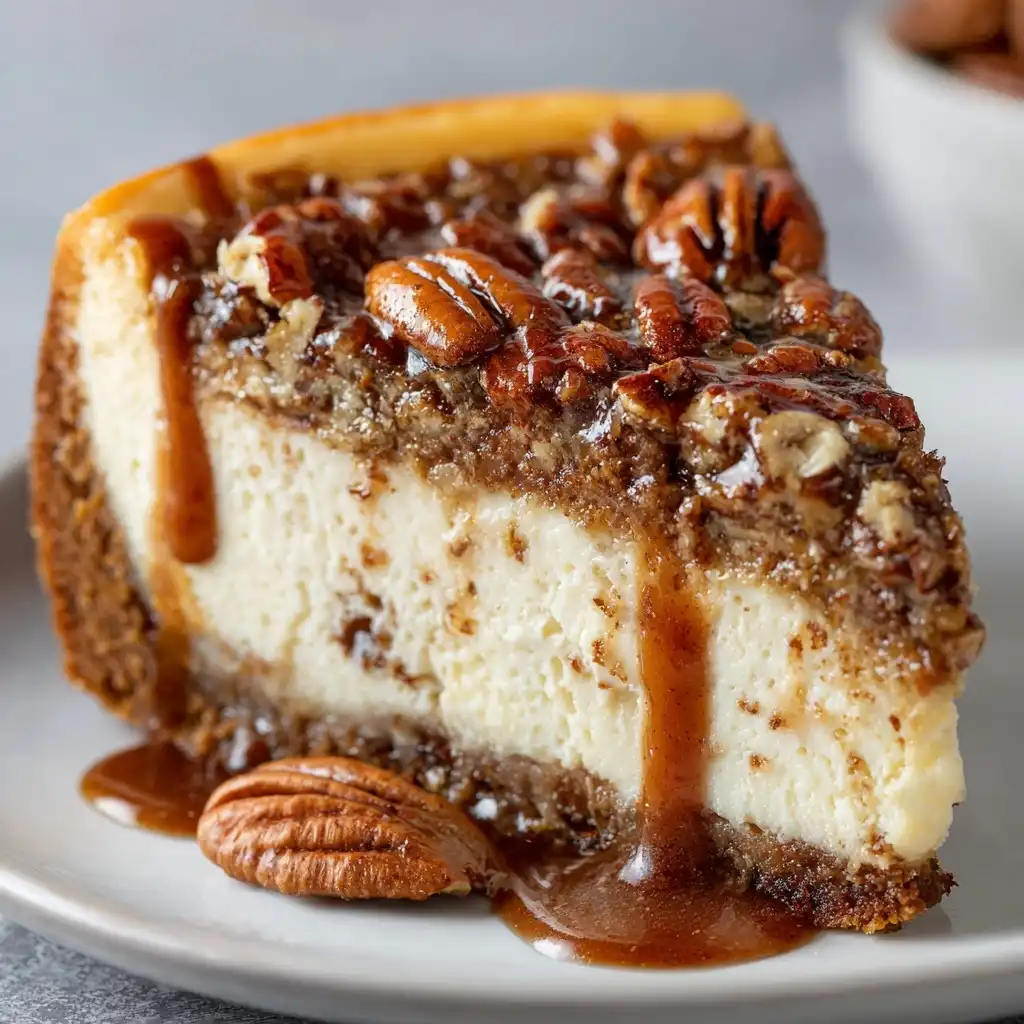
Pecan Pie Cheesecake is the ultimate marriage of two beloved American desserts — the rich, gooey decadence of classic Southern pecan pie and the luxuriously smooth, velvety texture of New York–style cheesecake. This showstopping hybrid dessert delivers the best of both worlds: a buttery graham cracker crust layered with a dense, creamy, tangy cheesecake filling, crowned with a glossy, caramel-kissed pecan topping that’s studded with toasted nuts and infused with deep molasses and bourbon notes. Whether served at Thanksgiving dinner, holiday gatherings, or as an indulgent weekend treat, Pecan Pie Cheesecake transcends seasonal expectations — it’s equally at home on a rustic farmhouse table or an elegant dinner party spread. Its complexity is balanced by approachable techniques, making it surprisingly achievable for home bakers who crave depth, contrast, and nostalgia in every forkful.
The History
The origins of Pecan Pie Cheesecake lie not in a single documented moment but in the delicious convergence of two iconic American dessert lineages. Pecan pie itself traces back to the 19th century in the Southern United States, where abundant native pecans were combined with newly accessible corn syrup (first commercially produced in the 1880s) to create the sticky-sweet, nut-dense confection we know today. Early versions often included molasses, brown sugar, or even sorghum, reflecting regional pantry staples. Cheesecake, by contrast, boasts ancient roots — from honey-sweetened ricotta cakes in Greece to medieval European baked curd tarts — but its modern American incarnation solidified in the early 20th century with the rise of cream cheese (notably Philadelphia Brand, introduced in 1872) and innovations like the water bath technique popularized by New York delis and bakeries. The fusion of these traditions began gaining traction in the 1980s and 1990s, as food magazines and regional cookbooks encouraged playful cross-genre baking. By the 2000s, “pie-cakes” — including pumpkin pie cheesecake and key lime pie cheesecake — became bakery mainstays, and Pecan Pie Cheesecake emerged as a particularly resonant variation, especially across Texas, Georgia, and Louisiana, where pecans are harvested commercially and culinary pride runs deep. Today, it’s celebrated not just as a novelty, but as a legitimate, sophisticated dessert genre — one that honors tradition while embracing innovation, structure, and soul.
Ingredients Breakdown
Understanding each ingredient’s role is essential to mastering this layered masterpiece. Unlike simpler desserts, Pecan Pie Cheesecake relies on precise chemistry — fat content, moisture levels, acidity, and temperature all influence texture, set, and flavor balance.
- Graham Cracker Crust Base: Crushed graham crackers provide structure and a subtle honeyed sweetness; granulated sugar enhances browning and crispness; melted unsalted butter binds the crumbs and adds richness and flakiness. A pinch of fine sea salt counters sweetness and heightens aroma.
- Cheesecake Layer: Full-fat brick-style cream cheese (room temperature) ensures smooth incorporation without lumps; sour cream adds tang, moisture, and tenderness; heavy cream contributes silkiness and helps prevent cracking; large eggs (also room temperature) act as emulsifiers and leavening agents; granulated sugar sweetens and stabilizes the protein matrix; pure vanilla extract adds aromatic complexity; and a touch of lemon juice balances richness with bright acidity — crucial for cutting through the pie layer’s intensity.
- Pecan Pie Topping: Light corn syrup forms the foundational viscous base, lending sheen and chew; dark corn syrup or Lyle’s Golden Syrup deepens color and adds nuanced caramel-molasses notes; brown sugar contributes molasses undertones and hygroscopic moisture retention; unsalted butter enriches mouthfeel and carries flavor; large egg yolk adds binding power and golden hue; pure maple syrup introduces earthy-sweet sophistication; real bourbon (optional but highly recommended) imparts oaky warmth and volatile aromatic compounds that lift the entire profile; pure vanilla extract and a whisper of flaky sea salt round out and harmonize; finally, toasted pecan halves — never pre-chopped — deliver textural contrast, visual elegance, and maximum nutty fragrance.
Step-by-Step Recipe
- Prep & Preheat: Position oven rack in the center position. Preheat oven to 325°F (163°C). Wrap the *outside* of a 9-inch springform pan tightly with two overlapping layers of heavy-duty aluminum foil — this is non-negotiable for the water bath. Lightly grease the *inside* of the pan (bottom and sides) with softened butter or non-stick spray.
- Make the Crust: In a food processor or sturdy zip-top bag, pulse or crush 1 ½ cups (150g) graham cracker crumbs until fine. Add ¼ cup (50g) granulated sugar and ¼ tsp fine sea salt; pulse to combine. Pour in 6 tbsp (85g) melted unsalted butter and pulse or stir until mixture resembles wet sand. Press firmly and evenly into the bottom and 1 inch up the sides of the prepared pan using the back of a measuring cup or flat-bottomed glass. Chill in the freezer for 15 minutes (or refrigerator for 30) to set.
- Bake the Crust: Bake chilled crust at 325°F for 10 minutes. Remove, carefully run a thin knife around the inner edge to loosen, and let cool completely on a wire rack. Reduce oven temp to 300°F (149°C) for the cheesecake bake.
- Prepare the Cheesecake Batter: Using a stand mixer fitted with the paddle attachment (or hand mixer), beat 24 oz (680g) full-fat cream cheese on medium speed for 2 minutes until completely smooth and creamy — scrape bowl thoroughly. Add 1 cup (200g) granulated sugar and beat 2 more minutes until light and fluffy. Scrape bowl. Add 1 cup (240g) full-fat sour cream, ½ cup (120ml) heavy cream, and 2 tsp pure vanilla extract; beat on medium-low until fully incorporated (~1 minute). Add 3 large room-temperature eggs, one at a time, beating on low just until yolk disappears (about 15 seconds per egg). Scrape bowl well after each addition. Finally, add 1 tbsp fresh lemon juice and beat *only* until just blended. Overmixing at this stage incorporates excess air, leading to cracking and sinking.
- Pour & Smooth: Pour batter over cooled crust. Tap pan sharply on counter 3–4 times to release air bubbles. Use an offset spatula to smooth the top. Place pan inside a larger roasting pan.
- Set Up Water Bath: Carefully pour hot (not boiling) water into the roasting pan until it reaches halfway up the *outside* of the springform pan. Ensure no water seeps into the foil wrap — if it does, rewrap securely.
- Bake Cheesecake: Bake at 300°F for 1 hour 25 minutes to 1 hour 40 minutes. The cheesecake is done when the outer 2–3 inches are set and lightly puffed, while the center 2 inches still jiggles slightly like Jell-O when gently shaken. Do *not* open the oven door during the first 75 minutes — temperature fluctuations cause cracks.
- Cool Gradually: Turn off oven. Crack the oven door open 1 inch with a wooden spoon handle. Let cheesecake rest in the oven for 1 hour. Then remove from water bath, carefully peel off foil, and cool completely on a wire rack (2–3 hours). Refrigerate uncovered for *at least* 12 hours — preferably 24 — before adding topping or slicing. This slow chill ensures perfect sliceability and flavor development.
- Prepare Pecan Pie Topping: While cheesecake chills, toast 2 cups (200g) pecan halves on a parchment-lined sheet pan at 350°F for 8–10 minutes until fragrant and lightly golden. Cool completely. In a medium saucepan over medium heat, combine ½ cup (120ml) light corn syrup, ½ cup (120ml) dark corn syrup, ¾ cup (150g) packed dark brown sugar, 6 tbsp (85g) unsalted butter, and 2 tbsp pure maple syrup. Stir constantly until butter melts and mixture comes to a gentle simmer. Reduce heat to low and cook, stirring occasionally, for 5 minutes — do not boil vigorously. Remove from heat. Whisk in 1 large egg yolk, 2 tbsp real bourbon (if using), 1 tsp pure vanilla extract, and ½ tsp flaky sea salt. Stir in toasted pecans. Let cool slightly — it should be warm but not hot (around 100–110°F) before pouring.
- Assemble & Finish: Once cheesecake is thoroughly chilled and firm, gently pour warm pecan mixture evenly over the surface. Tilt pan slightly to distribute. Optional: press a few extra whole pecans decoratively onto the surface. Refrigerate uncovered for at least 4 hours — preferably overnight — to allow topping to fully set and meld.
- Serve: Run a thin, warm knife under hot water, dry thoroughly, and carefully loosen edges. Unlatch springform and remove side band. For clean slices, dip knife in hot water and wipe dry between each cut. Serve chilled. Garnish with whipped cream, a drizzle of warm bourbon caramel, flaky salt, or candied pecans.
Tips
- Room Temperature Is Non-Negotiable: Cold cream cheese = lumps. Cold eggs = curdling. Cold sour cream = uneven emulsification. Plan ahead — pull dairy and eggs from the fridge 3–4 hours before baking.
- Toast Your Pecans — Always: Raw pecans taste bland and greasy. Toasting unlocks deep, buttery, almost coffee-like notes and improves crunch retention. Watch closely — they burn in seconds.
- Use Real Bourbon, Not Extract: Alcohol evaporates during cooking, leaving behind complex oak, vanilla, and spice notes impossible to replicate with imitation flavors. Choose a mid-range, unflavored bourbon like Buffalo Trace or Four Roses Small Batch.
- Don’t Skip the Lemon Juice: It’s not about tartness — it’s about pH balance. Lemon juice prevents the proteins in the cheesecake from over-coagulating, yielding a tender, melt-in-your-mouth crumb instead of rubbery density.
- Water Bath Precision Matters: Use hot (not boiling) water to avoid thermal shock. If water seeps in despite foil wrapping, place pan on a doubled-up clean kitchen towel inside the roasting pan — it absorbs minor leaks and adds insulation.
- Patience with Chilling Is Key: Rushing the refrigeration leads to weeping, sliding topping, and crumbly slices. Overnight chilling allows starches in the crust and proteins in the filling to fully relax and hydrate.
- Knife Technique Makes All the Difference: A dull knife tears the delicate layers. Use a long, thin-bladed chef’s knife or dedicated cheesecake server. Heat, wipe, repeat — every single time.
- Freeze for Long-Term Storage: Fully assembled, unfrosted cheesecake freezes beautifully for up to 3 months. Wrap tightly in plastic, then foil. Thaw overnight in the fridge — never at room temperature — to preserve texture.
Variations and Customizations
This recipe is a canvas — adaptable to dietary needs, seasonal ingredients, and personal flair — without sacrificing integrity or structure.
- Gluten-Free: Substitute gluten-free graham crackers (like Schar or Kinnikinnick) or a blend of almond flour (½ cup), oat flour (½ cup), and coconut sugar (¼ cup) for the crust. Ensure corn syrup and bourbon are certified GF.
- Lower-Sugar / Diabetic-Friendly: Replace granulated and brown sugars with 1:1 erythritol-based blends (e.g., Swerve) — note: topping may be slightly less glossy. Omit maple syrup and use sugar-free vanilla. Increase lemon juice to 1½ tbsp for brightness. Best served within 3 days.
- Vegan Adaptation: Use vegan cream cheese (Kite Hill or Miyoko’s), full-fat coconut yogurt instead of sour cream, coconut cream instead of heavy cream, flax eggs (3 tbsp ground flax + 9 tbsp water), and date syrup or brown rice syrup instead of corn syrup. Nutritional yeast (1 tsp) adds subtle umami depth. Requires testing for optimal bake time.
- Maple-Pecan Intensified: Swap all corn syrup for Grade B maple syrup (total 1 cup) and add 1 tsp maple extract to topping. Garnish with maple-glazed roasted pecans.
- Spiced Holiday Version: Add 1 tsp freshly grated orange zest + ¼ tsp ground cardamom + ⅛ tsp ground clove to the cheesecake batter; infuse topping with 1 cinnamon stick while heating syrups (remove before adding egg yolk).
- Chocolate-Pecan Swirl: Melt 4 oz high-quality dark chocolate (70%). After pouring cheesecake batter, dollop melted chocolate over surface and drag a toothpick through in a figure-eight pattern before baking.
- Mini Mason Jar Edition: Prepare crust and cheesecake batter as directed. Layer 1 tbsp crust, ¼ cup batter, and 1 tbsp warm pecan topping per 8-oz jar. Bake in water bath at 300°F for 35–40 minutes. Chill 6+ hours.
- Savory-Sweet Herb Infusion: Steep 2 tbsp fresh rosemary in warm cream for 20 minutes before adding to batter. Strain. Finish with flaky salt and a rosemary sprig garnish.
Health Considerations and Nutritional Value
While undeniably indulgent, Pecan Pie Cheesecake offers surprising nutritional merit when viewed beyond calories and sugar. A standard slice (1/12th of a 9-inch cake) contains approximately 620–680 kcal, with 42–48g total fat (of which 18–22g are saturated), 58–64g carbohydrates (42–46g sugars), and 8–10g protein. However, its nutrient density tells a richer story:
- Pecans: Among the most antioxidant-rich tree nuts (ORAC score ~17,900 μmol TE/100g), pecans deliver heart-healthy monounsaturated fats (oleic acid), magnesium, zinc, and ellagic acid — a polyphenol linked to anti-inflammatory and anticancer activity in preclinical studies.
- Cream Cheese & Sour Cream: Provide bioavailable calcium, vitamin A (as retinol), and conjugated linoleic acid (CLA), associated in some human trials with improved body composition and reduced cardiovascular risk markers.
- Maple Syrup & Brown Sugar: Contain trace minerals like manganese (critical for bone formation and antioxidant enzyme function) and potassium (supports blood pressure regulation) — unlike refined white sugar, which is nutritionally void.
- Bourbon: Contains lignans and ellagitannins from oak barrel aging, with emerging research suggesting potential vascular benefits at moderate intake levels.
That said, portion control remains essential. Those managing diabetes should monitor carbohydrate load and pair with protein/fiber (e.g., a small green salad or grilled chicken) to mitigate glycemic impact. Individuals with lactose sensitivity may tolerate baked, cultured dairy (sour cream, cream cheese) better than fluid milk, but vegan alternatives are widely available. Always consult a registered dietitian for personalized guidance — this dessert fits beautifully within a flexible, joyful, and sustainable eating pattern when enjoyed mindfully and occasionally.
Ingredients
For the Graham Cracker Crust:
- 1 ½ cups (150g) graham cracker crumbs (about 12 full sheets)
- ¼ cup (50g) granulated sugar
- ¼ teaspoon fine sea salt
- 6 tablespoons (85g) unsalted butter, melted
For the Cheesecake Filling:
- 24 ounces (680g) full-fat brick-style cream cheese, room temperature
- 1 cup (200g) granulated sugar
- 1 cup (240g) full-fat sour cream, room temperature
- ½ cup (120ml) heavy cream (36% fat), room temperature
- 2 teaspoons pure vanilla extract
- 3 large eggs, room temperature
- 1 tablespoon fresh lemon juice
For the Pecan Pie Topping:
- 2 cups (200g) pecan halves, toasted and cooled
- ½ cup (120ml) light corn syrup
- ½ cup (120ml) dark corn syrup or Lyle’s Golden Syrup
- ¾ cup (150g) packed dark brown sugar
- 6 tablespoons (85g) unsalted butter
- 2 tablespoons pure maple syrup
- 1 large egg yolk
- 2 tablespoons real bourbon (recommended: Buffalo Trace, Four Roses, or Maker’s Mark)
- 1 teaspoon pure vanilla extract
- ½ teaspoon flaky sea salt (e.g., Maldon)
Directions
- Preheat oven to 325°F (163°C). Wrap the *outside* of a 9-inch springform pan with two layers of heavy-duty aluminum foil. Lightly grease inside.
- In a food processor, combine graham cracker crumbs, sugar, and salt; pulse to mix. Add melted butter and pulse until mixture resembles wet sand. Press firmly into bottom and 1″ up sides of pan. Freeze 15 min.
- Bake crust 10 min at 325°F. Cool completely on wire rack. Reduce oven to 300°F (149°C).
- Beat cream cheese on medium 2 min until smooth. Add sugar; beat 2 min until fluffy. Scrape bowl.
- Add sour cream, heavy cream, and vanilla; beat on medium-low 1 min. Add eggs one at a time, beating just until incorporated (15 sec each). Scrape bowl well. Add lemon juice; beat just until blended.
- Pour batter over cooled crust. Tap pan on counter to release air. Place in roasting pan.
- Fill roasting pan with hot water to halfway up springform. Bake at 300°F 1 hr 25 min–1 hr 40 min until edges are set and center jiggles slightly.
- Turn off oven. Crack door open 1″. Rest cheesecake 1 hr. Remove from water bath, peel foil, cool 2–3 hrs on rack. Refrigerate uncovered ≥12 hrs.
- Toast pecans at 350°F 8–10 min. Cool completely.
- In saucepan, combine light syrup, dark syrup, brown sugar, butter, and maple syrup. Simmer gently 5 min. Remove from heat.
- Whisk in egg yolk, bourbon, vanilla, and salt. Stir in toasted pecans. Cool to ~100–110°F.
- Pour warm pecan mixture over chilled cheesecake. Refrigerate uncovered ≥4 hrs (preferably overnight).
- Loosen edges with warm knife. Unlatch pan. Slice with hot, wiped knife. Serve chilled.
FAQ
- Can I make this without a water bath?
- No — the water bath is critical for even, gentle heat transfer, preventing rapid expansion, cracking, and curdling. Skipping it risks a dry, fissured, or sunken cheesecake. If you’re nervous about leaks, double-wrap foil and place pan on a folded towel inside the roasting pan.
- Why did my topping sink or separate?
- Most commonly due to temperature mismatch: pouring hot topping onto a cold cheesecake causes condensation and destabilization. Ensure topping is warm (not hot) and cheesecake is thoroughly chilled but not frozen. Also verify egg yolk was fully whisked in before adding to warm syrup — raw yolk added too quickly will scramble.
- Can I use pre-toasted or roasted pecans from the store?
- Yes — but check labels for added oils, sugars, or preservatives. Dry-roasted, salted pecans work, but rinse and pat dry to remove excess salt/oil, then re-toast 3–4 minutes at 350°F to refresh aroma.
- My crust got soggy. How do I prevent that?
- A fully pre-baked, cooled, and *chilled* crust creates a moisture barrier. Never skip the freeze step before baking, and ensure crust is completely cool before adding batter. Also, avoid over-pouring batter — keep it level with crust edge.
- Can I add chocolate to the cheesecake layer?
- Absolutely — fold in 4 oz melted and cooled bittersweet chocolate (60–70%) into batter *after* eggs and lemon juice. For marbling, dollop chocolate on surface and swirl gently with a toothpick before baking.
- How do I store leftovers?
- Keep refrigerated, covered loosely with plastic or in an airtight container, for up to 5 days. For longer storage, freeze (uncovered until solid, then wrap in plastic + foil) up to 3 months. Thaw overnight in fridge.
- Is there a way to reduce the sweetness without ruining texture?
- Reduce granulated sugar in filling to ¾ cup (150g) and brown sugar in topping to ½ cup (100g). Compensate with extra ½ tsp vanilla and ¼ tsp salt. Avoid reducing corn syrup — it’s structural, not just sweet.
- Can I make this in advance for Thanksgiving?
- Yes — ideally bake the cheesecake 2 days ahead, add topping the night before serving, and refrigerate. It tastes even better on Day 2 and 3 as flavors meld and texture firms.
Summary
Pecan Pie Cheesecake is a masterclass in American dessert evolution — honoring centuries-old traditions of nut pies and cultured dairy cakes while delivering unprecedented textural harmony, layered flavor depth, and nostalgic resonance. With meticulous attention to ingredient temperature, water bath integrity, toasting discipline, and patient chilling, this ambitious yet accessible recipe rewards bakers with a stunning, conversation-starting centerpiece that satisfies both the soul and the senses.
Whether you’re a seasoned pastry chef or a passionate home baker, mastering Pecan Pie Cheesecake isn’t just about technique — it’s about participating in a living culinary legacy, one rich, golden, nut-studded slice at a time.