Introduction
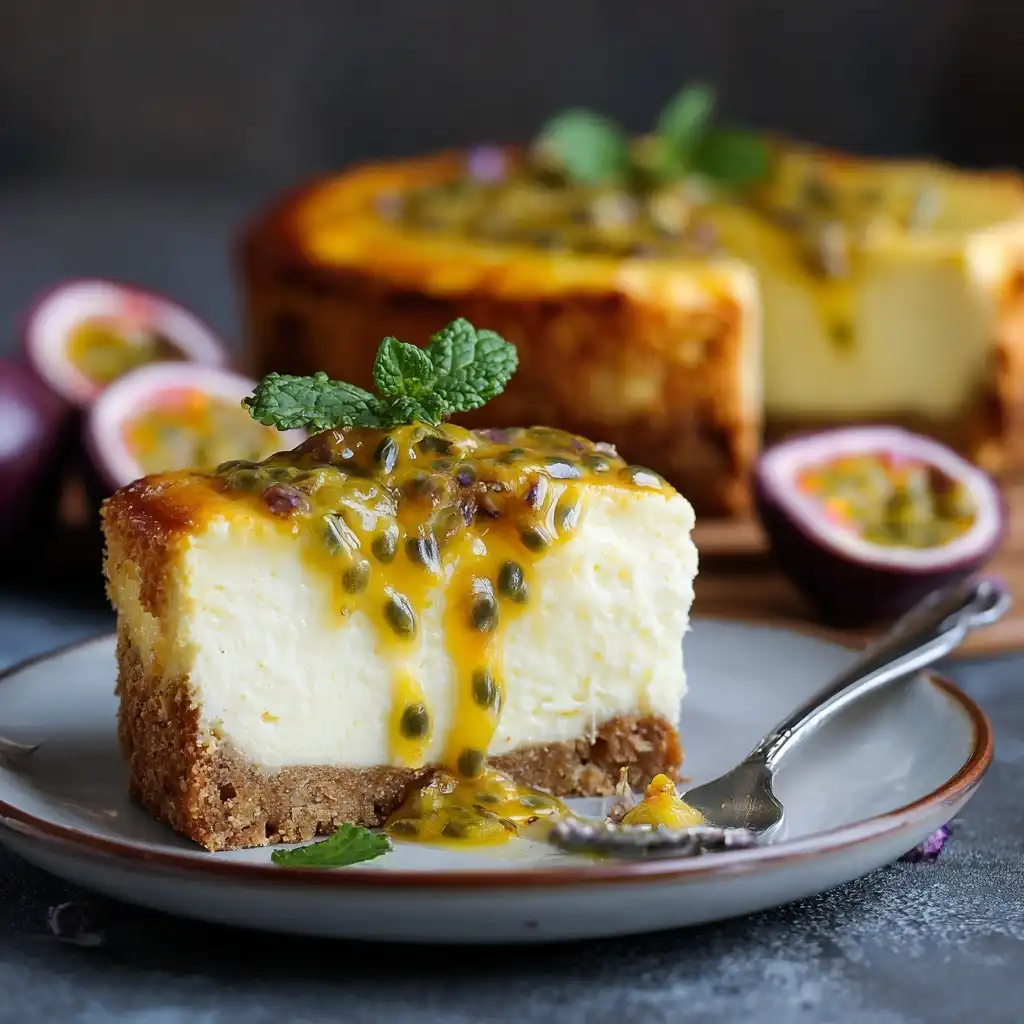
Passionfruit Cheesecake is a dazzling fusion of tropical vibrancy and classic creamy indulgence—a dessert that instantly transports you to sun-drenched shores with every velvety bite. Unlike traditional New York or no-bake varieties, this iteration marries the bold, tangy-sweet intensity of ripe passionfruit with the luxuriously smooth, rich texture of premium cream cheese. Its striking golden-orange swirls, fragrant floral aroma, and bright citrus finish make it not just a dessert—but an experience. Whether served at a summer soirée, a bridal shower, or simply as a weekend treat to uplift your spirit, Passionfruit Cheesecake balances sophistication and approachability, proving that extraordinary flavor doesn’t require complexity—just quality ingredients, thoughtful technique, and reverence for the fruit’s natural brilliance.
The History
The origins of cheesecake trace back over 2,000 years to ancient Greece, where simple versions made with honey-sweetened cheese and flour were served to athletes at the first Olympic Games in 776 BCE. The Romans later adopted and adapted the recipe, spreading it across their empire. Modern American-style baked cheesecake evolved in the late 19th and early 20th centuries—particularly after the 1872 invention of cream cheese by William Lawrence in Chester, New York—and was popularized further by Arnold Reuben’s “New York Cheesecake” in the 1920s. However, the integration of tropical fruits like passionfruit into cheesecake is a far more recent innovation, emerging globally in the mid-to-late 20th century as international travel, global trade, and culinary cross-pollination expanded ingredient accessibility. Passionfruit—native to South America (specifically southern Brazil, Paraguay, and northern Argentina)—was introduced to Australia, South Africa, Hawaii, and Southeast Asia in the 19th century. By the 1970s and ’80s, Australian and New Zealand patisseries began pioneering passionfruit-infused desserts, capitalizing on the fruit’s intense aroma and high pectin content—ideal for both flavor infusion and natural thickening. Today, Passionfruit Cheesecake stands as a hallmark of Pacific Rim and Australasian baking traditions, increasingly embraced by chefs from Tokyo to Toronto for its refreshing counterpoint to richness, and celebrated in food media as a “summer essential” and “tropical twist done right.”
Ingredients Breakdown
Every exceptional Passionfruit Cheesecake begins with intentionality—not just in selection, but in understanding *why* each component matters:
- Graham Cracker Crust Base: Finely crushed graham crackers (or digestive biscuits outside the U.S.) provide structure, subtle molasses sweetness, and a gentle crunch that contrasts the silkiness above. Butter binds the crumbs and adds richness; brown sugar deepens caramel notes and enhances browning.
- Cream Cheese: Full-fat, block-style cream cheese (e.g., Philadelphia) is non-negotiable. It must be at true room temperature (65–70°F / 18–21°C) to ensure seamless incorporation—cold cheese causes lumps, while overheated or softened-too-long cheese can destabilize emulsion.
- Sour Cream & Heavy Cream: Sour cream contributes acidity, moisture, and a slight tang that cuts through fat—enhancing brightness without sharpness. Heavy cream (36–40% fat) adds fluidity, tenderness, and a lush mouthfeel; it also helps regulate oven spring and prevents cracking.
- Eggs: Large, room-temperature eggs act as both binder and leavening agent. They’re added one at a time to maintain emulsion stability. Overmixing after egg addition introduces excess air—leading to collapse or fissures during cooling.
- Granulated Sugar: Not merely for sweetness—sugar tenderizes the protein matrix, aids in aeration during beating, and contributes to the signature slight crust formation on top.
- Vanilla Extract & Salt: Pure Madagascar bourbon vanilla adds warm, floral depth that complements—not competes with—passionfruit. Fine sea salt (not iodized) heightens all flavors and balances acidity.
- Fresh Passionfruit Pulp: The soul of the recipe. Only use pulp scraped directly from fully ripe, wrinkled-skinned, heavy-to-the-hand purple or yellow passionfruit. Avoid pre-bottled “juice drinks” laden with water, preservatives, and artificial flavors. Real pulp contains tiny edible black seeds that deliver textural pop and aromatic volatility—essential for authenticity.
- Passionfruit Reduction (Optional but Highly Recommended): Simmering fresh pulp with a touch of sugar until thickened (to ~¼ cup) intensifies flavor, removes excess water (preventing curdling), and concentrates volatile esters responsible for its iconic “perfumed” top note.
- Optional Garnishes: Fresh passionfruit halved and seeded, toasted coconut flakes, edible orchid blossoms, candied ginger, or a delicate passionfruit coulis drizzle—each elevating visual appeal and layered tasting experience.
Step-by-Step Recipe
- Prep & Prep Work (1 hour ahead): Chill mixing bowls and beaters. Preheat oven to 325°F (163°C). Wrap the *outside* of a 9-inch springform pan tightly with two layers of heavy-duty aluminum foil (to prevent water bath leakage). Place pan inside a larger roasting dish.
- Make the Crust: Pulse 1 ½ cups graham cracker crumbs, ¼ cup brown sugar, and ¼ tsp salt in a food processor until uniform. Add 6 tbsp melted unsalted butter and pulse until mixture resembles wet sand. Press firmly and evenly into bottom and 1 inch up sides of prepared pan using the back of a spoon or flat-bottomed glass. Bake 10 minutes. Cool completely on wire rack—minimum 20 minutes.
- Prepare Passionfruit Element: Scoop pulp from 12–15 ripe passionfruit (yields ~¾ cup raw pulp). Strain through a fine-mesh sieve to remove excess fibrous membrane—but retain all seeds. Transfer strained pulp to a small saucepan. Add 2 tbsp granulated sugar. Simmer over low heat 8–12 minutes, stirring frequently, until reduced to ~¼ cup thick, glossy, fragrant syrup. Cool to room temperature (do not refrigerate—it may seize).
- Beat Cream Cheese Base: In stand mixer fitted with paddle attachment, beat 24 oz (3 standard blocks) full-fat cream cheese on medium-low 2–3 minutes until perfectly smooth, scraping bowl thoroughly. Add 1 cup granulated sugar + ¼ tsp salt; beat 2 minutes until fluffy and lump-free. Scrape bowl. Add 1 tbsp pure vanilla; mix 30 seconds.
- Incorporate Dairy: Add 1 cup full-fat sour cream and ½ cup heavy cream. Mix on low 30 seconds, then medium 1 minute until homogenous and silky. Scrape bowl meticulously.
- Add Eggs With Precision: Add 4 large room-temp eggs *one at a time*, mixing on low just until yolk disappears (~15 seconds per egg). Overmixing = cracks. After fourth egg, add 2 tbsp reduced passionfruit pulp and mix on lowest speed 20 seconds—just to swirl in. Do *not* over-blend; streaks are welcome.
- Water Bath Setup: Place crust-lined pan inside roasting dish. Carefully pour hot (but not boiling) water into roasting dish until it reaches halfway up springform pan’s sides (~1.5 inches). This gentle, even heat is critical for crack-free results.
- Bake With Patience: Bake 1 hour 15 minutes–1 hour 25 minutes. Cake is done when edges are set and center jiggles *slightly* like Jell-O (not liquid). Turn off oven, crack door open 1 inch with a wooden spoon, and let cake cool *in oven* for 1 hour—this gradual cooldown prevents thermal shock and sinking.
- Chill & Set: Remove from water bath. Run thin knife around edge to loosen. Cool completely on rack (2 hours), then refrigerate *uncovered* for minimum 12 hours—ideally 24–48 hours. This allows flavors to meld, texture to firm, and acidity to mellow.
- Unmold & Finish: Before serving, dip bottom of pan briefly in hot water, dry thoroughly, then release springform. Use offset spatula to lift cake onto serving platter. Garnish generously with fresh passionfruit seeds, optional coconut, and a final drizzle of reserved reduction.
Tips
- Room Temperature Is Non-Negotiable: Take cream cheese, eggs, sour cream, and heavy cream out of the fridge 3–4 hours before baking—not just 30 minutes. True room temp ensures emulsion stability and eliminates graininess.
- Strain, But Don’t Over-Strain: Press pulp through sieve with a flexible spatula—not a spoon—to capture all aromatic oils clinging to seeds and membranes. Discard only tough white pith.
- Reduce, Don’t Just Use Raw Pulp: Raw passionfruit juice is ~85% water. Reducing concentrates flavor and removes water that could cause weeping or separation during baking.
- Low & Slow Is Law: Never exceed 325°F. Higher temps cause rapid protein coagulation → cracks, rubberiness, and “cheese sweat” (whey separation).
- Water Bath Water Must Be Hot—Not Boiling: Boiling water creates steam pockets and uneven heating. Use tap-hot water (~140°F) for consistent thermal transfer.
- Don’t Rush the Chill: A rushed chill yields a soft, fragile cake prone to crumbling. Overnight sets the proteins fully and lets acidity mellow from sharp to complex.
- Use a Springform Pan With a Tight Seal: Even with foil wrapping, older pans may leak. Test yours with water before committing to batter.
- Freeze for Longevity: Unfrosted, well-wrapped cheesecake freezes beautifully for up to 3 months. Thaw overnight in fridge—never at room temp—to preserve texture.
- Knife Hygiene: For clean slices, dip knife in hot water and wipe dry between *every* cut. A serrated knife works surprisingly well for clean edges.
- Taste Your Passionfruit: If fruit tastes bland or fermented, don’t use it—even if it looks ripe. Flavor compounds develop best in warm, humid climates; imported fruit may lack terroir-driven nuance.
Variations and Customizations
This versatile canvas invites creativity—while honoring its tropical soul:
- No-Bake Passionfruit Cheesecake: Replace baked base with a blend of 16 oz cold cream cheese, 1 cup cold heavy cream whipped to stiff peaks, ⅓ cup powdered sugar, 2 tbsp passionfruit reduction, and 1 tsp lime zest. Fold gently, pour over chilled crust, and refrigerate 8+ hours. Lighter, airier, and ideal for hot climates.
- Vegan Passionfruit Cheesecake: Use soaked cashews (2 cups), coconut cream (1 cup), lemon juice (3 tbsp), maple syrup (⅓ cup), 3 tbsp passionfruit reduction, and 1 tsp agar-agar (bloomed in 2 tbsp water). Blend until ultra-smooth, pour over date-walnut crust, and set in freezer 6 hours.
- Passionfruit Swirl Cheesecake: Reserve ⅓ cup reduced pulp. After pouring batter, dollop reduction over surface and drag a toothpick in figure-eights for dramatic marbling—avoid over-swirling.
- Tropical Fusion: Add ½ cup toasted macadamia pieces to crust; fold ⅓ cup diced dried mango or pineapple into batter; top with grilled pineapple rings before serving.
- Passionfruit-Lime Cheesecake: Add 2 tsp finely grated Key lime zest + 1 tbsp lime juice to batter along with passionfruit. Brightens profile and adds aromatic complexity.
- Crumb-Topped Version: Mix ¼ cup flour, ¼ cup brown sugar, 2 tbsp cold butter, and 2 tbsp crushed passionfruit seeds for a crunchy, nutty streusel applied in final 15 minutes of baking.
- Mini Jar Cheesecakes: Portion into 4-oz mason jars. Reduce bake time to 25–30 minutes in water bath. Perfect for gifts or portion control.
- Gluten-Free Adaptation: Substitute gluten-free graham crackers or almond flour crust (1 ½ cups almond flour + ¼ cup coconut sugar + 6 tbsp butter + pinch salt). Ensure all other ingredients are certified GF.
- Alcoholic Infusion: Stir 1 tbsp passionfruit liqueur (e.g., Passoa) or 2 tsp rum into cooled reduction. Adds warmth and depth—omit if serving to children or avoiding alcohol.
- Matcha-Passionfruit Layer: Prepare a thin matcha-white chocolate ganache layer (½ cup white chocolate + 1 tsp matcha + 2 tbsp cream) and spread between crust and batter for a vibrant green contrast and earthy balance.
Health Considerations and Nutritional Value
A single generous slice (1/12 of a 9-inch cake, approx. 220g) contains roughly:
- Calories: 420–460 kcal
- Total Fat: 32–36g (18–20g saturated)
- Carbohydrates: 30–34g (24–27g sugars, primarily from fruit and added sweeteners)
- Protein: 7–9g
- Fiber: 1.5–2g (mostly from crust and passionfruit seeds)
- Vitamin C: ~35–45mg (≈50% DV)—thanks to passionfruit’s exceptional bioavailability
- Iron, Magnesium, Potassium: Moderate amounts from seeds and whole-grain crust options
- Antioxidants: High levels of polyphenols (rutin, kaempferol), beta-cryptoxanthin, and vitamin A precursors—all linked to reduced oxidative stress and anti-inflammatory activity
Considerations: While decadent, passionfruit itself is low-calorie (17kcal per fruit), rich in fiber, and boasts one of the highest antioxidant capacities among fruits (ORAC score ~3,400 µmol TE/100g). Its natural acidity may aid digestion and improve nutrient absorption—especially iron from plant sources. That said, moderation remains key: the cream cheese, butter, and sugar contribute significant saturated fat and added sugars. Health-conscious adaptations include reducing sugar by 25%, using Greek yogurt instead of half the sour cream, incorporating a 50/50 oat-and-cracker crust, or serving smaller portions alongside fresh berries and mint. Notably, passionfruit contains mild sedative alkaloids (harman, harmaline) in very low concentrations—generally safe, but those sensitive to MAO inhibitors should consult a healthcare provider. As always, enjoy mindfully—not as “health food,” but as joyful, nourishing celebration.
Ingredients
- For the Crust:
- 1 ½ cups (150g) graham cracker crumbs (about 12 full sheets)
- ¼ cup (50g) packed light brown sugar
- ¼ teaspoon fine sea salt
- 6 tablespoons (85g) unsalted butter, melted
- For the Filling:
- 24 ounces (680g) full-fat brick-style cream cheese, room temperature
- 1 cup (200g) granulated sugar
- ¼ teaspoon fine sea salt
- 1 tablespoon pure vanilla extract
- 1 cup (240g) full-fat sour cream, room temperature
- ½ cup (120ml) heavy cream (36–40% fat), room temperature
- 4 large eggs, room temperature
- ¼ cup (60ml) passionfruit reduction (see Step-by-Step for preparation)
- For the Passionfruit Reduction:
- ¾ cup (180ml) fresh passionfruit pulp (from ~12–15 ripe fruits)
- 2 tablespoons (25g) granulated sugar
- For Garnish (optional but recommended):
- Fresh passionfruit halves, seeded
- Unsweetened toasted coconut flakes
- Edible flowers (violas, pansies, or orchids)
- Extra passionfruit reduction for drizzling
Directions
- Make the Passionfruit Reduction: In a small, heavy-bottomed saucepan, combine fresh passionfruit pulp and sugar. Bring to a gentle simmer over medium-low heat, stirring occasionally. Reduce heat to low and simmer uncovered, stirring every 2 minutes, until volume reduces by about two-thirds and mixture coats the back of a spoon thickly (approx. 8–12 minutes). Transfer to a small bowl and cool completely to room temperature—do not refrigerate. Set aside.
- Prepare Crust: Preheat oven to 325°F (163°C). Grease bottom and sides of a 9-inch springform pan; wrap *exterior* tightly with two overlapping layers of heavy-duty aluminum foil. In food processor, pulse graham crackers until fine crumbs form. Add brown sugar and salt; pulse to combine. Drizzle in melted butter and pulse until mixture resembles damp sand. Press firmly and evenly into bottom and 1 inch up sides of pan. Bake 10 minutes. Cool completely on wire rack—minimum 20 minutes.
- Prepare Cream Cheese Base: Using stand mixer with paddle attachment, beat cream cheese on medium-low 2–3 minutes until completely smooth and creamy, scraping bowl and paddle thoroughly. Add sugar and salt; beat 2 minutes until fluffy and lump-free. Scrape bowl. Add vanilla; mix 30 seconds.
- Incorporate Dairy: Add sour cream and heavy cream. Mix on low 30 seconds, then medium 1 minute until fully combined and velvety. Scrape bowl and paddle.
- Add Eggs: Add eggs one at a time, mixing on low speed just until yolk disappears (~15 seconds per egg). Scrape bowl after each addition. After fourth egg, add ¼ cup cooled passionfruit reduction. Mix on lowest speed for 20 seconds—just enough to disperse, leaving subtle swirls.
- Water Bath Setup: Place springform pan inside a large roasting pan. Carefully pour hot tap water (≈140°F) into roasting pan until water reaches halfway up sides of springform pan.
- Bake: Place roasting pan on center oven rack. Bake 1 hour 15 minutes to 1 hour 25 minutes. Cake is done when edges are puffed and set, and center jiggles slightly—like firm Jell-O—when gently shaken. Do not overbake.
- Cool Gradually: Turn off oven. Prop door open 1 inch with wooden spoon. Let cake cool in oven for exactly 1 hour. Remove from water bath. Run thin knife around edge. Cool completely on wire rack (≈2 hours).
- Chill Thoroughly: Refrigerate uncovered for minimum 12 hours—preferably 24–48 hours—for optimal texture, flavor development, and clean slicing.
- Unmold & Serve: Dip bottom of pan briefly in hot water, dry well, then release latch. Slide offset spatula between crust and pan base to loosen. Lift onto serving plate. Garnish lavishly. Store covered in fridge up to 5 days—or freeze up to 3 months.
FAQ
- Can I use bottled passionfruit juice?
- No—most commercial “passionfruit juice” is diluted, pasteurized, and contains preservatives, artificial flavors, and added sugars that mute aroma and destabilize the batter. Always use freshly scooped, strained pulp for authentic flavor and proper chemistry.
- Why did my cheesecake crack?
- Most common causes: (1) Batter too cold when poured; (2) Oven temperature too high; (3) Sudden temperature change (opening oven door, skipping water bath, or cooling too fast); (4) Overmixing after adding eggs; (5) Underbaking followed by over-chilling. Our step-by-step mitigates all five.
- Can I make this gluten-free?
- Absolutely. Substitute graham crackers with certified GF graham-style cookies or a blend of 1 cup almond flour + ½ cup gluten-free oat flour + ¼ cup coconut sugar + 6 tbsp butter + pinch salt. Ensure cream cheese and all dairy are GF-certified.
- How do I know if passionfruit is ripe?
- Ripe passionfruit has deeply wrinkled, dimpled, paper-thin skin—purple or golden yellow depending on variety—and feels heavy for its size. Slight give when gently squeezed is ideal. Smooth, taut skin = underripe. Fermented smell or mold = overripe.
- Can I freeze the baked cheesecake?
- Yes! Once fully chilled and unmolded, wrap tightly in plastic wrap, then in foil, and freeze up to 3 months. Thaw overnight in refrigerator—never at room temperature—to preserve moisture and prevent condensation.
- What if I don’t have a water bath?
- A water bath is strongly recommended for crack-free, creamy results. However, if unavoidable: place pan on lowest oven rack, fill a second empty roasting pan with 1 inch of boiling water on the rack *above* the cheesecake (creating steam), and reduce oven temp to 300°F. Monitor closely—results may vary.
- Can I double the recipe?
- Not recommended for a single batch. Baking time and heat distribution change significantly. Instead, make two separate batches using identical equipment and timing—ensuring consistency.
- Is there a lower-sugar version?
- You can reduce granulated sugar to ¾ cup (150g) without compromising structure—but expect a more tart, less rounded flavor. Do not reduce sugar in the crust or reduction, as both rely on it for binding and caramelization.
- Why strain the passionfruit pulp?
- Straining removes tough, fibrous membranes that would create unpleasant texture and interfere with smooth batter. However, *keep the seeds*—they’re flavorful, nutritious, and essential for authentic mouthfeel and aroma release.
- Can I use frozen passionfruit pulp?
- Yes—if unsweetened, flash-frozen at peak ripeness, and thawed in refrigerator overnight. Drain any excess liquid before reducing. Avoid freeze-thaw cycles, which degrade volatile oils.
Summary
Passionfruit Cheesecake is a masterclass in balance—where the electrifying tang and perfume of sun-ripened passionfruit elevate the timeless luxury of velvety cream cheese into something utterly transportive and unforgettable.
With meticulous attention to ingredient integrity, temperature control, and patient chilling, this dessert delivers restaurant-quality elegance in your own kitchen—proving that the most vibrant flavors often bloom brightest against a backdrop of creamy calm.