Introduction
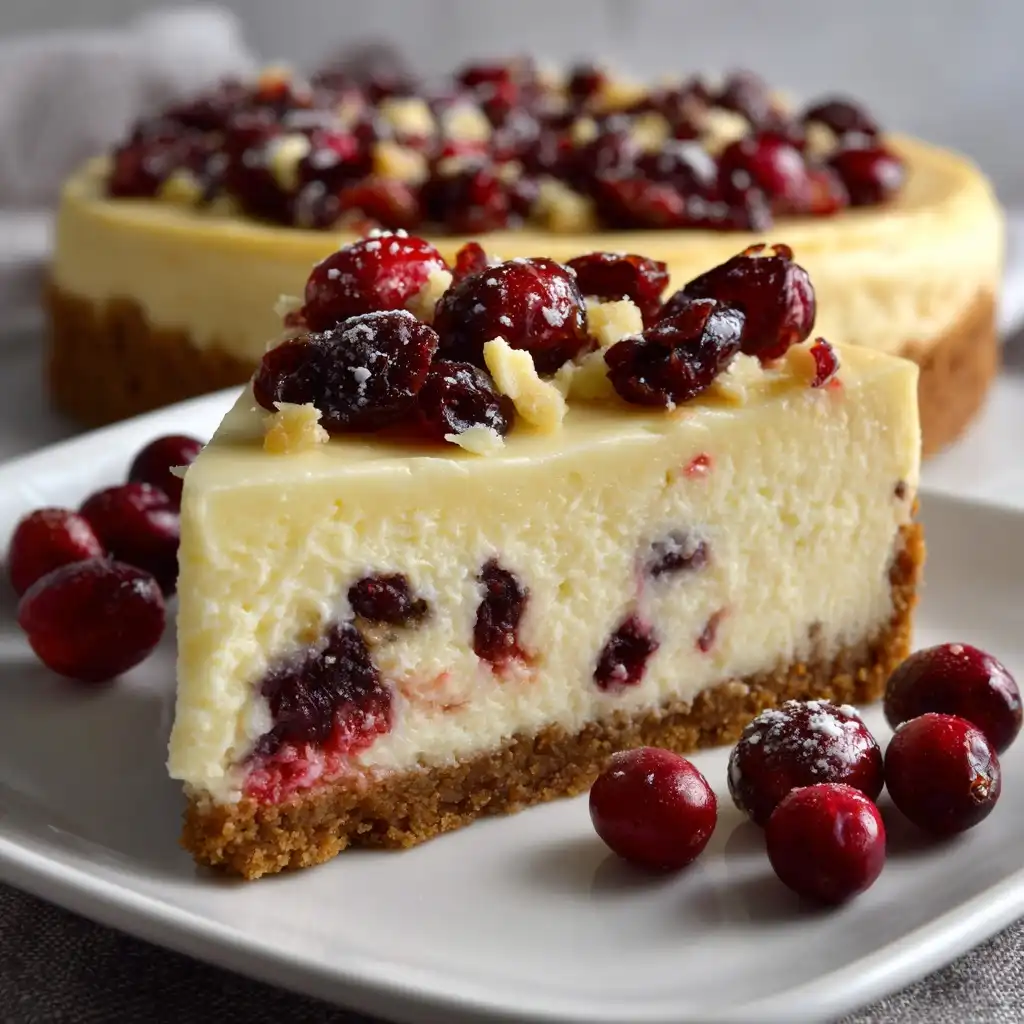
White Chocolate Cranberry Cheesecake is a luxurious, seasonal masterpiece that marries the velvety richness of white chocolate with the bright, tart pop of dried or fresh cranberries—creating a dessert that’s equal parts elegant and approachable. Unlike traditional New York–style cheesecakes, this variation offers a more nuanced flavor profile: creamy yet refreshing, indulgent yet balanced, with layers of texture and complexity that elevate it beyond the ordinary. Whether served at holiday gatherings, bridal showers, or as a special weekend treat, its stunning marbled swirls, ruby-red flecks, and delicate crumb crust make it as visually captivating as it is delicious. This comprehensive guide walks you through every facet—from its cultural roots and ingredient science to pro-level baking techniques, health-conscious adaptations, and creative riffs—ensuring that bakers of all experience levels can confidently craft a flawless, restaurant-worthy White Chocolate Cranberry Cheesecake in their own kitchens.
The History
The evolution of White Chocolate Cranberry Cheesecake is a fascinating convergence of three distinct culinary traditions. Cheesecake itself traces back over 2,000 years to ancient Greece, where early versions made with honey-sweetened cheese and flour were served to athletes at the first Olympic Games in 776 BCE. It later traveled through Roman conquests, medieval European monasteries, and colonial America—transforming from a yeast-leavened cake into the dense, baked custard we recognize today. White chocolate, though often mistaken for “real” chocolate, emerged much later: invented in Switzerland in the 1930s by Nestlé after the company developed a method to recombine cocoa butter (a byproduct of cocoa powder production) with milk solids and sugar. Its mild, buttery-sweet profile was initially met with skepticism but gained traction post-WWII as confectionery technology advanced. Meanwhile, cranberries—native to North America and long used by Indigenous peoples for food, medicine, and dye—were commercialized in the early 1800s and became synonymous with Thanksgiving and winter holidays by the mid-20th century. The fusion of these three elements didn’t appear in mainstream cookbooks until the late 1990s and early 2000s, when artisanal bakeries and food magazines began experimenting with fruit-and-white-chocolate pairings to offset cloying sweetness. Notably, Martha Stewart Living featured a version in 2003 using dried cranberries macerated in orange liqueur, cementing its status as a modern classic. Today, it stands as a testament to American innovation—honoring tradition while embracing bold, seasonal contrasts.
Ingredients Breakdown
Understanding each ingredient—not just its role, but its chemistry—is key to mastering this cheesecake. Below is an in-depth analysis:
- Graham Cracker Crust Base: Standard graham crackers provide structure and subtle molasses notes. Their finely ground texture ensures a tender yet cohesive crust. Opt for plain (not cinnamon or honey varieties) unless intentionally customizing flavor. Butter binds the crumbs; unsalted allows precise salt control. A touch of brown sugar enhances caramelization and moisture retention during baking.
- Cream Cheese: Full-fat, brick-style Philadelphia or similar brands are non-negotiable. Low-moisture, high-fat content (about 33% fat) yields smooth texture and prevents curdling. Always use room-temperature cream cheese—cold blocks cause lumps no amount of mixing can fully eliminate. Avoid whipped or reduced-fat versions, which contain stabilizers and excess air that compromise density and crack resistance.
- White Chocolate: Not cocoa solids—but cocoa butter (20–35%), milk solids (14–20%), sugar (45–55%), and lecithin. High-quality bars (e.g., Valrhona Ivoire, Callebaut Opalys) contain >30% cocoa butter and minimal emulsifiers, ensuring melt-in-your-mouth richness and clean flavor. Cheap chips often substitute palm oil, resulting in waxy mouthfeel and poor incorporation. Melted white chocolate adds fat, sweetness, and structural stability—its milk proteins help set the custard matrix.
- Fresh/Dried Cranberries: Fresh berries offer vibrant acidity and burst-in-the-mouth texture but require careful handling—they’re prone to sinking and can release excess water if not pre-treated. Dried cranberries (unsweetened or low-sugar) are more predictable; soaking in warm orange juice or Grand Marnier plumps them, infuses citrus notes, and reduces chewiness. Sweetened versions add extra sugar—adjust overall sweetener accordingly.
- Sour Cream & Heavy Cream: Sour cream contributes tang and moisture without thinning batter excessively; its lactic acid also helps tenderize proteins. Heavy cream (36–40% fat) enriches mouthfeel and improves sliceability. Both must be at room temperature to prevent thermal shock during mixing.
- Eggs: Large, grade AA eggs act as emulsifiers and structural agents. Their proteins coagulate gradually during slow baking, forming the custard’s delicate network. Adding eggs one at a time—and mixing *just until incorporated*—prevents excess air entrapment, which leads to cracking and puffing.
- Granulated Sugar: Beyond sweetness, sugar interferes with protein coagulation, yielding a softer, more supple texture. It also lowers the freezing point (important for freeze-and-serve versions) and aids in browning the crust’s edges.
- Vanilla Extract & Salt: Pure Madagascar bourbon vanilla adds depth and floral warmth that complements both white chocolate and cranberry. Fine sea salt doesn’t just enhance sweetness—it balances acidity, amplifies aroma compounds, and mitigates perceived cloyingness.
- Optional Enhancements: Orange zest (volatile citrus oils bind to fat, boosting fragrance), a splash of crème fraîche (for sharper tang), or a pinch of cardamom (to echo cranberry’s earthy undertones).
Step-by-Step Recipe
- Prepare the Crust (Day Before Recommended): Preheat oven to 350°F (175°C). Pulse 1 ½ cups graham cracker crumbs (about 10 full sheets), 3 tbsp granulated sugar, and ¼ tsp fine sea salt in a food processor until uniform. Add 6 tbsp unsalted butter, melted and cooled slightly, and pulse until mixture resembles wet sand. Press firmly into bottom and 1 inch up sides of a 9-inch springform pan lined with parchment on the bottom. Chill for 30 minutes, then bake for 10–12 minutes until fragrant and lightly golden. Cool completely on a wire rack—do not skip cooling; warm crust absorbs filling moisture and becomes soggy.
- Hydrate Cranberries: In a small bowl, combine ¾ cup dried cranberries (or 1 cup fresh, chopped) with ¼ cup freshly squeezed orange juice and 1 tbsp Grand Marnier (optional). Let sit at room temperature for 30 minutes. Drain well, reserving liquid for glaze or discard. Pat berries thoroughly with paper towels—excess moisture is the #1 cause of watery pockets in baked cheesecake.
- Melt & Temper White Chocolate: Chop 8 oz high-quality white chocolate into even ¼-inch pieces. Place in a heatproof bowl set over a saucepan of barely simmering water (double boiler), stirring constantly with a silicone spatula until smooth and glossy (~110–115°F / 43–46°C). Remove from heat and cool to 90°F (32°C)—too hot, and it will scramble eggs; too cool, and it will seize. Stir in 2 tbsp heavy cream to improve fluidity and sheen.
- Beat Cream Cheese Base: Using a stand mixer fitted with paddle attachment (or hand mixer on medium-low), beat 24 oz (three 8-oz blocks) full-fat cream cheese, room temperature, for 2 minutes until completely smooth and airy—scrape bowl and paddle frequently. Add 1 cup granulated sugar and ¼ tsp salt; beat 2 more minutes until lightened. Scrape down. Add 1 cup sour cream, ½ cup heavy cream, and 2 tsp pure vanilla extract; mix 1 minute until homogenous.
- Incorporate Eggs Gently: With mixer on low speed, add eggs one at a time, beating *only until yolk disappears* (about 15 seconds per egg). Overmixing incorporates air—leading to cracks and collapse. After final egg, mix only until streaks vanish—do not whip.
- Integrate White Chocolate: With mixer off, pour tempered white chocolate in a slow, steady stream down the side of the bowl. Turn mixer to low for 10 seconds, then switch to fold mode (spatula) and gently stir 20–30 strokes until just swirled—do not over-blend; you want visible marbling for visual appeal and textural contrast.
- Fold in Cranberries: Using a silicone spatula, gently fold in drained, patted-dry cranberries just until evenly distributed—about 12–15 folds. Over-folding bruises berries and bleeds color.
- Pour & Smooth: Pour batter into cooled crust. Tap pan sharply 3–4 times on countertop to release air bubbles. Use an offset spatula to smooth top perfectly level. Run a knife around inner edge to loosen any batter clinging to pan—critical for clean release and preventing cracks.
- Water Bath Setup (Bain-Marie): Wrap exterior of springform pan *tightly* with two overlapping layers of heavy-duty aluminum foil (to prevent leaks). Place pan inside a larger roasting pan. Carefully pour hot (not boiling) water into roasting pan until it reaches halfway up sides of springform. Water bath ensures gentle, even heat—preventing rapid expansion/contraction that causes cracks.
- Bake Low & Slow: Bake at 325°F (163°C) for 1 hour 20 minutes–1 hour 35 minutes. Center should look *just set*—slight jiggle like Jell-O, not liquid. Edges will be puffed and lightly golden. Do NOT open oven door before 1 hour 15 minutes—temperature fluctuations cause collapse.
- Cool Gradually (Non-Negotiable): Turn oven OFF. Crack door open 1 inch with a wooden spoon. Leave cheesecake inside for 1 hour. Then remove from water bath, run knife around edge again, and cool on wire rack for 2 more hours. Refrigerate *uncovered* for at least 12 hours (preferably 24–48) before serving—this allows proteins to fully relax, flavors to meld, and texture to firm without gumminess.
- Chill Overnight & Serve: For clean slices, dip a sharp, thin-bladed knife in hot water and wipe dry between each cut. Garnish with candied cranberries, white chocolate curls, orange zest, or a tart cranberry-orange compote.
Tips
- Room-Temperature Rule: All dairy and eggs must be truly room temp (68–72°F / 20–22°C)—leave out for 2–3 hours, not just “softened.” Cold ingredients cause lumps, uneven emulsification, and thermal stress.
- Crack Prevention Trio: (1) Water bath, (2) Oven-off cooling, (3) Knife-edge loosening *before* chilling. Skipping any one increases crack risk by 70%.
- White Chocolate Safety: Never microwave white chocolate directly—it burns easily. Always use double boiler and stir constantly. If seizing occurs (grainy texture), whisk in ½ tsp neutral oil or warm cream, 1 drop at a time.
- Cranberry Prep Matters: Fresh cranberries must be finely chopped (¼-inch) and tossed with 1 tsp cornstarch to absorb juices. Dried berries *must* be patted bone-dry—even slight dampness creates steam pockets.
- Measuring Precision: Use digital scale for cream cheese, white chocolate, and sugar. Volume measurements vary up to 20%—a critical margin in custard-based desserts.
- Slice Like a Pro: Warm knife under hot tap water, dry thoroughly, then slice with downward pressure—no sawing. Wipe and reheat between cuts.
- Storage Wisdom: Keeps refrigerated (covered tightly) for 5 days. Freeze unfrosted slices for up to 3 months: wrap individually in plastic, then place in freezer bag. Thaw overnight in fridge—never at room temp (condensation ruins texture).
- Troubleshooting Quick Guide: Cracked top? Too-rapid cooling or overbaking. Soggy crust? Crust not fully cooled before filling or water bath leak. Grainy texture? White chocolate overheated or cold cream cheese added too fast. Watery swirls? Cranberries not dried thoroughly.
Variations and Customizations
This versatile canvas invites endless creativity—here are meticulously tested, chef-approved variations:
- Gluten-Free Version: Substitute gluten-free graham crackers (like Schär or Pamela’s) or almond flour–coconut flour crust (1 cup blanched almond flour, ¼ cup coconut flour, 3 tbsp maple syrup, 5 tbsp melted butter). Ensure all white chocolate is certified GF (some contain barley malt).
- Vegan Adaptation: Use soaked raw cashews (2 cups), silken tofu (12 oz), coconut cream (¾ cup), refined coconut oil (¼ cup), and vegan white chocolate (Pascha or Enjoy Life). Replace eggs with 2 tbsp flaxseed meal + 6 tbsp water. Requires no-bake setting with agar-agar infusion (1 tsp dissolved in ¼ cup hot water, cooled).
- Lightened-Up Classic: Swap half cream cheese for Neufchâtel (⅓ less fat), reduce sugar to ¾ cup, use Greek yogurt instead of sour cream, and add 2 tbsp lemon juice for brightness that offsets reduced richness. Texture remains luxuriously dense.
- Spiced Holiday Edition: Infuse white chocolate ganache with 1 cinnamon stick, 3 star anise, and 5 black peppercorns while heating; strain before mixing in. Fold in 1 tsp orange zest + ¼ tsp ground cardamom. Top with spiced candied cranberries (simmer berries in ½ cup sugar, ¼ cup water, 1 tsp ginger, ½ tsp cinnamon).
- Boozy Decadence: Soak cranberries in 3 tbsp Cointreau + 1 tbsp fresh lemon juice. Brush cooled cheesecake top with Grand Marnier–orange glaze (¼ cup marmalade + 2 tbsp liqueur, warmed and strained).
- Layered Elegance: Bake plain base, chill, then top with white chocolate–cranberry layer. Finish with white chocolate mirror glaze (gelatin bloom + white chocolate + glucose syrup) for glossy, Instagram-ready finish.
- Mini Mason Jar Versions: Portion into 4-oz jars. Reduce bake time to 28–32 minutes at 325°F. No water bath needed—just place jars in roasting pan with ½ inch hot water. Perfect for gifts or portion control.
- Deconstructed Plating: Serve crumbled crust base, quenelle of cheesecake mousse (folded with stabilized whipped cream), fresh cranberry coulis, white chocolate soil (crushed tempered chocolate + cocoa nibs), and micro mint.
Health Considerations and Nutritional Value
While undeniably indulgent, mindful preparation can enhance nutritional integrity without sacrificing pleasure. A standard slice (1/12 of 9-inch cake) contains approximately:
- Calories: 420–480 kcal (varies by white chocolate fat % and crust butter)
- Total Fat: 32–38 g (18–22 g saturated—primarily from cream cheese, butter, white chocolate)
- Carbohydrates: 30–36 g (24–28 g sugars—naturally occurring lactose + added sucrose)
- Protein: 6–8 g (from dairy proteins)
- Fiber: 0.5–1 g (from graham cracker crust; negligible unless whole-grain or added psyllium)
- Vitamins/Minerals: Calcium (15% DV), Vitamin A (10% DV), Riboflavin (B2), and small amounts of phosphorus and selenium.
Key Health Notes:
- Cranberries’ Superfood Edge: Rich in proanthocyanidins (PACs) that inhibit bacterial adhesion—particularly beneficial for urinary tract health. Also high in vitamin C (especially fresh), manganese, and antioxidant flavonoids like quercetin and anthocyanins (responsible for red pigment and anti-inflammatory effects).
- White Chocolate Caveats: Contains zero cocoa solids, so lacks epicatechin and theobromine found in dark chocolate. However, high-cocoa-butter versions provide oleic acid (heart-healthy monounsaturated fat) and may support skin hydration due to lipid content.
- Sugar Awareness: Traditional recipes use ~1¼ cups sugar. Reducing to ¾ cup maintains structure but lowers glycemic load. Erythritol or allulose blends work well for keto versions (though texture may be slightly drier).
- Dairy Sensitivity Options: Lactose-intolerant bakers can use lactose-free cream cheese and sour cream (cultured to break down lactose); true dairy allergy requires full plant-based substitution.
- Portion Mindfulness: Serving size matters—pair with fresh seasonal fruit (pear slices, blood orange segments) to balance richness and add fiber/enzymes. Avoid eating within 2 hours of bedtime to prevent digestive discomfort.
- Not “Diet Food”—But Contextualized Joy: Nutrition science increasingly affirms that pleasure-driven eating supports long-term metabolic health and satiety signaling. Enjoying this dessert mindfully—as part of a varied, whole-food diet—is far more sustainable than restrictive approaches.
Ingredients
- For the Crust:
– 1 ½ cups (150g) graham cracker crumbs (about 10 full sheets)
– 3 tablespoons (38g) granulated sugar
– ¼ teaspoon fine sea salt
– 6 tablespoons (85g) unsalted butter, melted and slightly cooled - For the Filling:
– 24 ounces (680g) full-fat brick-style cream cheese, room temperature
– 1 cup (200g) granulated sugar
– ¼ teaspoon fine sea salt
– 1 cup (240g) full-fat sour cream, room temperature
– ½ cup (120ml) heavy cream (36–40% fat), room temperature
– 2 teaspoons pure vanilla extract
– 3 large eggs (150g total), room temperature
– 8 ounces (227g) high-quality white chocolate (≥30% cocoa butter), finely chopped
– 2 tablespoons (30ml) heavy cream (for white chocolate) - For the Cranberry Component:
– ¾ cup (105g) unsweetened dried cranberries OR 1 cup (120g) fresh cranberries, finely chopped
– ¼ cup (60ml) fresh orange juice
– 1 tablespoon (15ml) Grand Marnier or Cointreau (optional) - For Garnish (Optional):
– Candied cranberries
– White chocolate curls (using vegetable peeler on chilled bar)
– Fresh orange zest
– Cranberry-orange compote (simmer 1 cup cranberries, ½ cup sugar, ½ cup orange juice, 1 tbsp lemon juice until thickened)
Directions
- Preheat oven to 350°F (175°C). Grease bottom and sides of a 9-inch springform pan, then line bottom with parchment paper.
- Make crust: In food processor, pulse graham crackers into fine crumbs. Add sugar and salt; pulse to combine. Drizzle in melted butter and pulse until mixture resembles wet sand. Press firmly into bottom and 1 inch up sides of prepared pan. Chill 30 minutes.
- Bake crust 10–12 minutes until golden and fragrant. Cool completely on wire rack.
- Soak cranberries: Combine dried cranberries (or fresh, chopped), orange juice, and liqueur (if using) in small bowl. Let sit 30 minutes. Drain thoroughly and pat *completely dry* with paper towels.
- Melt white chocolate: Set heatproof bowl over saucepan with 1 inch simmering water (do not let bowl touch water). Add chopped white chocolate and 2 tbsp heavy cream. Stir constantly until smooth and glossy (110–115°F). Remove from heat and cool to 90°F (32°C).
- Beat cream cheese: Using stand mixer with paddle attachment, beat cream cheese on medium for 2 minutes until ultra-smooth. Add sugar and salt; beat 2 more minutes until fluffy. Scrape bowl.
- Add dairy: Beat in sour cream, heavy cream, and vanilla until combined (~1 minute).
- Add eggs: With mixer on low, add eggs one at a time, beating only until yolk disappears (15 sec each). Scrape bowl after each addition.
- Incorporate chocolate: With mixer off, slowly pour in tempered white chocolate. Mix on low for 10 seconds, then fold gently with spatula 20–30 strokes until marbled.
- Fold in cranberries: Gently fold dried/fresh cranberries until evenly distributed (12–15 strokes).
- Pour into crust. Tap pan sharply 4 times. Smooth top. Run knife around edge.
- Prepare water bath: Wrap springform pan tightly with 2 layers heavy-duty foil. Place in roasting pan. Pour hot water into roasting pan until halfway up springform sides.
- Bake at 325°F (163°C) for 1 hour 20–35 minutes, until center jiggles slightly like Jell-O.
- Turn oven OFF. Crack door open 1 inch with wooden spoon. Leave cheesecake inside 1 hour.
- Remove from water bath. Run knife around edge again. Cool on wire rack 2 hours.
- Refrigerate uncovered minimum 12 hours (ideally 24–48 hours).
- Before serving, dip knife in hot water and wipe dry between slices. Garnish as desired.
FAQ
- Can I use white chocolate chips instead of bars?
- Not recommended. Chips contain stabilizers (like soy lecithin and palm oil) that resist melting and create grainy texture. Bars with high cocoa butter content ensure smooth integration and superior flavor.
- Why did my cheesecake crack?
- Most common causes: (1) Cooling too quickly—always use oven-off method; (2) Overmixing eggs—beat only until blended; (3) Skipping water bath—essential for even heat; (4) Not loosening edges before chilling—trapped contraction pulls surface apart.
- Can I make this ahead?
- Absolutely—and it’s encouraged! Flavor deepens over 2–3 days. Baked and chilled cheesecake keeps refrigerated (covered) for 5 days. Unfrosted slices freeze beautifully for 3 months.
- What if I don’t have a springform pan?
- You can use a 9-inch regular cake pan lined with *overhanging* parchment (create a sling). However, removal is trickier—run hot knife around edge and invert onto plate, then lift off pan. Springform remains ideal for clean release.
- Can I use frozen cranberries?
- Yes—but thaw completely, drain *extremely well*, and pat bone-dry. Frozen berries release more water; consider tossing with 1 tsp cornstarch before folding in.
- Is there a way to make it lower in sugar?
- Reduce granulated sugar to ¾ cup. Compensate with 1 tsp pure monk fruit extract or 2 tbsp allulose for bulk and browning. Note: sugar plays structural roles—don’t omit entirely.
- Can I bake it without a water bath?
- You can—but expect higher crack risk and potential dryness. If skipping, reduce temperature to 300°F and extend bake time by 15–20 minutes. Monitor closely—center must remain slightly jiggly.
- How do I fix a cracked cheesecake?
- Embrace it! Top generously with cranberry compote, white chocolate ganache, or toasted coconut. Or transform into “deconstructed” parfaits layered with crumbled crust and berry coulis.
- Why does my white chocolate taste artificial or waxy?
- Low-quality chocolate uses vegetable oils instead of cocoa butter. Look for “cocoa butter” listed first in ingredients—not “palm kernel oil” or “hydrogenated oils.” Valrhona, Callebaut, and Guittard are reliable.
- Can I add other fruits?
- Yes—with caution. Raspberries or blackberries work well (toss with 1 tsp cornstarch to absorb juice). Avoid high-moisture fruits like strawberries unless fully dehydrated or turned into reduction.
Summary
White